

 WordPress & YOOtheme Pro
 WooCommerce Development
 Website Planning
 Website Ownership & Access
 Website Support & Growth
 Website Launch Checklist
Website Support and Growth: Choose the Right Work After Launch
A completed website gives the business a working foundation. Continued work has two related purposes: keep that foundation dependable and improve its ability to help customers and support the business.
Those purposes need different decisions. Updating software does not answer a missing buyer question. Publishing more articles does not repair a broken inquiry form. A useful support and growth plan identifies the actual constraint before choosing the work.
This guide explains how to make that choice after a new website is built, how the specialist topics connect, and what responsibilities need to be agreed if someone manages the site for you.
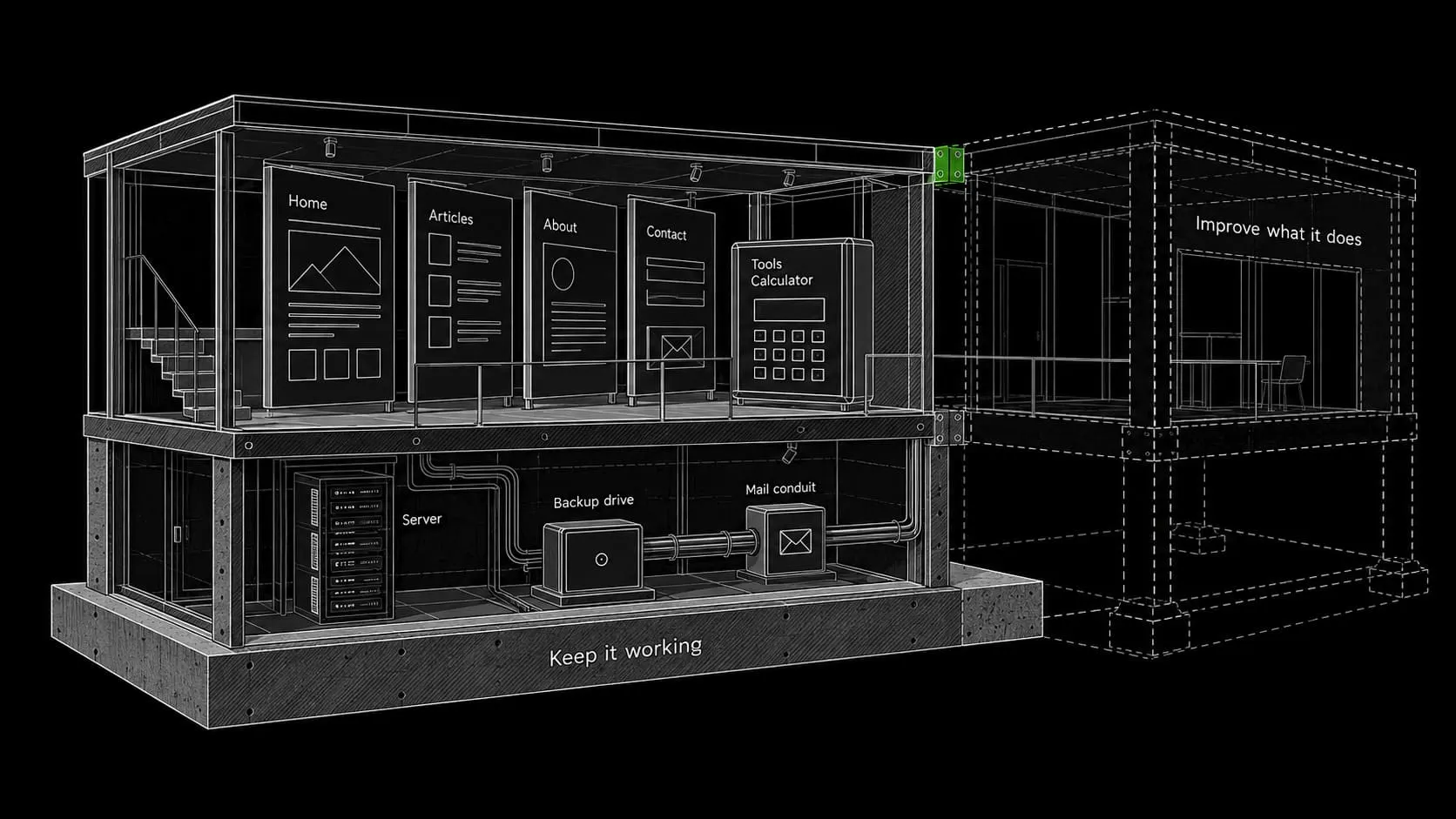
Establish who is responsible before choosing the next improvement
Assign tasks, not just dashboard access
Name the person responsible for renewals, software changes, backups, alerts, and inquiries. For a store, also assign product accuracy, stock, fulfillment, and payment follow-up.
Responsibility is more specific than access. Several people may be able to enter the dashboard while nobody is actually reviewing an alert or checking that a backup can be restored.
Agree when my management and monitoring apply
If I continue managing the website, it can be added to the monitoring and audit panel and followed within the agreed scope. If the project is handed over without ongoing management, I do not assume continuing access or monitor it on your behalf. You can assign another maintainer and change account access.
Use the ownership and handover inventory to make sure the responsible person can reach the systems they are expected to manage.
Distinguish technical care from development
Protect the functions already in use
Technical care protects the website’s ability to operate: software maintenance, recovery arrangements, availability, and the functions already in use. Development changes what the website can do or explain: new content, improved structures, new features, and broader promotion.
Scope development separately from routine care
Agree which tasks are recurring, which are triggered by an event, and which require separate scoping. Do not assume that a general maintenance arrangement includes writing a new content cluster, building an integration, or managing an advertising campaign.
Similarly, a content arrangement should not leave uncertainty over who fixes a failed form or an expired infrastructure subscription. Even when one person performs several kinds of work, the responsibilities should remain clear.
Use evidence to identify the next task
Compare symptoms before choosing a remedy
Review search data alongside real customer behavior and the website’s operating condition. A metric is a clue, not a diagnosis.
| What you observe | What to check before choosing work | A likely direction if confirmed |
|---|---|---|
| The site is unavailable or key actions fail | Reproduce the failure; inspect hosting, recent changes, mail, or checkout | Restore operation through technical care |
| Important pages are not being discovered or indexed | Access restrictions, internal links, canonical behavior, page quality, and Search Console evidence | Technical SEO or content correction |
| Relevant pages receive impressions but limited visits | Actual query relevance, position, result appearance, country, and device | Refine the page’s targeting and presentation |
| Visitors arrive but few useful inquiries follow | Measurement accuracy, offer fit, missing information, forms, and response handling | Improve the explanation or inquiry journey |
| Customers repeatedly ask a question the site does not answer | Whether an existing page should cover it and what facts are available | Expand or improve content |
| The business offers something new | Delivery readiness, audience fit, and overlap with existing pages | Extend the site structure deliberately |
| Customers face a repetitive task a tool could simplify | Frequency, input quality, expected output, and maintenance needs | Scope a useful feature or automation |
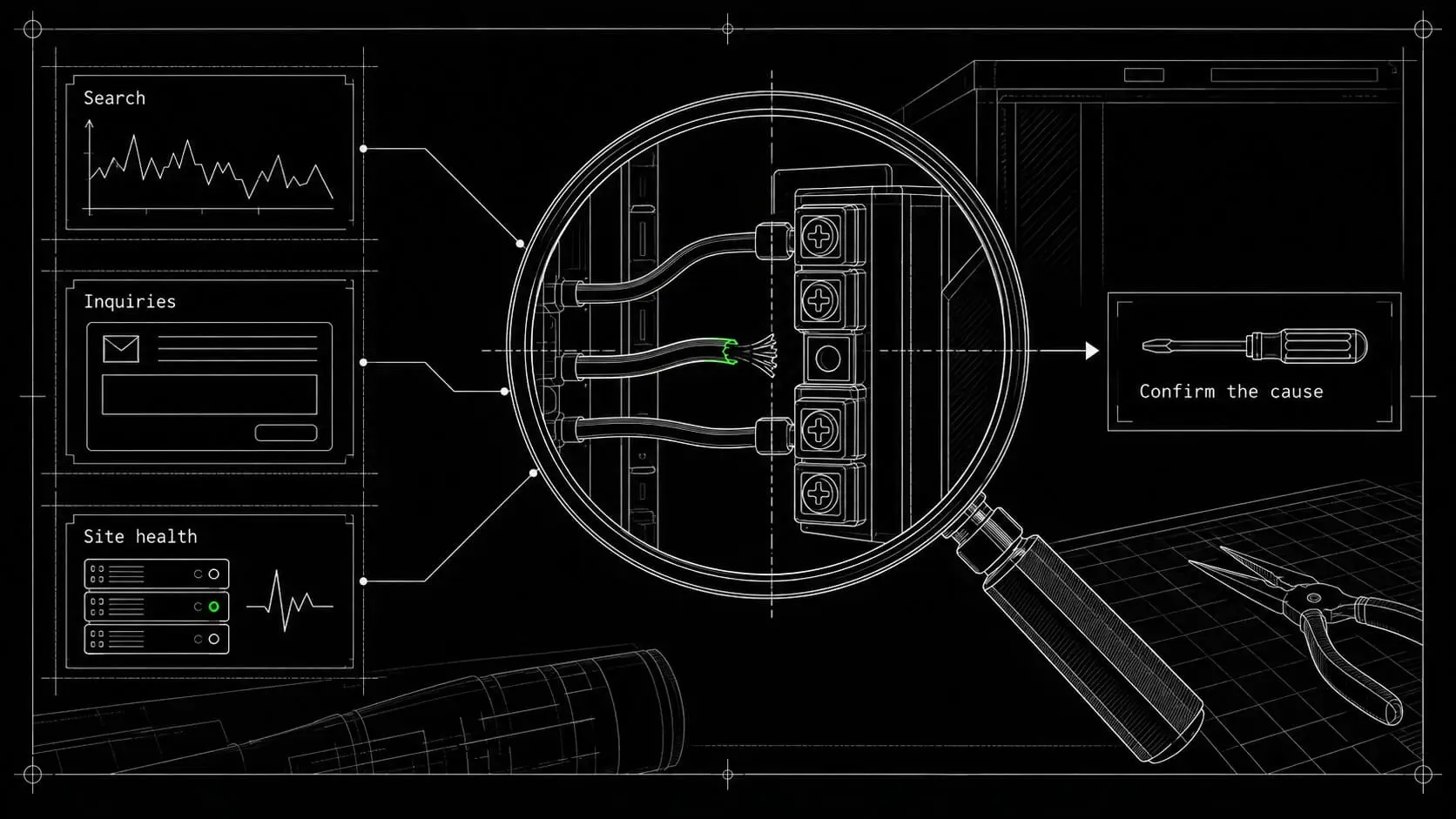
Interpret search data in context
Search Console reports clicks, impressions, click-through rate, and position, with particular rules for how those measurements are counted and attributed. Compare appropriate page and query groups rather than interpreting a whole-site average in isolation. Search Console measurement definitions
For a new or low-traffic website, small changes in counts can look dramatic as percentages. Allow enough observation for the decision and use owner feedback when analytics alone is inconclusive.
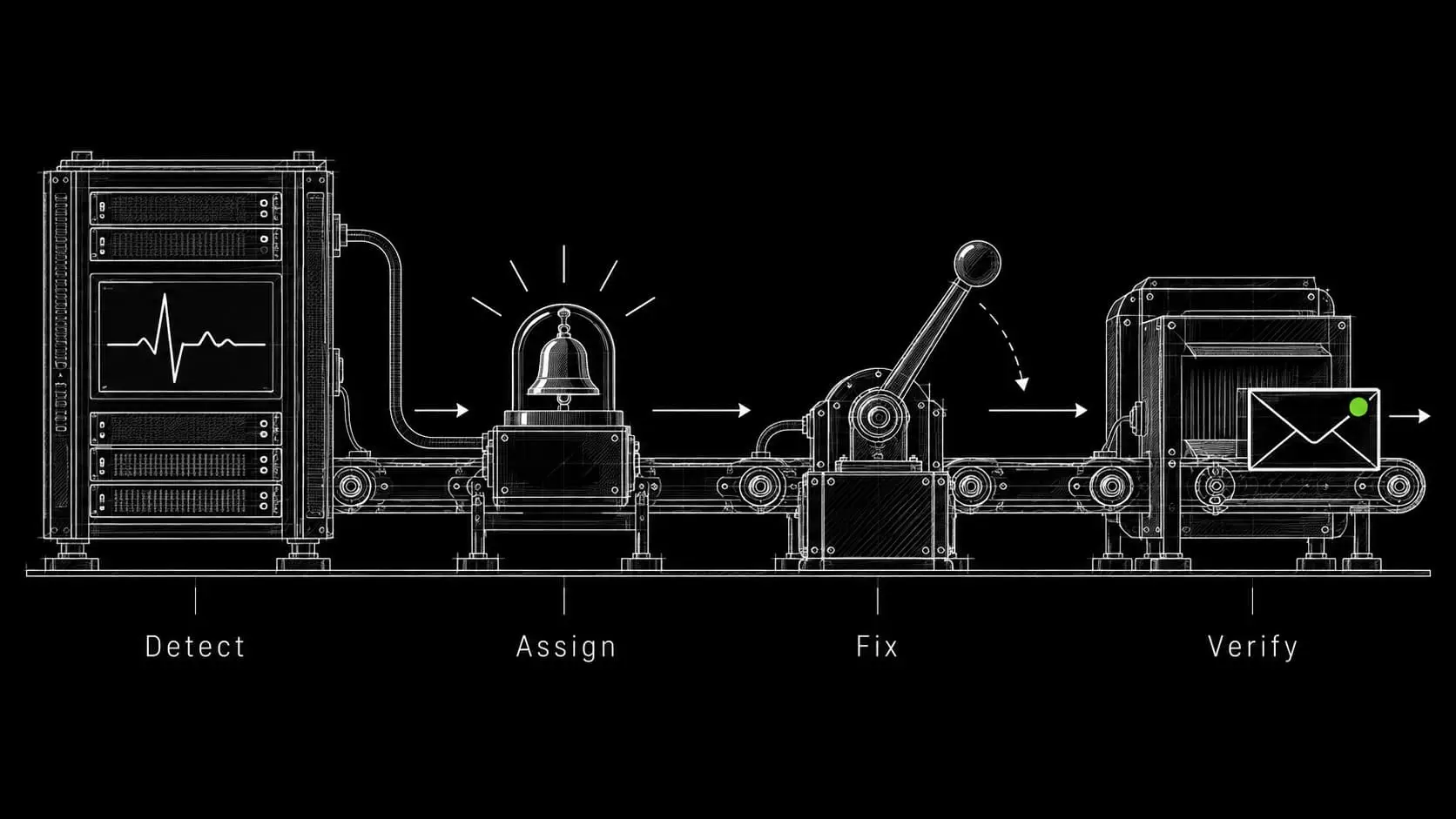
Keep technical monitoring connected to a response
Connect each alert to a responsible person
An alert is useful when someone receives it, understands what it indicates, and can act. Decide which events matter and what constitutes a meaningful failure. A homepage returning a successful response does not prove that forms, mail, or checkout are working.
Review the required checks against the site’s functions. A content site and an active store can have different consequences from downtime or a failed update. Choose the review cadence and backup arrangements accordingly rather than copying a universal schedule.
Keep changes and recovery under control
Software changes should have a recoverable path. Test material changes on an appropriate environment, inspect affected functions, and record what changed. Before any restoration involving a live store, account for orders and other data created after the backup.
The detailed practices belong in Website Infrastructure: server operation, monitoring, maintenance, and recovery. This page connects those practices to the website’s continuing needs; it does not duplicate the server manuals.
Investigate search problems before rewriting the site
Locate the change before explaining it
When search traffic changes, identify where and when the change occurred. Compare affected pages, queries, countries, and devices, and check the timing against deployments or content edits. Consider whether the business or audience has seasonal patterns.
Google’s troubleshooting guidance separates possible technical issues from changes in demand and search performance. Use a structured investigation rather than attributing every decline to one algorithm explanation. Google’s traffic-drop guidance
Inspect the affected pages and their purpose
If a page is not indexed, inspect that page and its context. If two pages appear to answer the same need, compare their actual purposes before merging them. Preserve useful information and account for changed URLs when consolidating material.
The Technical SEO hub is the deeper destination for diagnosing crawlability, indexability, templates, and related implementation issues. Monitoring can identify a change; it does not by itself establish the cause or automatically complete the fix.
Expand content where the business and the reader need it
Decide whether to update a page or create one
Return to the page map before creating another article. Decide whether the new information belongs on an existing page, deserves a supporting page, or falls outside the business’s scope.
Prioritize questions that affect customer understanding and decisions. Look for missing conditions, unclear comparisons, outdated facts, and useful practical detail. A new page is justified by a distinct task and enough substance to answer it, not by a monthly quota.
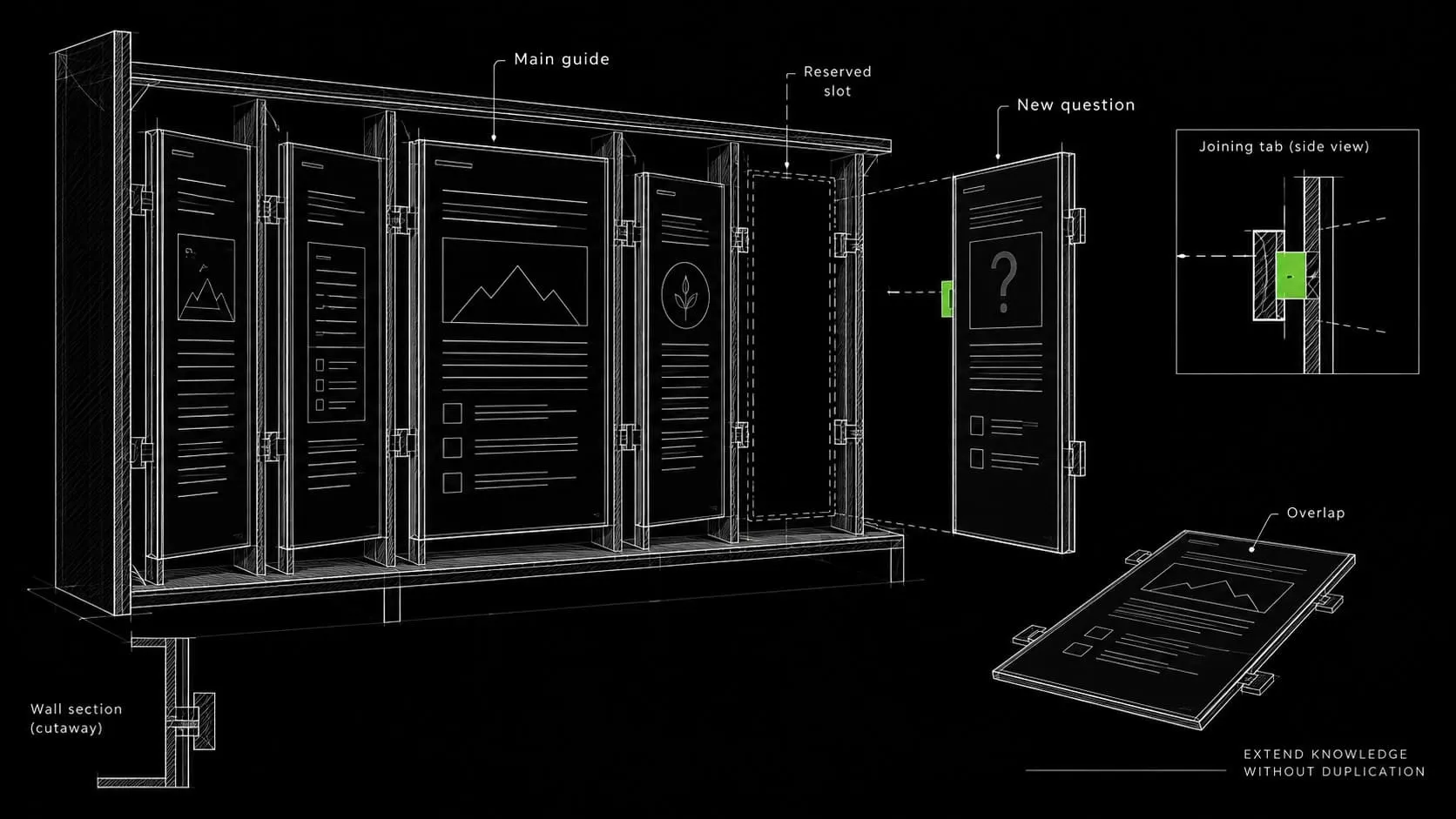
Extend the cluster without duplicating answers
When expanding a cluster, update the parent page where needed and add the links that explain the relationship. Review nearby pages for duplication. Keep important facts consistent across the website without reproducing whole sections of copy.
The SEO Content hub covers writing and editorial development in depth. This continued work extends the original site while preserving its subject boundaries.
Add tools when they solve a recurring problem
Define the task and validate the underlying rules
A calculator, guided brief, comparison tool, or integration can improve a website when it helps people do something they already need to do. Start by writing the user’s task, the inputs required, and the decision the output can support.
Check the underlying rules and limitations before building an interface. A calculator needs defensible assumptions. A guided brief needs to collect useful information without demanding unnecessary effort. An automation needs an owner who can recognize failures and update its connections.
Plan for maintenance and human oversight
Estimate the ongoing work as well as the initial build: data updates, external service costs, testing, and support. A small, well-defined tool can be more sustainable than an ambitious feature whose inputs cannot be maintained.
AI integrations require the same discipline. Define their permitted information, useful role, and route to a person when they cannot answer reliably. Further implementation belongs in AI Agents and Business Automation, with the feature scoped to the actual website and business.

Choose promotion that supports the site you have
External visibility should connect to useful destinations and an offer the business can fulfill. Sending more visitors to an unclear page does not resolve the underlying explanation.
Evaluate relevant references and promotion
The Link Building and Authority hub explores external references and promotion. Evaluate opportunities by relevance, audience, credibility, and the actual reason for the link. Buying links primarily to manipulate rankings falls under Google’s link-spam policies; advertising and sponsorship require appropriate treatment. Google’s spam policies
Choose sustainable social channels
The Social Media hub connects published content with suitable social channels and posting workflows. Choose channels the business can maintain and where the content has a useful role. Repeating the same link everywhere is not a substitute for relevant communication.
Scope partner advertising independently
Where quicker paid acquisition is appropriate, Advertising is a separate, partner-delivered direction. Its budget, responsibilities, and measurement should be agreed independently from routine website care.
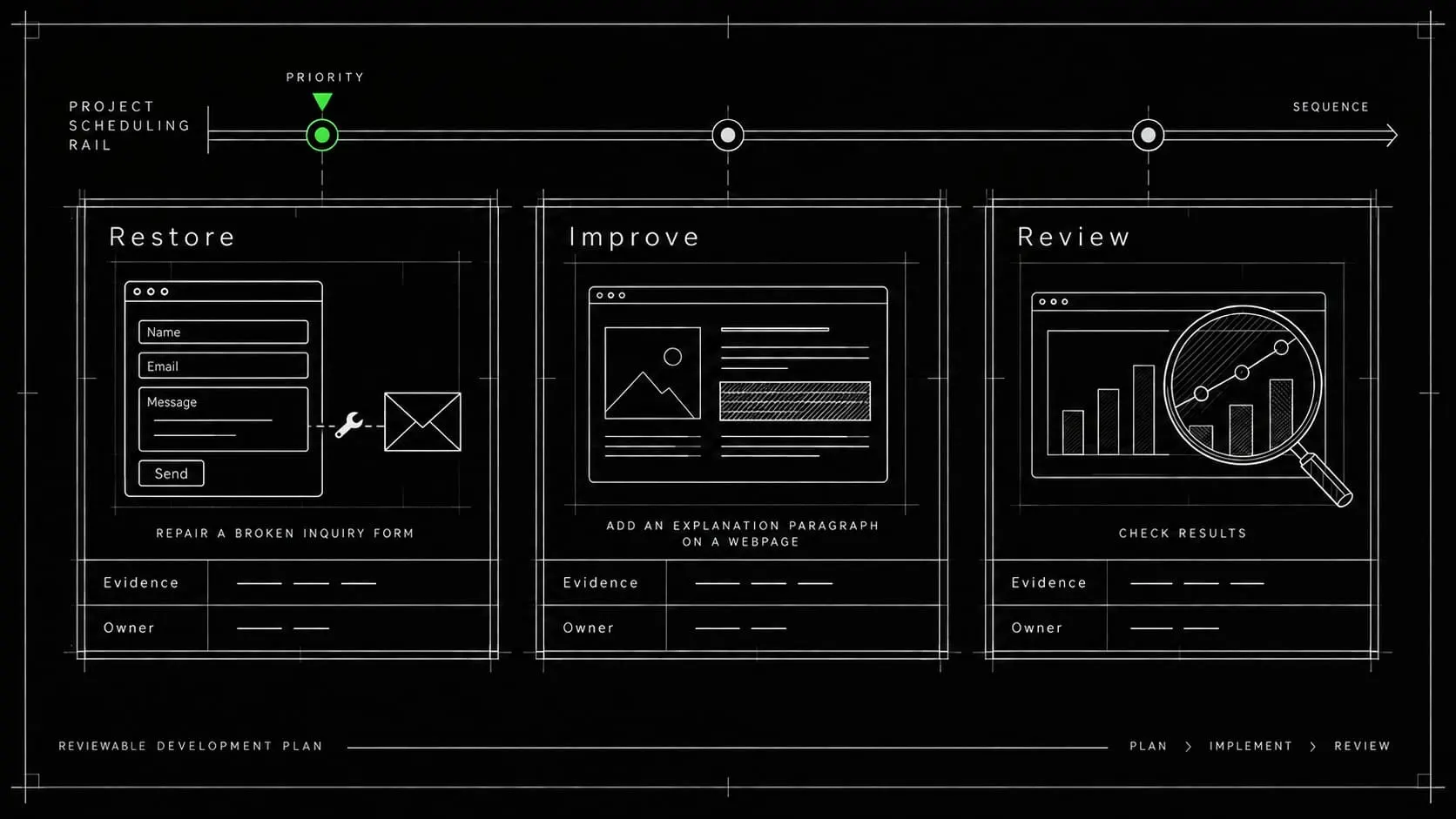
Keep a small, reviewable development plan
Describe the problem and the check for success
For each proposed task, record the problem, supporting evidence, intended change, dependency, and way to check the result. Include effort and responsibility. This makes it possible to compare a content improvement with a technical repair without pretending they are the same type of work.
A useful task description might say: “The project form fails in the tested mobile condition; correct the error and confirm successful delivery from that condition.” Another might say: “Customer conversations reveal a missing suitability question; add a supported explanation to the relevant page and review the clarity with the owner.” These describe decision patterns, not claims about a past client.
Prioritize the work and record the outcome
Address critical failures first. Then choose improvements according to their relevance to the business, the strength of the evidence, and the work required. Avoid changing several unrelated things at once when doing so would make the outcome difficult to interpret.
Record completed changes and the observation period appropriate to each one. Form delivery can be retested immediately. Search performance may need a longer review, and the result may still be affected by factors outside the change itself.
Measure business usefulness as well as traffic
Separate traffic from business outcomes
Keep the distinction between visibility, visits, inquiries, qualified opportunities, and completed business. An increase in one stage does not prove that all later stages improved.
Use inquiry feedback to improve the website
Ask the owner what happened to the inquiries. Were they relevant? Did the website set realistic expectations? Were replies timely? Did prospective customers need explanations that should have been available before contacting the business?
Use that feedback to improve content and the brief. Traffic is valuable when it connects the right audience with the business; the development plan should keep that relationship visible.


