

 WordPress & YOOtheme Pro
 WooCommerce Development
 Website Planning
 Website Ownership & Access
 Website Support & Growth
 Website Launch Checklist
Build an SEO Content Blueprint Before Writing the Website
A content blueprint connects the business’s offer with the pages needed to explain it. It should show what belongs on the website, what each page will answer, how pages relate, and what needs to be ready for the initial launch.
It is more useful than a list of article titles because it records decisions. A writer can see the boundaries of an assignment. The owner can see whether the plan represents the business. A developer can understand the content types and relationships the website needs to support.
This guide develops the planning part of SEO content and copywriting. The outcome is a reviewable page map, not a promise that publishing a particular number of pages will produce a particular amount of traffic.
Write the boundaries before collecting topics
Define the offer and customer fit
Start with a short description of the actual offer. Include the problems the company solves, the customers it can serve, the geography where relevant, and the work it can deliver now.
Add the conditions that change suitability. Does a project depend on materials the customer must supply? Are some activities delivered by a partner? Are there requests the company regularly declines? These facts are part of the plan because they determine which search journeys should lead into the business.
Separate the current offer from future possibilities
For my website projects, this boundary matters: a complete WordPress content system is a core offer. That does not require the site to become a publication about every programming language or every advertising channel. Adjacent subjects belong only where they explain a relevant decision or an actual service.
Keep future possibilities separate from current capability. A promising idea may enter the development backlog, but it should not appear in the public plan as a service already available.
Turn the research into questions you can answer
Collect research with its source and context
Collect relevant searches, recurring customer questions, and concerns raised during conversations. Review competitors’ public pages to understand how the subject is commonly presented and where an explanation is incomplete. Record the source of each observation.
Then translate the material into reader questions. “What does this include?” is different from “How do I prepare?” even when both concern the same service. “How do I do the work?” may need a procedure, while “Which approach suits me?” needs criteria and tradeoffs.
Translate search observations into page decisions
Do not create pages directly from an export. Research entries can include synonyms, unrelated meanings, unsuitable audiences, and several expressions of the same need. Interpret them before assigning URLs.
In client work, I use Ahrefs research after the business discussion and share the resulting structure. The owner reviews the decisions, not an unexplained spreadsheet. If a planning exercise uses only qualitative observations, describe it as qualitative; do not add invented volumes or traffic projections to make it look more precise.
For the reasoning behind grouping questions, use the search intent guide.
Map the subject’s useful entities and relationships
Map concepts that affect the reader’s understanding
An entity map is a way to identify the things the reader must understand and how they interact. It is not a list of words to insert into the draft.
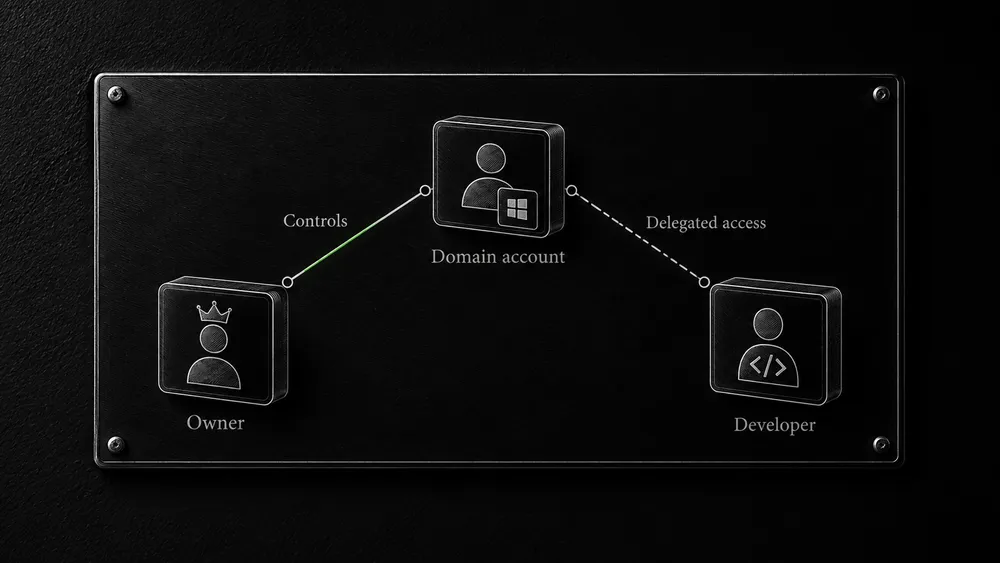
For website ownership, the relevant objects might include the domain account, hosting account, content, licenses, access permissions, and handover documentation. Their relationships matter: who controls an account, what a license permits, and which access another developer would need.
Test whether each concept contributes to the task
Ask what happens if each concept is omitted. Would the reader make a poorer decision, misunderstand responsibility, or be unable to complete a step? If so, it belongs somewhere in the explanation. If it adds only vocabulary without changing understanding, it may not be useful.
Group this material into decisions, prerequisites, methods, evidence, exceptions, and next steps. That gives the writer a domain of meaning to cover while leaving room to choose natural wording.
A competitor mentioning a concept is a reason to investigate it, not proof that your page must include it. Relevance comes from the task and the business boundary.
Decide whether a question needs a section or a separate page
Compare a supporting section with an independent page
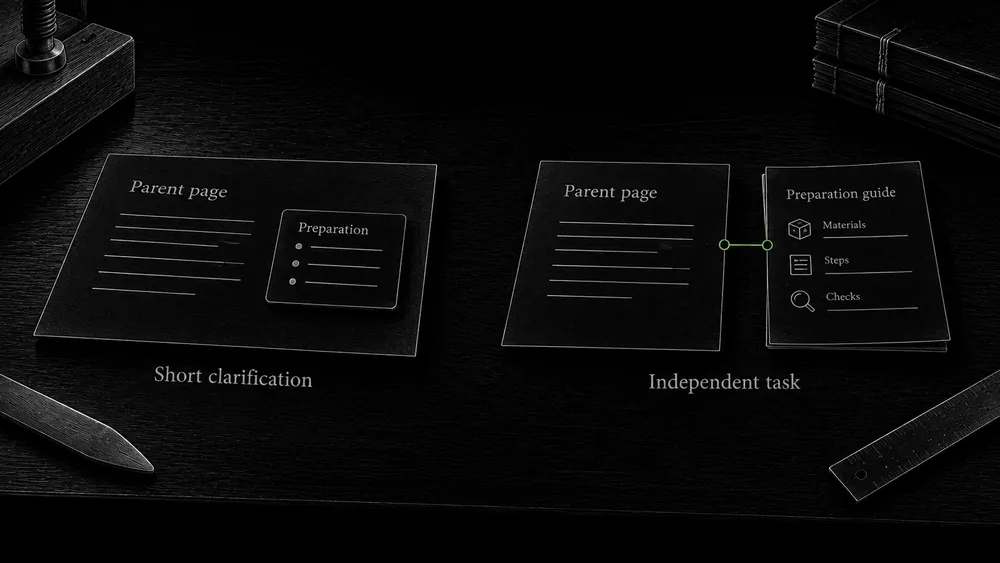
A topic deserves its own page when it has a substantial independent answer and a useful role in the site. A short clarification can remain a section or FAQ on the parent page.
| Proposed addition | Prefer a section when… | Consider a separate page when… |
|---|---|---|
| Preparation advice | A few requirements explain what the reader needs | Preparation involves its own decisions, materials, and checks |
| A comparison | One distinction resolves the choice | Several criteria and conditions change the recommendation |
| A technical detail | A definition is enough to continue | The reader needs a full diagnostic or implementation procedure |
| An exception | A short qualification prevents misunderstanding | The exception changes the workflow substantially |
| A related question | It completes the current answer | It begins a different task that deserves independent treatment |
Test the need for a separate answer
Do not use length alone to decide. A tightly scoped page can be valuable, while a long repetitive draft may still duplicate its neighbor. The independent task is the stronger test.
Try a replacement question: if this new page disappeared, could the parent answer its task adequately in a few paragraphs? If yes, keep it there until there is a reason to expand.
Give hubs enough substance to stand alone
Define the hub’s answer and the spoke’s depth
The hub is the main explanation of a topic. It should describe who the approach suits, what decisions matter, how the process fits together, and what a sensible outcome looks like. It also needs to address the uncertainties that could prevent the reader from understanding the whole subject.
A spoke deepens a part of that explanation. It may teach a procedure, compare approaches, or address a recurring condition. The hub still provides the essential answer; the spoke supplies the depth someone needs to act on that narrower task.
Review a simple website-development page map
A small illustrative part of a website-development map could be:
Website development: overall approach and decisions
├── Planning: scope, structure, and preparation
├── Launch checks: readiness of the delivered website
└── Ownership: accounts, access, and handover
This is a structural example, not a completed keyword study. The three supporting pages have different jobs even though each discusses part of the same project.
Avoid making a hub a list of one-sentence previews. Equally, avoid copying each spoke’s full instructions into the hub. Provide enough explanation to understand the decision, then offer a precise route to the deeper work.
Keep an actionable page register
Record the task, boundaries, and production requirements
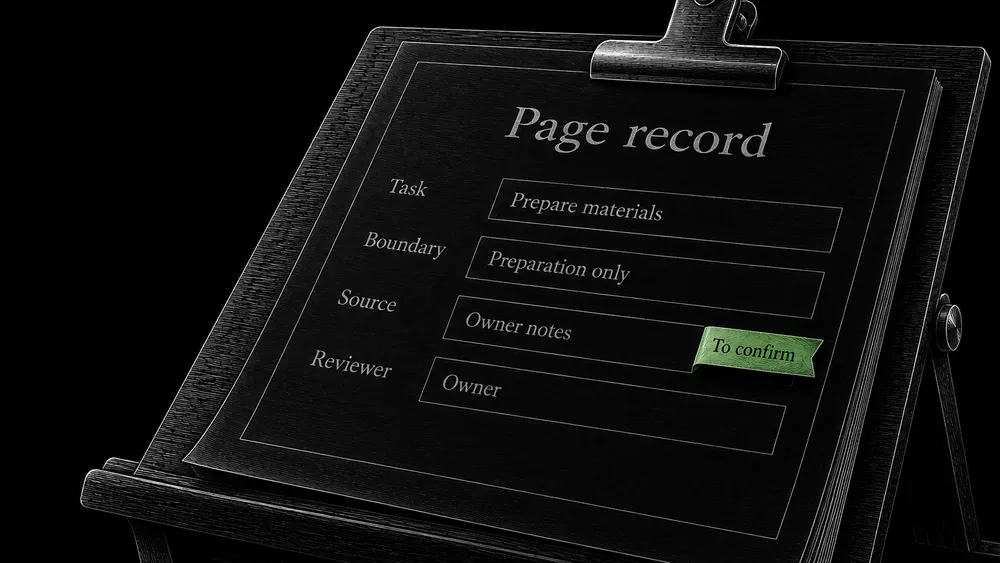
Each planned page needs a concise record. You can maintain it in a spreadsheet or another shared document; the format matters less than the clarity of the decisions.
Proposed title and URL:
Reader and main task:
Primary question answered:
Necessary concepts and decisions:
Facts or materials required:
What stays on this page:
What belongs on linked pages:
Parent hub and useful next destinations:
Appropriate inquiry or other next step:
Release priority and dependencies:
Owner and review status:
Make the page outcome and missing facts explicit
Write the task as an outcome: “understand what access must remain with the client,” rather than “write about ownership.” The first tells a writer what the reader must be able to evaluate after reading.
Record uncertainty explicitly. If an important fact is missing, mark the dependency and the person who can answer it. A page title should not be treated as ready for production simply because it has a row in the plan.
Check neighboring pages for overlap
Compare neighboring pages by their intended outcome
Read the task statements of each neighboring pair. Compare the questions, required information, and expected next steps.
Shared context is normal. Both a launch guide and an ownership guide may mention account access. The launch guide needs to confirm readiness; the ownership guide needs to explain control and transferability. The repeated concept serves different decisions.
Resolve overlap before assigning separate URLs
If two pages require almost the same outline and conclusion, examine why both exist. They may need merging, clearer scope, or a different angle grounded in a real task. Changing a title is not enough if the answer remains the same.
Canonical tags address equivalent URL versions; they are not a substitute for this editorial decision. Use the duplicate-content guide when the problem is technical duplication rather than overlapping page purposes.
Design the connections before drafting all the pages
For each page, identify its parent context and the next questions likely to arise. Add those relationships to the register.
The structure should let a reader arrive through search at a narrow guide, understand where it fits, and continue to relevant information. It should also let a visitor begin at the hub and choose the detail appropriate to their situation.
A supporting page can be useful to more than one hub. Give it one stable home and link to it from the other relevant contexts. Creating several copies of the same explanation for different directories makes maintenance harder and can introduce conflicting advice.
The internal linking guide explains how to turn these planned relationships into actual links and test whether pages remain reachable.
Set the initial release around essential customer decisions
Prioritize essential customer decisions for launch
The first release needs a coherent explanation of the offer and a working route to an inquiry. It does not need every possible future article.
Prioritize pages that explain suitability, scope, process, preparation, and the most consequential uncertainties. Include the supporting detail necessary to make those explanations trustworthy. Defer additions that depend on unconfirmed services, unavailable evidence, or a separate future project.
Record priority reasons and production dependencies
A useful priority record explains the reason: “needed to understand the main offer,” “requires an existing parent guide,” or “awaits confirmed product documentation.” Avoid turning priority into an unexplained number.
Also consider production dependencies. The person writing a detailed spoke needs the agreed boundary of its hub. The developer needs to know which content fields are reusable. The owner needs time to confirm claims that affect delivery. A publishing calendar should account for these relationships.
Review the plan with the owner and the implementer
Review business accuracy and implementation needs
The owner should be able to answer whether the plan represents the business accurately and attracts work they want. The implementer should be able to explain how the planned page types and navigation will work.
Ask the owner to review the offer boundaries, terminology, unsupported claims, and priorities. They do not need to approve every technical SEO convention or predict search behavior.
Translate the agreed structure into content production
For WordPress, connect the plan to the website planning process and the chosen WordPress and YOOtheme Pro implementation. A content model that needs repeated structured fields should be considered before dozens of pages are assembled manually.
Once the structure is agreed, turn each page record into a content brief. Keep later scope changes visible rather than allowing the draft to absorb unrelated topics silently.
Frequently asked questions
Is a content blueprint the same as a sitemap?
A sitemap lists URLs. The blueprint explains why pages exist, what they answer, how they connect, and what is required to produce them. The final URL structure can be derived from that plan, but the editorial decisions go further than the list.
How many hubs should a business website have?
Enough to organize its actual areas of work clearly. There is no useful universal count. If two proposed hubs explain the same offer in nearly the same way, reconsider their boundaries before multiplying supporting pages.
Can a page belong to several topic clusters?
It can support several contexts through links while keeping one stable URL and a clear primary role. Document the shared relationship so the same guide is not rewritten independently in several places.
Must the initial website cover every question found in research?
No. Filter the questions by relevance, the business’s capabilities, and the needs of the initial customer journey. Some belong within existing pages, some deserve later development, and some are outside scope entirely.
Can the structure change after writing begins?
Yes, when new facts or a clearer understanding justify it. Update the page register and affected briefs together. If the site is already public, also assess links and URL behavior before moving or merging pages.
What will I review before the content is written?
The proposed structure, page purposes, initial priorities, and important factual dependencies. I make the plan visible so you can confirm it reflects the work your business can deliver.
Turn your offer into a reviewable website plan
Describe your services, intended customers, and whether the site is new or already public. I can research the subject and develop a content structure as part of a new WordPress project or agreed expansion work.