

 WordPress & YOOtheme Pro
 WooCommerce Development
 Website Planning
 Website Ownership & Access
 Website Support & Growth
 Website Launch Checklist
SeoDrift: Website Monitoring, SEO Checks, and a History of What Changed
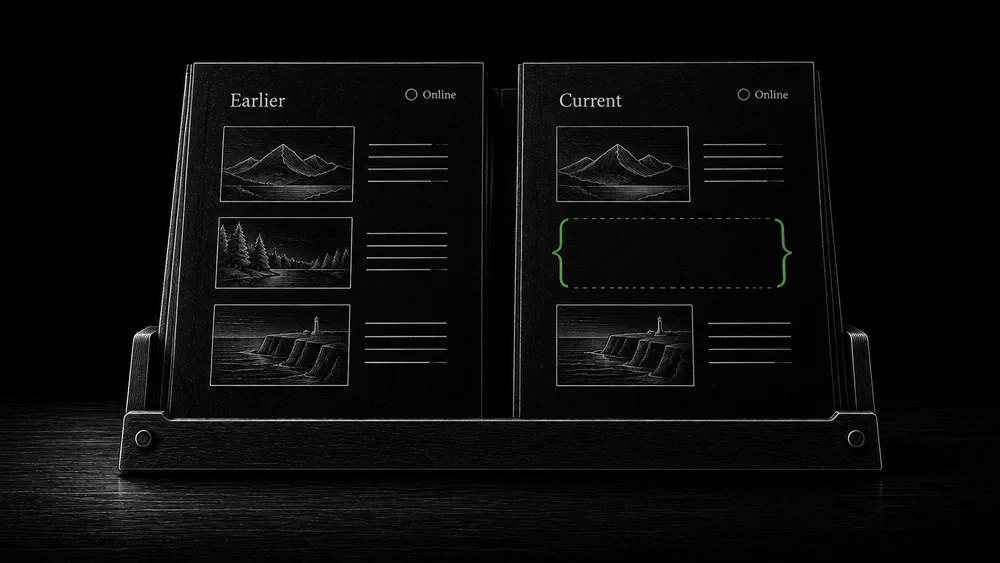
A website can remain online while something important changes. A content update can remove a useful section. A template change can alter headings across a group of pages. A publishing setting can change after a plugin update. The site still opens, but the version now being delivered is no longer the version you intended.
SeoDrift brings availability monitoring, website crawling, SEO checks, change history, and alerts into the same investigation. It helps you notice changes and establish what needs review instead of relying on someone to remember how a page looked before.
I am Theo, the developer of SeoDrift. The service has its own website, where you can explore the product and its current offering.
Why an uptime check is only part of the picture
Distinguish availability from page integrity
Availability answers whether the monitored request succeeds. It does not establish that every important page still contains the right information or follows the site’s agreed SEO configuration.
A useful monitoring process asks several questions: can the website be reached, what is being delivered, what changed, and does that change match an intentional decision? Those questions become more important as more people, templates, plugins, and integrations affect the public site.
Include the pages and files that support the business
For a content-rich WordPress website, the monitored object is not only the homepage. It is also the structure and output supporting the business: service pages, guides, categories, and relevant technical files. For a store, it includes the public catalog’s behavior within the monitoring scope you configure.
The underlying principles are explained in the technical SEO guide. SeoDrift supports the ongoing observation needed after the initial setup and audit.
What SeoDrift checks and records
| Capability | What it helps you investigate |
|---|---|
| Availability monitoring | Whether a monitored website can be reached |
| Website crawling | The pages and technical output encountered within the crawl scope |
| Change history, the “time machine” | Differences between recorded observations |
| SEO-setting checks | Changes or issues in the SEO configuration the service inspects |
| Heading-structure checks | How page headings are organized and whether that output changes |
| Broken-link checks | References that no longer lead to a working destination |
| Robots.txt and sitemap checks | Changes to important crawling and URL-discovery files |
| Server-security checks | Supported security-related findings that require review |
| Backlink checks | The state of backlinks covered by the monitoring |
| Telegram, Discord, and Slack alerts | Notifications delivered into a team’s chosen communication channel |
Choose the monitoring scope and notification setup around the website you need to maintain. The exact check coverage, intervals, retention, and plan conditions should be confirmed against the current service offering rather than inferred from a feature name.
AI suggestions are planned for future development. They are not presented here as an available automatic diagnosis or repair feature.
Use the time machine to investigate a difference
Compare the affected URL with its earlier state
A current audit tells you what a page returns now. A history of observations gives you something to compare it with.
Start with the affected URL and identify the most recent recorded state that matched your expectation. Compare it with the changed state. Then review the releases, edits, or imports that occurred between those observations.
The value is a narrower question. Instead of asking why “SEO changed,” you can ask why a particular page no longer contains the expected content or why an inspected setting now has a different value. That is a more useful starting point for the person responsible for the site.
Interpret the interval between recorded checks
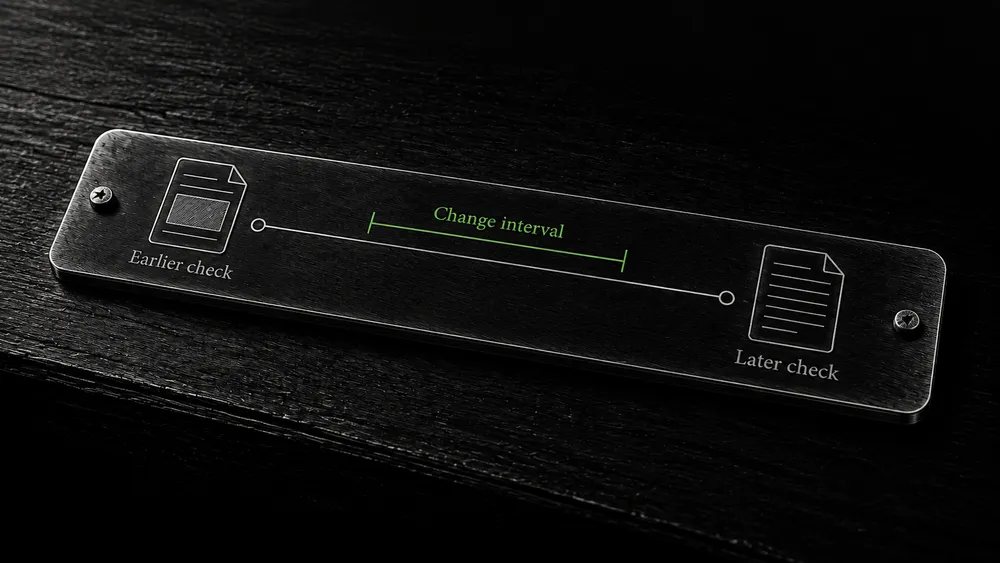
Observation timestamps still need interpretation. A detected difference occurred sometime between the relevant checks; that does not automatically identify the exact edit time or the person who made it. Use your release and editorial records to complete the picture.
Keep change history separate from recoverable backups
Change history is also different from a recoverable backup. A record of what changed can guide a repair, but it should not be treated as a promise that the service can restore files, roll back code, or recover a database. Keep backups and recovery as a separate operational capability.
Establish an expected state before relying on alerts
Document expected behavior and intentional exceptions
Monitoring becomes more useful when someone has defined what correct behavior looks like. Review the important pages first and record intentional exceptions.
For example, some URLs may deliberately remain outside the search-facing inventory. A page’s content may change frequently by design. A retired address may intentionally return a missing-page response. Those conditions need context so they do not become recurring mysteries.
Establish a baseline with an initial SEO audit
Use an initial technical SEO audit to resolve major unknowns and document the decisions. Then identify the properties whose unexpected changes would deserve attention.
This is my recommended operating process, not a claim that every decision is automatically inferred by SeoDrift. The owner or maintainer still determines which pages matter and which behaviors are intentional.
Make an alert lead to a decision
Assign alert recipients and response responsibilities
Telegram, Discord, and Slack notifications help bring findings to the place where the responsible person works. Delivery alone is not a response process.
For each monitored website, decide who receives alerts, who can investigate, and who can authorize a production change. If the first recipient is unavailable, define the next contact through your support arrangement.
Record the evidence needed to investigate an alert
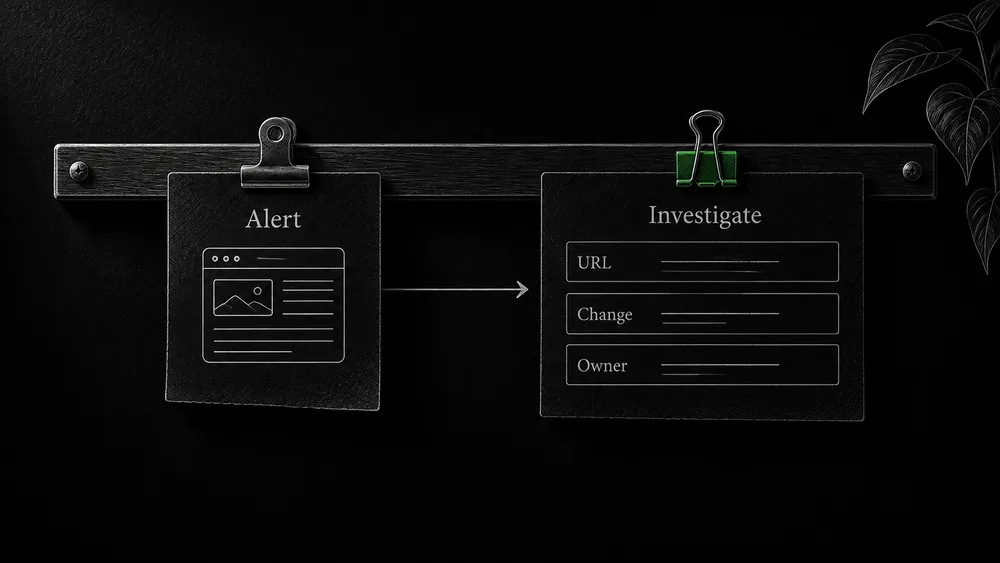
A useful internal response note should contain:
- The affected website and URL or file.
- The observed change or failure and its timestamp.
- Whether a planned release or edit explains it.
- The result of a current independent check.
- The assigned next action and owner.
This is a recommended investigation record; it is not a specification of the exact fields in a SeoDrift notification. Keep sensitive customer information and credentials out of shared alert channels.
Test notification delivery and ownership
Before relying on the setup, verify that the chosen channel receives the expected notification under a safe, agreed test. Confirm who acts on it. A notification in an unattended channel creates a record but may not shorten the time to repair.
Follow a consistent response to a detected change
Confirm the current state
Open the affected page anonymously or inspect the relevant response. Determine whether the issue is still present and whether it affects one URL or a larger group. Save the evidence before changing the configuration.
Compare it with the intended change
Check the release or editorial record. A heading rewrite may be approved. A sitemap change may reflect a new section. An unexpected difference deserves investigation; an expected difference may simply need the baseline and documentation updated.
Choose the relevant diagnostic path
For a missing or redirected destination, use redirect and broken-link diagnosis. For a robots or sitemap change, use the crawl-control guide. For a suspected search exclusion, continue with crawling and indexing checks.
Repair the source and verify recurrence
Correct the responsible setting, template, or component, then inspect the public result. If the same finding returns later, investigate why the source changes again. Repeatedly correcting the symptom without changing the process leaves the website exposed to the same regression.
Keep website observations separate from Google’s decisions
Use the right evidence for Google indexing questions
A crawler can inspect the content and technical conditions it receives. It cannot, from that observation alone, establish that Google has indexed the page, selected it as canonical, or assigned it a particular ranking.
Use Search Console for Google’s recorded page information and the appropriate reports for search performance. Google’s URL Inspection documentation explains the page-level evidence available there.
Treat a change timeline as context for investigation
That separation makes the tools complementary. A recorded website change can help establish a timeline for a search investigation. A later traffic change does not, by itself, prove that the recorded change caused it.
The same restraint applies to individual checks. A heading observation needs interpretation in the context of the article. A security-related finding needs assessment and an appropriate response. A backlink observation concerns the links covered by the check, not an assumed complete inventory of every link on the web.
Decide between a tool and managed website support
Choose who will investigate and implement repairs
SeoDrift is relevant when you need ongoing observation and a record of changes. Someone must still evaluate findings and maintain the website.
If your team handles implementation, the service can support that workflow. If you want me to remain responsible for agreed maintenance and development, monitoring can be included in the website support and growth arrangement.
Define monitoring coverage and support boundaries
The scope should identify what is monitored, who responds, and which repair work is included. Do not assume that an alert channel includes round-the-clock support or unlimited implementation.
If our project ends at handover, the website and accounts remain under your control. Continued access and observation require an ongoing agreement; monitoring does not create a dependency that prevents you from choosing another developer.
Frequently asked questions
Is SeoDrift only an uptime monitor?
No. Availability is one capability alongside crawling, SEO checks, change history, and supported alerts. The combination helps investigate a website that remains reachable but changes in an important way.
Does the time machine restore my website?
Treat it as a history of changes for comparison and investigation. Keep a separate backup and recovery process. Do not assume that retaining observations provides file, code, or database rollback.
Can SeoDrift prove that a page is indexed in Google?
A crawl observation alone cannot establish that. Use Google’s reported page information for indexing evidence. SeoDrift’s observations can help explain what the website delivered and what changed around the period under investigation.
Are AI suggestions available now?
They are planned for future development. The capabilities described on this page should be evaluated independently of that future feature.
Does a backlink check replace a complete link-building analysis?
No. It supports review of the links covered by the check. A broader strategy requires context about relevance, sources, and the site’s goals; do not infer a complete external link index from monitoring alone.
Who should receive the notifications?
Choose someone who can assess the finding or route it to the person responsible. Use the team’s preferred supported channel and test delivery. Define the response responsibility in your own process or management agreement.
Who develops SeoDrift?
I do. SeoDrift is one of my software projects alongside my work building and developing WordPress websites. You can learn more about my background on About Theo and explore the service on its own website.
Explore the service or discuss monitoring for your website
Visit SeoDrift to explore the product and current offering. If you need help deciding what to monitor or want observation connected to ongoing website work, describe your website and who currently maintains it.