

 WordPress & YOOtheme Pro
 WooCommerce Development
 Website Planning
 Website Ownership & Access
 Website Support & Growth
 Website Launch Checklist
Guest Posts & Sponsored Articles: Publish Something Worth Reading
A contributed article should help the publication’s readers even if they never click your link. That is the starting point for choosing a topic, preparing the draft, and deciding whether the placement is worth arranging.
The format can support a business introduction, explain a problem connected to your service, or make a useful resource easier to discover. It becomes weaker when the article exists only to surround a keyword link with enough words for publication.
Before writing, confirm the publisher, the relationship, and the destination. Those decisions determine what you can say, how the article should be presented, and what you can reasonably expect from it.
For deciding whether this format fits your wider website work, use the Link Building & Content Placement guide. Here, the focus is the article itself, from the initial concept to the published result.
Know which relationship you are arranging
Identify compensation, editorial control, and publication conditions
“Guest post” describes a contribution from outside a publication. It does not tell you whether money changes hands, whether the publisher independently selects references, or whether publication is guaranteed.
| Arrangement | What to establish |
|---|---|
| Unpaid contributed article | Submission rules, editorial discretion, author attribution, and permitted references |
| Sponsored article | Payment, visible commercial disclosure, link treatment, approval, and distribution |
| Independently selected mention | What the publisher needs from you and what remains its editorial decision |
| Paid addition to an existing article | Exact page, reason for the addition, revised text, and commercial treatment |
A publisher may reject or edit an unpaid contribution. That is different from a paid offer with defined publication conditions. Do not describe guaranteed commercial coverage as independent endorsement.
Check paid-link attributes separately from visible sponsorship
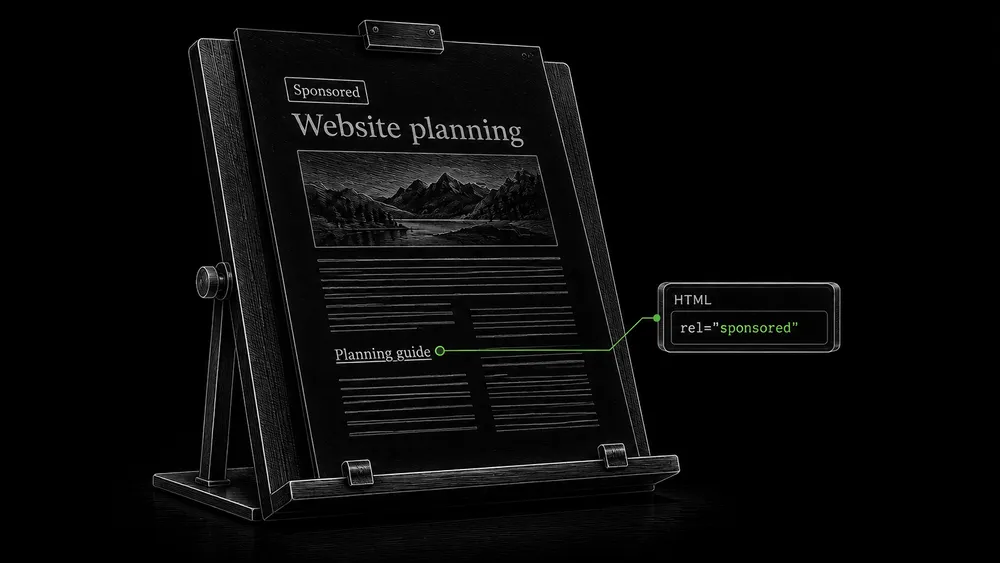
Google’s link guidance calls for sponsored on paid placements and accepts nofollow as an alternative. For example:
<a href="https://example.com/website-planning/" rel="sponsored">
  website planning guide
</a>
The attribute does not create a visible advertising label. Google’s documentation covers the link relationship.
For US-facing sponsored content, readers should understand when an article is advertising. FTC guidance explains that necessary native advertising disclosures must be clear, prominent, and understandable; placement near the headline and readability on mobile matter. A hidden HTML attribute does not communicate sponsorship to a reader. See the FTC’s native advertising guide.
Agree on both the visible presentation and the underlying link treatment. Neither should be left to assumptions after payment.
Choose a subject at the intersection of three needs
Match the publication, reader question, and business expertise
A workable article connects the publication’s subject, a reader’s real question, and something your business can explain accurately. If one of these is missing, the draft tends to become irrelevant, superficial, or misleading.
Read the relevant section before suggesting topics. Identify the audience’s assumed knowledge, the questions already covered, and the level of practical detail the publication accepts. Avoid pitching a slightly renamed version of an article it already has unless there is a clear new contribution.
Choose a practical contribution instead of generic promotion
For example, a business publication covering website projects might benefit from an article about what an owner should prepare before development begins. The useful contribution would be a preparation method, important decisions, and common missing information. A reference to a detailed planning resource could extend that answer. This is a topic illustration, not a claim about a real placement.
Compare that with a draft titled “Why Our Agency Is the Best.” Unless the agreed format is explicitly a company advertisement, it is unlikely to help the same reader evaluate their project.
A commercial objective and useful content can coexist. The reader learns something relevant, understands the author’s connection to the subject, and has a sensible next destination if they need more help.
Write a publication brief before a long draft
Define the article’s task and approval requirements
A short brief reduces the risk of writing an article that the publisher will not accept. It also gives the business owner a chance to correct claims before they are woven through the text.
Proposed working title:
Publisher and section:
Reader's situation:
Question the article will answer:
Practical result the reader should leave with:
Main points and important exceptions:
Facts or materials supplied by the business:
Claims still requiring confirmation:
Reference destination and reason for including it:
Author identity and relationship disclosure:
Publisher requirements and approval steps:
Gather facts and choose supporting material honestly
The business owner does not need to supply polished copy. A clear explanation of the service, what it includes, where it does not fit, and any usable materials is a useful starting point.
Photographs, screenshots, diagrams, or documents can help when they illustrate a real point. Check permission and context before supplying them. Do not present a generated illustration as a photograph of a completed project or a simulated dashboard as a measured result.
If supporting material is unavailable, choose an explanatory topic you can substantiate. An article can be useful without a fabricated case study. The content brief guide explains how to separate confirmed facts from ideas requiring review.
Develop the answer before introducing the business
Develop a concrete answer with appropriate formatting
Open with the reader’s problem and the answer the article will develop. Explain the process or decision in enough detail to be useful, including the conditions that might change the recommendation.
Prefer concrete instructions to generic benefits. “Choose reliable hosting” is broad advice. Explaining what to confirm about account ownership, backups, access, and responsibility gives the reader something to check. The appropriate depth depends on the publication’s audience and agreed subject.
Use tables when comparing the same criteria across options. Use numbered steps when order matters. Use a short example when it makes an abstract instruction understandable. There is no reason for every article to contain all three.
Verify claims and complete the answer before promotion
Support consequential factual claims with appropriate sources or business evidence. AI can assist with organization and drafting, but review its claims, references, and examples. A plausible-sounding statement about the company’s experience is still untrue if the company has never done the work.
Close the explanation before the promotional invitation. A reader should be able to use the article without contacting you to obtain the missing half of the answer.

Make the link a useful continuation
Select a relevant destination and natural link text
Choose a destination that supplies the next relevant layer of detail. A planning article may lead to a planning guide. A company introduction may use the homepage. A discussion of implementation can lead to the page explaining that implementation.
Write the linked text so that the reader knows what to expect. There is no need to force a commercial keyword into a sentence that would otherwise use a resource name or a clear description.
Do not overload a contribution with links to your own pages. Include references because they help substantiate or extend the article, subject to the publisher’s policy. No fixed count makes an article good; the purpose of each reference should be evident.
Agree on tracking URLs and maintain the destination
For paid campaigns that use tracking parameters, agree on the final URL and measurement approach before publication. Confirm that the destination works with those parameters and keep naming consistent. Do not silently replace an approved URL with a tracking service or redirect the publisher has not accepted.
The linked page must remain useful after the campaign’s first reporting period. Keep the destination stable or handle a later move properly through redirects and broken-link management.
Put the publishing conditions in writing
Document fees, responsibilities, and content rights
Confirm the scope before incurring the publication fee. At minimum, document the publication and section, article responsibilities, revision process, destination, commercial treatment, included distribution, total fees, and correction contact.
Clarify rights to the text and images. An author retaining a copy does not necessarily mean the article can be republished everywhere. Ask whether exclusivity applies, whether reuse requires permission, and what can be included in your own portfolio or handover materials.
Clarify publication duration and review material changes
If a provider promises long-term publication, ask how that promise is defined. A coverage period, remedy, or replacement condition is more useful than the word “permanent” on its own. Do not assume you own space on the publisher’s server or can edit it directly.
If the publisher changes the subject or inserts claims about your business during editing, review those changes. Cosmetic edits may be routine; statements about results, capabilities, pricing, or customer experience deserve explicit factual confirmation.
For a placement in an existing article, preserve the proposed before-and-after passage. That makes it possible to judge whether the addition is coherent and to verify what was actually published.
Accept the live article against the agreement
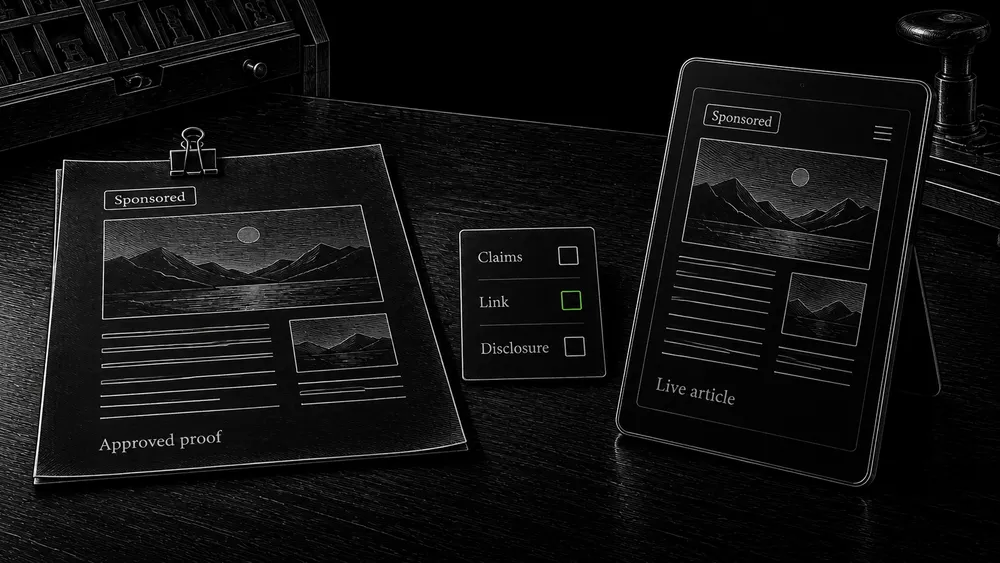
Compare the live article with the approved scope
Read the published page, not only the preview. Check it on a mobile screen as well as a wider display.
- Confirm the correct article, publication, and section.
- Compare important claims, author details, and images with the approved version.
- Find the link, inspect its destination and attributes, and follow it.
- Check that paid content has the agreed visible disclosure.
- Confirm any specifically promised distribution using the agreed evidence.
- Record the live URL, publication date, and any outstanding corrections.
Record outstanding corrections and later monitoring responsibilities
An article can be live while still containing a delivery error. Keep that distinction in the record. Likewise, correct publication does not prove that it has generated leads or improved rankings.
After acceptance, use a defined monitoring and reporting process if later checks are part of the scope. The article may be edited, removed, or moved in the future, and the destination on your own site may change too.
Frequently asked questions
Are guest posts always paid?
No. Some publications accept outside contributions through an editorial process; others sell article placements. Ask about compensation, publication conditions, and control over references. The label alone does not identify the relationship.
Can a sponsored article still be useful if the link is qualified?
Yes, when the publication reaches appropriate readers and the article offers something useful. Evaluate that audience opportunity and its actual cost. Do not justify the purchase by promising ranking credit from a paid link.
Can I reuse an article from my own website?
Check the publisher’s requirements and the rights involved first. Often the better contribution is a distinct article suited to that audience, referencing your fuller resource where appropriate. Do not assume a publisher will accept material already published elsewhere.
Do I need original research to contribute something valuable?
No. A carefully explained process, decision framework, or practical checklist can help readers. It must be accurate and grounded in what you can support. Original research is one possible contribution, not a reason to invent data when you do not have it.
What should happen if the publisher removes the link?
Check the live page and the agreed terms, then contact the responsible party with the URL and documented change. The available remedy depends on the arrangement. A correction, replacement, or refund should not be assumed unless the terms provide for it.
Can you guarantee that an article will be accepted or rank?
Editorial acceptance depends on the publication, while paid publication follows its own agreed conditions. Search performance is a separate outcome. Define the work and acceptance criteria clearly rather than combining all three into a guarantee.
Prepare an article for the right publication
Share the publication you are considering, or describe the audience you want to reach. Add the service or resource the article should support and any material already available. The next step is to match a useful topic with realistic publication conditions.