

 WordPress & YOOtheme Pro
 WooCommerce Development
 Website Planning
 Website Ownership & Access
 Website Support & Growth
 Website Launch Checklist
Link Building Strategy: Decide What Deserves Your Budget
A workable link building strategy explains which people you want to reach, which pages deserve their attention, and what would make a placement worth arranging. “Get more backlinks” leaves all three questions unanswered.
The first plan does not need dozens of target websites or a complicated monthly schedule. It needs a defensible starting point, a clear spending boundary, and a way to learn from completed work. You should be able to explain every proposed placement without referring only to a domain score.
This guide focuses on planning website and article placements. For the wider context, including the distinction between editorial references and paid placements, start with Link Building & Content Placement.
Write the business objective before the SEO objective
Define the offer, audience, and market boundaries
Begin with the commercial situation. What do you sell? Who can realistically buy it? What do those people need to understand before they will contact you? Which services are you prepared to deliver now?
These boundaries prevent a campaign from drifting toward large audiences that have little connection to the business. A publication can be excellent and still be the wrong place for your article.
Record the primary outcome and spending authority
Use a short planning note:
Business offer:
People we want to reach:
Market and language:
Decision those people are making:
Page that helps with that decision:
Reason another publication would reference that page:
Primary outcome we want to observe:
Budget boundary and approval owner:
Write the answers in ordinary language. “Business owners planning a content-rich WordPress website” is more actionable than “high-intent traffic.” It helps you judge subjects, publishers, and destinations consistently. This is an illustrative planning example, not a report of campaign results.
Choose one primary outcome for the initial scope. It could be relevant referral inquiries, audience introduction through a specialist publication, or completing accurate profiles on directories that buyers use. Record other potential benefits as secondary observations. Do not combine them into a single score that hides whether the main objective was met.
Choose a small set of destination pages
Match each destination to the referring article’s promise
List pages that could genuinely help the intended reader. For each one, write the promise a referring article would make and check whether the page fulfills it.
A service page can be appropriate when a reader is evaluating implementation. A detailed guide fits someone investigating a problem. A homepage works when the publication introduces the business overall. None of these page types is automatically the correct target for every placement.
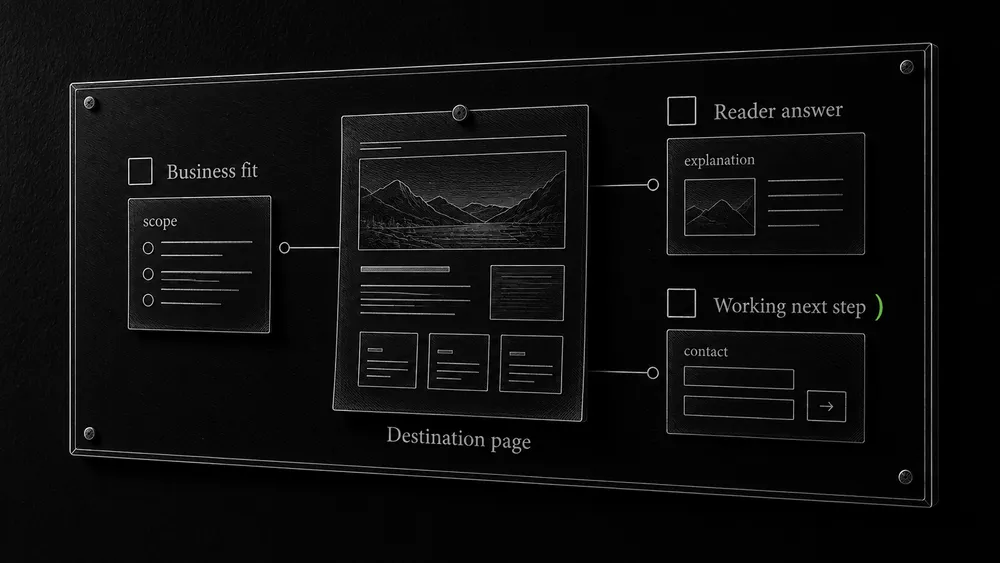
Test business fit, reader fit, and page readiness
Prioritize using three questions:
- Business fit: does this page support work the company wants and can perform?
- Reader fit: would the expected visitor find the promised answer here?
- Readiness: is the page complete, accurate, accessible, and connected to a working next step?
A commercially important but unfinished page belongs in the improvement queue. A polished page outside the company’s priorities does not become a good target just because it is easy to link to.
Use the content audit guide if you need to decide what to improve. Avoid launching a second version of a page merely to give a campaign a unique URL; campaign measurement and site architecture are different problems.
Identify where the buyer already looks for information
Find candidate publications through the intended audience
Build an opportunity list from the audience outward. Consider relevant industry publications, specialist resources, professional organizations, business directories, and sites that already explain the decisions surrounding your service.
Competitor backlinks can provide leads. They do not establish that every discovered placement was useful, paid, current, or suitable for your business. An observed link might come from an old partnership, an unrelated product, or a page whose circumstances have changed. Inspect it before treating it as a model.
Use discovery sources without letting inventory define the strategy
Search results can also help you discover publications around a topic. Save the actual page and the reason it looks relevant. A list of domains without context creates another research task for whoever evaluates it later.
A placement marketplace is another possible source. Its advantage is access to offers and stated conditions. Its limitation is that available inventory may shape your choices before you have established what you need. Define your criteria first, then search the inventory.
You do not need to use every discovery method. Start with the ones that yield plausible candidates for your specific offer.
Separate discovery from approval
A useful shortlist has three stages: found, assessed, and approved. Mixing them leads to accidental commitments and makes a report look more advanced than the work actually is.
At discovery, record the URL and initial reason for interest. During assessment, inspect the publication and obtain the relevant terms. Approval happens only when the proposed topic, destination, commercial relationship, and total cost are clear.
| Stage | Record | Decision |
|---|---|---|
| Found | Publication, relevant section, initial audience fit | Worth investigating? |
| Assessed | Evidence, proposed format, terms, uncertainties | Suitable, unsuitable, or missing information? |
| Approved | Topic, destination, budget, responsibilities, conditions | Authorized to proceed within this scope? |
| Published | Live URL and comparison with agreement | Delivered correctly or needs correction? |
| Reviewed | Observed response and current condition | Continue, change, pause, or stop? |
Use website quality assessment for the investigation itself. This strategy page determines what gets investigated and why; it should not turn into a duplicate donor audit.
Allocate budget to the whole job
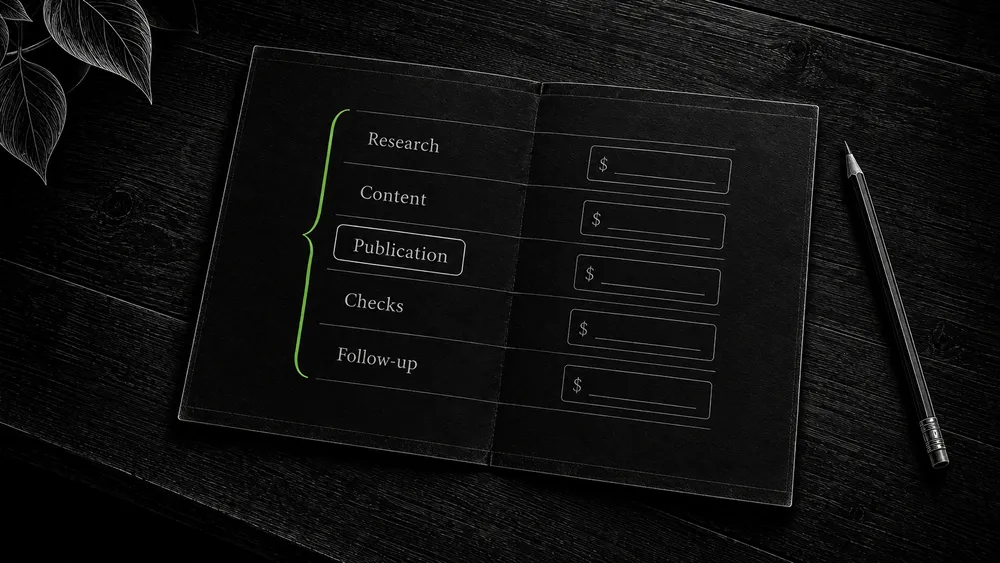
Budget for research, content, publication, and checking
A publication fee is only one part of a placement. Someone must research the opportunity, prepare the material, approve edits, check the published result, and maintain records.
A plan that spends everything on inventory has no room to reject a weak offer, rewrite an article, or resolve a publication problem. Preserve that capacity before deciding how many placements you can afford.
| Budget component | What the scope should make visible |
|---|---|
| Research and selection | Who checks candidates and how the shortlist is approved |
| Content preparation | Drafting, fact collection, editing, and included revisions |
| Publisher or platform fees | Exact offer, currency, taxes or platform charges where applicable |
| Publication checks | Who compares the live page with the approved version |
| Follow-up | Whether later checks, corrections, and reporting are included |
Compare full scope and set an approval ceiling
Ask whether a quote bundles these items or charges them separately. A higher total may include work absent from a cheaper quote; it may also simply be higher. Compare the actual scope rather than assuming either explanation.
Set an approval ceiling and a review point. These are business controls, not recommendations to spend a fixed percentage of revenue on links. If appropriate candidates cost more than the available budget, reduce the initial scope or postpone. Filling the gap with unrelated cheap placements defeats the selection work.
Plan an initial scope that can teach you something
Define a specific audience and destination hypothesis
Group opportunities around a clear hypothesis: this audience is likely to care about this subject, and this destination should help them take the next step. The hypothesis should be specific enough that disappointing results suggest a sensible investigation.
Do not change the audience, topic, destination, article quality, and measurement method for every placement and then compare them as though price were the only difference. At the same time, a small initial campaign is not a controlled experiment capable of proving a universal result.
Record other changes and choose a relevant review window
Record a baseline before publication: the destination’s condition, the measurement setup, existing inquiries where available, and other planned website changes. A major content rewrite or advertising campaign during the same period may affect what you observe.
Set the first review date based on publication and distribution arrangements. An article included in a scheduled newsletter has a different immediate observation window from a profile that readers may discover gradually. Avoid arbitrary promises that all placements will reveal their value within the same number of days.
Define a useful stop rule
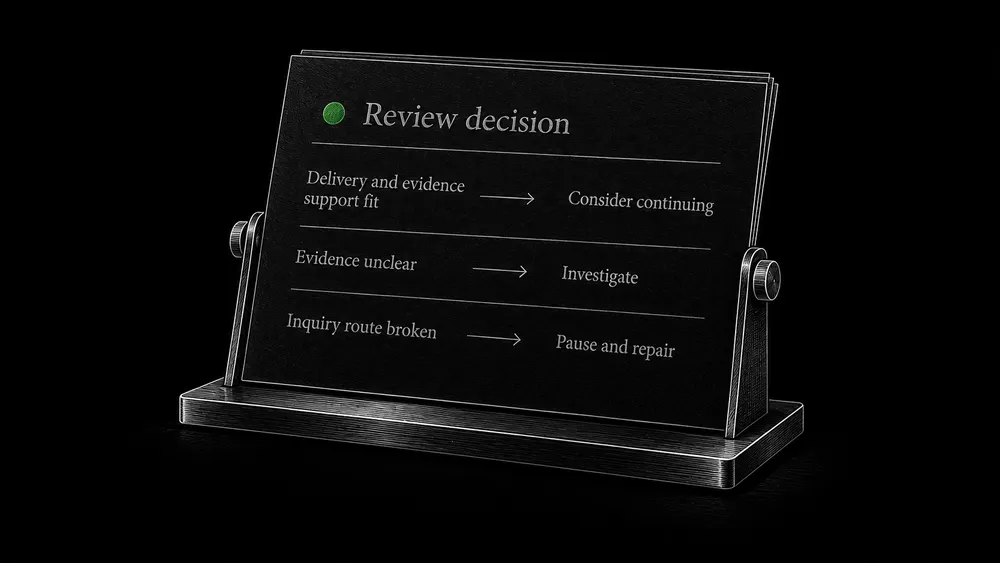
Define when to continue, investigate, change, or pause
Decide in advance what would justify a change. Otherwise, a recurring plan can continue simply because a monthly link count has become familiar.
Continue when delivery is sound and the available evidence supports more of the same type of opportunity. Investigate when results are unclear or the audience evidence was weak. Change the destination when visitors arrive but cannot find the promised information. Pause spending when the inquiry route is broken or the publication does not meet agreed conditions.
Stop for substantive mismatches and label missing evidence
Stop considering a publisher when it cannot provide essential information, proposes a misleading arrangement, or fails your substantive quality criteria. You do not need a numerical score to overrule a clear mismatch.
Poor recorded response does not automatically prove the publication has no readers. It does mean the original reason for spending deserves review. Separate “not measured,” “measured and absent,” and “measured but too limited to interpret.”
Keep the scope understandable to the owner
A client should receive a clear explanation of the proposed work, not a list of unexplained metrics. Summarize the candidate’s audience, the article’s purpose, the destination, costs, important conditions, and outstanding uncertainty.
The owner should confirm business claims and approve spending. They should not have to learn an SEO platform to judge whether the proposal describes their company accurately.
If placement work is part of ongoing website development, keep it separate from the content and technical tasks in the plan. This makes tradeoffs visible. Sometimes improving one important page is the better next use of the budget; sometimes the website is ready and an appropriate publication offers a useful introduction.
Frequently asked questions
Can a small business start without a competitor backlink analysis?
Yes. You can begin with your audience, relevant publications, existing relationships, and a careful inspection of proposed opportunities. Competitor data can expand discovery, but it does not replace business fit or publisher assessment.
Should I focus on the homepage or deeper pages?
Use the page that continues the surrounding content naturally. A broad company profile may belong with the homepage; a detailed article may need a focused guide. Do not force a fixed distribution across page types without a reader-based reason.
How much should I spend on link building?
There is no useful universal figure without a scope and real offers. Budget for selection, content, publication, and checking. Decide what you can spend without compromising the website’s core needs, then compare suitable opportunities within that boundary.
Do I need a monthly placement package?
Only if recurring work suits your needs and there are enough appropriate opportunities. A defined initial project can be easier to evaluate. Any recurring package should explain selection criteria, approval, unused budget, and what happens when suitable inventory is unavailable.
Should I copy the links of the best-ranking competitor?
Use them as research leads. You cannot infer the cause of a competitor’s rankings from its backlink list, and you may not know why individual links exist. Assess the current publication and the proposed arrangement on their own merits.
What if I need inquiries sooner than this approach can reasonably deliver?
Discuss a separate acquisition plan instead of forcing link placements to carry an immediate lead promise. The website still needs a clear offer and a working inquiry route. Any additional channel should have its own scope, budget, and measurement expectations.
Turn your business priorities into a placement plan
Share the services you want to promote, your intended customers, and any pages or publications already under consideration. The first useful decision is where to focus, not how many links to order.