

 WordPress & YOOtheme Pro
 WooCommerce Development
 Website Planning
 Website Ownership & Access
 Website Support & Growth
 Website Launch Checklist
Measuring AI Search Visibility: Separate Citations, Visits, and Leads
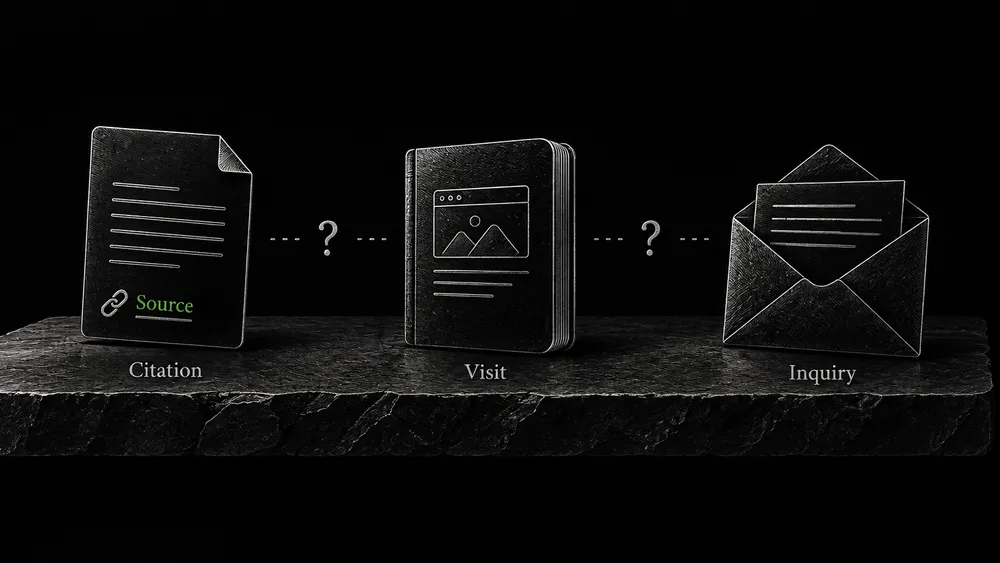
An AI citation can show that a page was used as a source in an observed answer. It does not automatically show how many people saw the answer, how many visited the site, or whether anyone became a customer.
A useful measurement process keeps those events separate. Combine platform evidence, consistent manual observations, website analytics, and actual inquiry records. Describe the limits of each source so the owner can make a decision without relying on a mysterious visibility score.
This is the observation stage of AI Search Optimization. It begins after you know what has been published and which implementation checks have actually been completed.
Define what you mean by visibility
Choose the event you are discussing before choosing a metric.
| Event | Evidence | What it does not prove |
|---|---|---|
| A crawler accessed a page | Appropriate request records and response checks | That the page was indexed or cited |
| A business name appeared | Saved answer and context | That the website supplied the information |
| A page was cited | Source link in the observed answer or supported platform reporting | That the mention was a recommendation |
| A visitor arrived | Analytics or other appropriate visit evidence | That the visitor became a qualified lead |
| An inquiry arrived | Confirmed contact record | That AI search was its only influence |
| A project was agreed | Actual business records | That one content edit caused the sale |
The distinctions matter when comparing tools. One dashboard may count brand mentions, another source URLs, and another visits from recognizable referrers. Adding those values together would not produce a meaningful total.
Record the publication baseline
Record publication, checks, and missing baseline data
Keep a list of the pages in scope, their purpose, publication dates, and significant changes. Include the dates of actual access and content checks.
Do not call a manuscript “indexed” or a saved configuration “verified access.” A baseline should expose what is still unknown. For a newly launched site, there may be no prior visibility data to compare.
Describe releases in terms that support later comparison
Write changes in concrete terms: corrected a public access rule, added a missing condition, clarified a product feature, or fixed a broken destination. Avoid labeling every edit “AI optimization,” because that prevents later interpretation.
The content guide and crawler guide provide the implementation records that can support this baseline.
Know the scope of platform reports
Read Google and Bing reporting within their documented scope
Google currently includes traffic from its AI search features within Search Console’s Web performance reporting. Do not label the entire Web total as AI-only traffic. Google’s reporting explanation.
Bing announced AI Performance in public preview for Microsoft Copilot, Bing AI summaries, and selected partner integrations. It reports citations, cited pages, and sampled grounding queries. These indicate activity across supported experiences, not a universal ranking or an exhaustive view of all AI products. Verify availability and current definitions in your account. Bing’s AI Performance documentation.
Separate referral evidence from unclicked mentions
OpenAI documents ChatGPT referral URLs with utm_source=chatgpt.com. That can help identify incoming traffic in a suitable analytics setup; it does not expose every answer that mentioned the business without a click. OpenAI’s publisher FAQ.
Keep platform names, report definitions, date ranges, and available filters in the record. Product reporting changes over time. Preserve exported evidence where appropriate rather than assuming a screenshot will remain self-explanatory.
Build a small question set around real customers
Choose observation questions from real customer tasks
Use questions connected to the work the business wants to receive. Include different stages: understanding a problem, comparing approaches, checking implementation, and evaluating a provider.
For this website, example topics include what a complete website build involves, how a client retains ownership, and what needs testing before launch. These are candidate observation questions drawn from the content, not claims about measured demand or recorded citations.
Separate unbranded discovery, branded queries, and supplied URLs
Keep three categories separate:
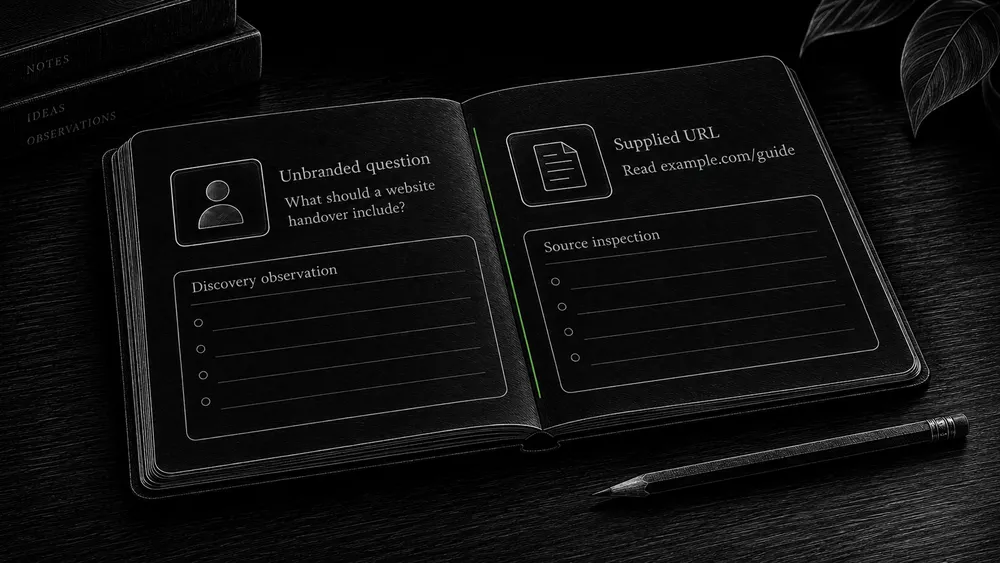
- Unbranded discovery: the question does not name your company or supply its URL.
- Branded understanding: the question asks about your company or product explicitly.
- Supplied-source inspection: you give the service a URL and ask it to read or explain it.
All three can be useful, but they test different things. Supplied-source inspection may reveal a reading problem. It cannot demonstrate that the system independently discovered the page.
Do not expand the question list simply to find more favorable results. Add questions when they represent a meaningful customer need and document the change in scope.
Preserve the conditions of each observation
Preserve wording, service, mode, and observation conditions
Record enough context to interpret a repeated check:
Date and time:
Service and mode where known:
Language and region context:
Question wording:
New or existing conversation:
Search used, not used, or unknown:
Was the brand or URL supplied?
Answer appeared:
Business mentioned:
Exact source URL cited:
Relevant answer passage:
Accuracy or context issue:
Evidence location and limitations:
A fresh conversation can reduce contamination from earlier discussion, but it does not remove all personalization or variability. If a condition is unknown, mark it unknown rather than silently assuming a standard environment.
Include negative results and define the sample behind any rate
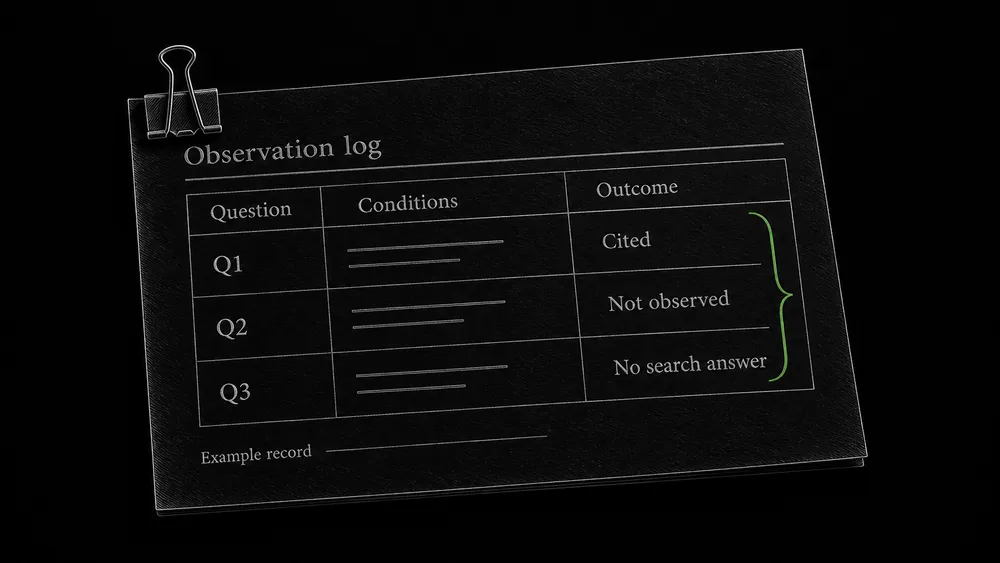
Preserve the result before interpreting it. Include “not observed” outcomes and instances where no search-based answer appeared. Otherwise the record becomes a collection of successes without a denominator.
If you report a citation rate within your test set, state the set and method explicitly. It is a rate within that sample, not the share of all potential customer conversations on the internet.
Read the answer, not only the source list
Inspect whether the cited answer preserves the page’s meaning
A source link is useful evidence, but inspect the claim it accompanies. Does the answer represent the service correctly? Does it preserve a condition that changes the recommendation? Is it citing a current page or an outdated version?
For the ownership example, a summary that says clients receive exclusive ownership of all third-party software would misrepresent the guide. The source page’s distinction between account control and licensing gives you a concrete basis for investigating the error.
Check your content before attributing an external answer error
First verify your own published content. If it is ambiguous or contradictory, improve it. If it is already clear, record the inaccurate answer without claiming that another rewrite will necessarily correct the external system.
A wrong answer can be an important observation even when it contains a citation. Counting only citations would miss that problem.
Connect visits with useful business actions
Verify landing-page relevance and inquiry delivery
Check the landing pages reached by identifiable AI-search traffic. Do they continue the question the visitor was investigating? Is the next step relevant and usable?
Verify that forms work and that successful submissions are measured appropriately. A button click and a received inquiry are different events. The launch checklist provides the practical end-to-end checks.
Keep attribution gaps and self-reported discovery visible
Compare relevant inquiries with the traffic evidence available. Some visitors may return through another route, contact you outside the site, or decline analytics collection. Do not force an attribution claim when the records do not establish the path.
You can also ask new clients how they found the business, with an optional free-text response. Treat self-reported discovery as another evidence source rather than a perfect reconstruction of every interaction.
Decide whether a change is justified
| Observation | Reasonable next step |
|---|---|
| Access checks fail | Fix the confirmed delivery problem before judging content visibility |
| The page omits a recurring customer question | Improve the answer or add an appropriate spoke |
| A service is described inconsistently across pages | Correct the factual conflict |
| A page is cited accurately but visits are limited | Inspect the answer context and whether a click is needed; avoid claiming failure from citation data alone |
| Relevant visits arrive but inquiries do not | Review the destination, offer clarity, form, and audience fit |
| A single check shows no citation | Keep the observation and avoid a major rewrite without additional evidence |
| A report definition or question set changes | Mark the break before comparing periods |
This process does not require proving every cause before making a useful improvement. It requires explaining which observation supports the action.
If several important changes happen together, preserve them in the record. A later increase in visibility may be associated with the work, but the record may not isolate the contribution of each edit.
Keep reporting understandable and portable
Summarize four things: what changed on the website, what was observed, what remains uncertain, and what should happen next. Keep raw exports and answer records available behind the summary.
Avoid promising a universal citation count or an automated audit of every AI answer. Before adopting a third-party tool, ask which products, question sets, locations, and events it actually observes. A useful tool can still cover only a defined sample.
Choose a review cadence that fits the site’s scale and the work being done. Repeatedly checking unchanged questions several times a day can generate noise without creating a better business decision.
If monitoring is part of ongoing support, define responsibility and access. If it ends, hand over the records and known limitations. Do not imply continued account access after the client takes over.
Frequently asked questions
Can I see every AI answer that mentions my business?
Do not assume any available report provides that complete view. Platform reporting and third-party tools have defined coverage. Combine evidence while keeping those boundaries visible.
Is a citation better than a brand mention?
They answer different questions. A citation identifies a referenced source; a mention shows the name appeared in the observed response. Read the context and connect the observation with your objective rather than assigning universal value to either event.
Can I count all Search Console traffic as AI traffic?
No. The Web report includes broader search activity. Use the definitions and filters actually provided rather than inventing a separate AI total from aggregate data.
Does asking an assistant to read my URL test discovery?
It tests behavior with a supplied source. Keep it separate from an unbranded question where the service must find sources itself. Both can help diagnose different issues.
How soon should a new site show results?
There is no dependable universal deadline. Record publication, access, and subsequent observations. Avoid converting an implementation schedule into a guarantee of citations or customers.
What if citations increase but leads do not?
Review the audience, answer context, landing pages, offer, and measurement. More source references do not necessarily mean more visitors, and more visitors do not automatically mean relevant inquiries.
Can this site become a case study later?
Yes, when actual implementation records and observations exist. Keep the baseline now so a later case can distinguish what was done, what was measured, and what cannot be attributed confidently.
Make your visibility reports useful
Share what you currently measure and which questions you need the reporting to answer. We can discuss a defined observation and website-improvement scope without pretending to monitor the entire AI ecosystem.