

 WordPress & YOOtheme Pro
 WooCommerce Development
 Website Planning
 Website Ownership & Access
 Website Support & Growth
 Website Launch Checklist
Google AI Overviews & AI Mode: Check Readiness Before Chasing Citations
When your website does not appear in a Google AI answer, the absence alone does not tell you what is wrong. The page may not be indexed, the content may not address the question, or Google may simply select other sources for that response.
A useful review separates those possibilities. Start with the page’s known state, then inspect the answer it provides and the way you are observing results. Avoid turning one missing citation into a full website rewrite.
This guide focuses on Google. The AI Search Optimization hub explains the wider relationship between content, access, and visibility across services.
Establish the actual eligibility condition
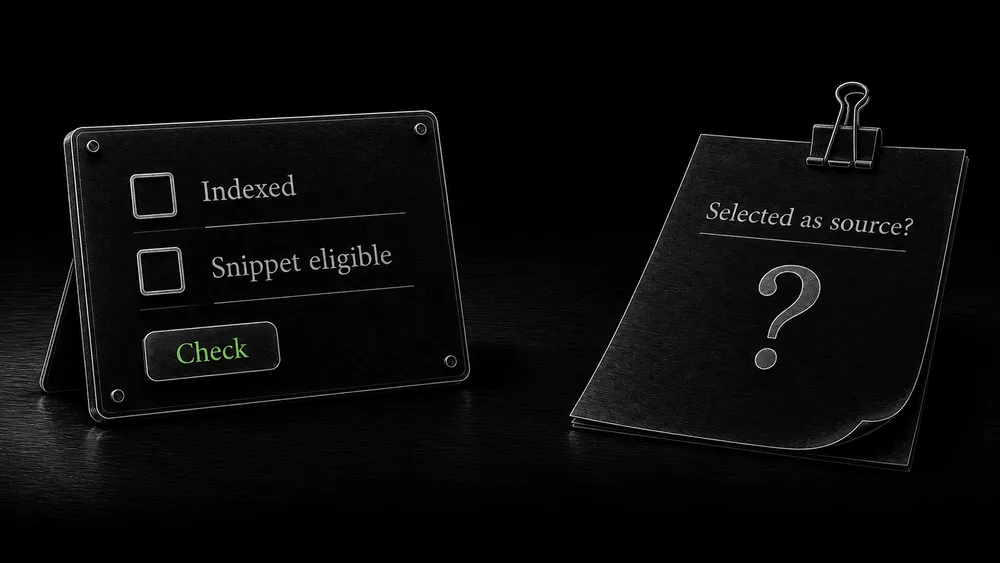
Check indexing and snippet eligibility for the intended URL
Google requires a supporting page in AI Overviews or AI Mode to be indexed and eligible for a Search snippet. Meeting those conditions does not guarantee selection. These features do not require a special schema type or an additional AI text file. Google’s official guidance.
That is more precise than saying the website must be “fully SEO optimized.” An audit score is not the same as the state of a particular URL. Find the issue that actually affects the page you want considered.
Distinguish the indexed version from a live accessibility test
Use the verified property for your website and inspect the intended canonical URL. Record what the available report says and when it was checked. A live accessibility test and evidence of an indexed version answer different questions; do not replace one with the other.
The existing crawling and indexing guide covers the diagnostic detail. Keep that work attached to the real page rather than assuming that an indexed homepage establishes the status of every spoke.
Diagnose by state, not by a generic checklist score
| Observed state | First investigation | Avoid this assumption |
|---|---|---|
| Page is not public yet | Release readiness and production settings | A staging draft should already be cited |
| Public page cannot be retrieved properly | Server response, access controls, and delivered content | More paragraphs will solve access |
| Page is accessible but not indexed | Indexing report, canonical selection, directives, and page value | Sitemap submission proved indexing |
| Page is indexed but answers a different question | Intent, scope, and missing conditions | Technical eligibility establishes relevance |
| Page is relevant but not observed in the answer | Observation method and competing explanations | The page has failed a hidden AI certification |
| Page is cited but receives few visits | Answer context, audience need, and measurement | A citation necessarily creates traffic |
Work from evidence you can verify. Some states lead to a concrete fix; others lead to observation or editorial judgment. It is reasonable to report uncertainty when the available data does not identify a cause.
Review the answer at the level of the question
Match the page to the question being investigated
Ask what a person needs to understand, decide, or do. A broad service page may be helpful for evaluating a provider but insufficient for a narrow implementation question. A detailed checklist may answer that narrower question well without repeating the entire commercial offer.
For this site’s development cluster, “What should be checked before a website launches?” belongs naturally with the launch checklist. Its pass conditions turn a broad concept into something inspectable: a form is not accepted simply because it shows a success message; the recipient must receive the inquiry.
Use content examples honestly and add depth where needed
That is a content example, not a report that Google has cited the page. The editorial lesson is to make the answer useful and verifiable before discussing how a search system might select it.
If a missing detail is brief and necessary to understand the page, add it in context. If it requires an independent workflow, link to a substantive spoke. Do not create a page for every minor rewording of the same question.
Keep conditions beside the recommendation
Keep readiness claims beside their essential conditions
An answer may become misleading when its limitation is far from its conclusion. Review sections that use words such as “always,” “complete,” “secure,” “owned,” or “ready.” Those terms often conceal conditions the reader needs.
For example, a launch guide should distinguish technical readiness from observed indexing. A page can be prepared for public release while discovery and indexing still require later observation. That distinction belongs near the readiness explanation, not only in a closing disclaimer.
Explain the specific control or rights behind broad claims
Likewise, “the client owns the website” should lead to a concrete account and dependency explanation. The ownership guide distinguishes administration, editing access, and usage rights. Those distinctions make the answer more accurate even when someone reads only the relevant section.
Use the content-for-AI guide for a fuller editing method. Here the point is to verify that the page genuinely serves the question you are testing.
Use competitors as evidence of answer coverage
Read the contribution made by cited sources
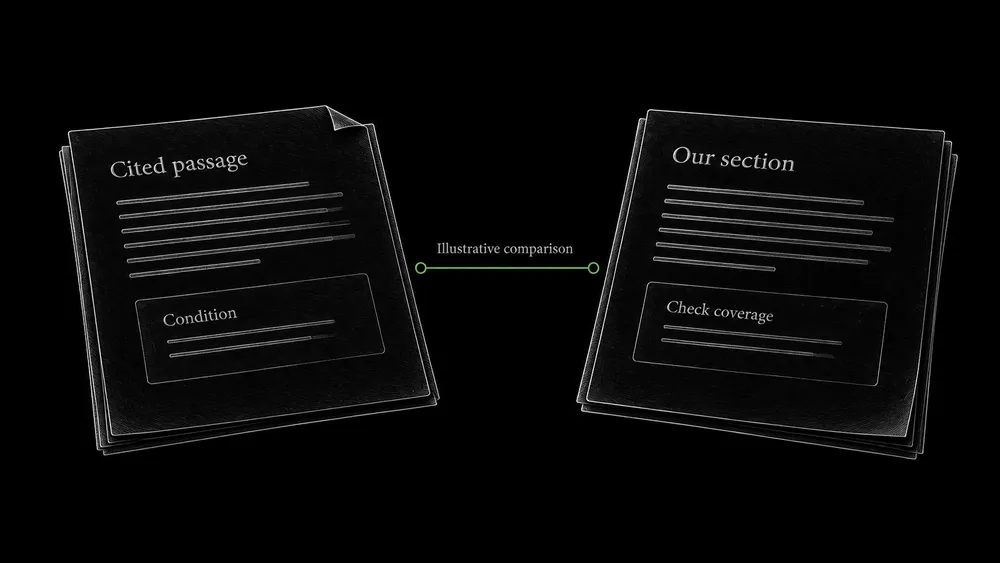
When reviewing an observed AI answer, open the cited sources and read the relevant passages. Record what they contribute: a definition, current fact, comparison, procedure, or firsthand evidence.
Then compare the information with your own page. Do you omit an important condition? Do you explain a different situation? Is your claim unsupported? These are useful editorial questions.
Compare substantive coverage without copying presumed citation factors
Do not conclude that a competitor’s table, heading count, or page length caused its citation. The visible result does not expose the full selection process. Copying its layout while missing its substantive contribution is unlikely to improve your explanation.
Also avoid expanding beyond the business’s scope simply because a cited competitor covers more services. Your page should be accurate about what you offer and provide relevant depth around that boundary.
Check the deployed version after changes
Verify the deployed content and affected page families
A corrected draft does not establish that the live page changed. Confirm the published URL, visible text, essential links, and relevant metadata. If a template or caching layer is involved, check the public response after deployment.
Test page families as well as one sample. A reusable WordPress template can create the same defect across many guides, while an individual page can still contain its own factual error. Separate template corrections from page-specific editing.
Record the actual editorial or implementation change
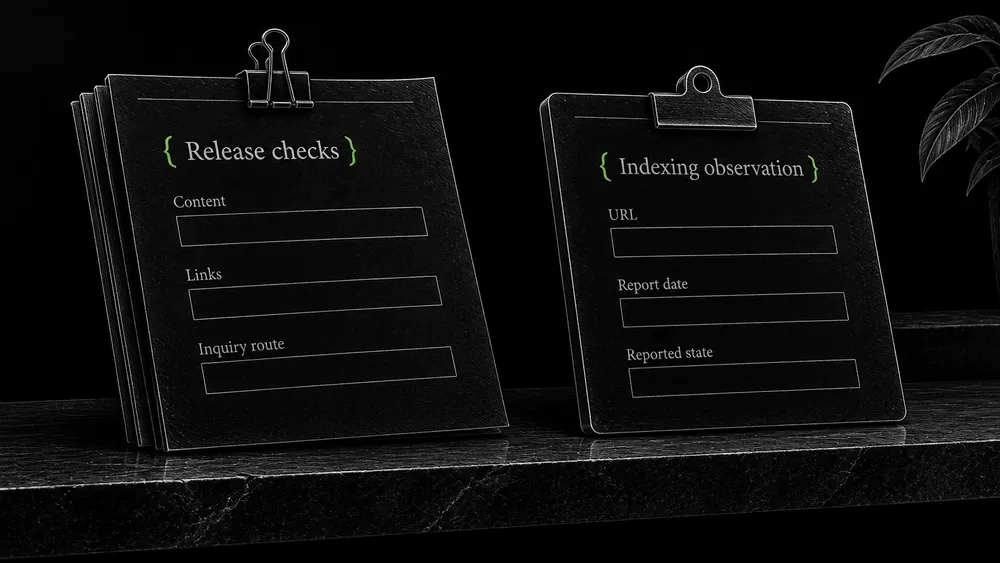
Keep a short release note explaining the change and its reason. “Added the distinction between account control and software licensing” is more useful than “optimized for AI.” It makes later review possible even if the page’s search exposure does not visibly change.
Observe answers without manufacturing a success story
Preserve question wording and observation context
Use a stable set of questions based on actual buyer needs. Preserve the wording and note the date, service or mode, language, and relevant location context. Record whether an AI answer appeared at all and whether your page was included as a source.
Do not mix a broad discovery question with a branded question naming your company and call both independent discovery. Do not supply your URL and then report the assistant’s use of it as proof that it would have found the site unaided.
Retain negative observations and check cited-answer accuracy
A useful observation can be negative or inconclusive. If no citation is seen, the record still helps you avoid changing the experiment every time. If a citation is seen, inspect whether the answer represented the page correctly.
Measurement across services belongs in AI visibility and reporting. An observed answer is a sample of behavior, not a permanent ranking position.
Frequently asked questions
Does being indexed mean my page will appear in an AI answer?
No. Eligibility and selection are different. Use indexing evidence to rule out one class of problem, then consider relevance and the limits of your observations. Do not interpret eligibility as a publication commitment from Google.
Should I target a broad hub or a detailed spoke?
Match the page to the question. The hub should explain the overall subject independently. A spoke should handle a deeper task with enough detail to stand on its own. Both can be useful without receiving identical content.
Is a perfect performance score required?
Do not treat a tool score as an AI admission threshold. Investigate problems that materially affect access or use. A page that fails to deliver its content needs attention; a minor score difference does not by itself explain citation selection.
Should I add an FAQ to every page?
Add questions that help the reader resolve remaining uncertainty. Main decisions deserve developed explanations. An FAQ should complement that work rather than repeat every heading or add unrelated questions for volume.
Should I rewrite a useful page if a competitor appears instead?
First identify a specific gap or error. A competing citation can help you investigate coverage, but it does not prove your page needs wholesale revision. Preserve sound material and make changes you can justify.
Can I measure a permanent position in AI Mode?
Treat observed answers as contextual results that may vary. Define the question set and observation conditions, and report what was actually seen. A universal fixed position is not an appropriate promise for this work.
Review the pages you want Google to understand
Share the relevant URLs, the questions they should answer, and any known indexing issues. The review can distinguish a release problem, a content gap, and an observation that does not yet justify a change.