

 WordPress & YOOtheme Pro
 WooCommerce Development
 Website Planning
 Website Ownership & Access
 Website Support & Growth
 Website Launch Checklist
An SEO Content Audit That Helps You Decide What to Improve
As a website grows, its content can drift away from the original plan. Services change, explanations become outdated, new guides overlap older ones, and useful pages lose their place in navigation. Publishing more articles does not resolve those problems automatically.
A content audit compares what the website is meant to do with what its pages currently provide. The outcome is a set of editorial decisions: preserve, improve, consolidate, separate, or retire content, with a reason and a verification plan for each change.
This guide focuses on content and its role in the customer journey. Use the technical SEO audit for access, response, rendering, and indexing defects. Both support the broader SEO content system, but they answer different questions.
Establish why you are reviewing the content
Set the audit question and page scope
Define the reason for the audit before collecting metrics. You might need to prepare an existing site for expansion, investigate unsuitable inquiries, resolve overlapping articles, or update information after a change in the business.
Choose the scope: a complete small website, one hub and its spokes, or a group of pages affected by a known change. A focused review can be more useful than a sitewide export that nobody has time to interpret.
Define the decisions the audit should support
Record what a successful audit would let you decide. For example: which guides are ready to keep, where the essential buying questions remain unanswered, and which pages need facts from the owner before they can be revised.
Do not begin with a predetermined instruction to delete everything below a traffic threshold. That prevents the audit from discovering why a page exists and whether it performs a useful supporting role.
Build an inventory that includes purpose and evidence
Inventory page purposes and available evidence
For each page, record its URL, title, parent topic, intended reader task, main next step, and owner. Add the last meaningful review date and any known factual dependencies.
Then collect the evidence available for that page: search observations, relevant website events, inquiry quality, internal links, and the content itself. Keep data periods and sources visible.
Keep a usable record when performance data is limited
The minimum useful record is:
URL and page role:
Reader task and business relevance:
Current answer and missing decisions:
Facts or sources needing review:
Related pages and possible overlap:
Search and inquiry evidence, with dates:
Technical conditions that affect interpretation:
Proposed action and reason:
Owner, dependencies, and verification:
A page with little data can still be assessed for accuracy, usefulness, and structural role. Label the absence of evidence rather than converting it into a conclusion that the page has no value.
Read the page before deciding from the dashboard
Check whether the reader can use the explanation
Ask whether the current content answers its defined task. Follow the procedure if one is given. Try to use the comparison criteria. Check whether the preparation requirements are specific enough for a reader to act.
Look for statements that have become vague through repetition: “optimize the process,” “use best practices,” or “ensure quality.” Determine whether the article explains what those instructions mean in this context.
Review business facts and source accuracy
Review factual claims separately. Are the services still offered? Does a tool behave as described? Are screenshots current enough to support the instructions? Are external sources still available and relevant?
A page may need a substantial improvement despite healthy traffic. Conversely, a low-traffic preparation guide may remain accurate and useful to people already considering the service. Editorial judgment should consider both cases.
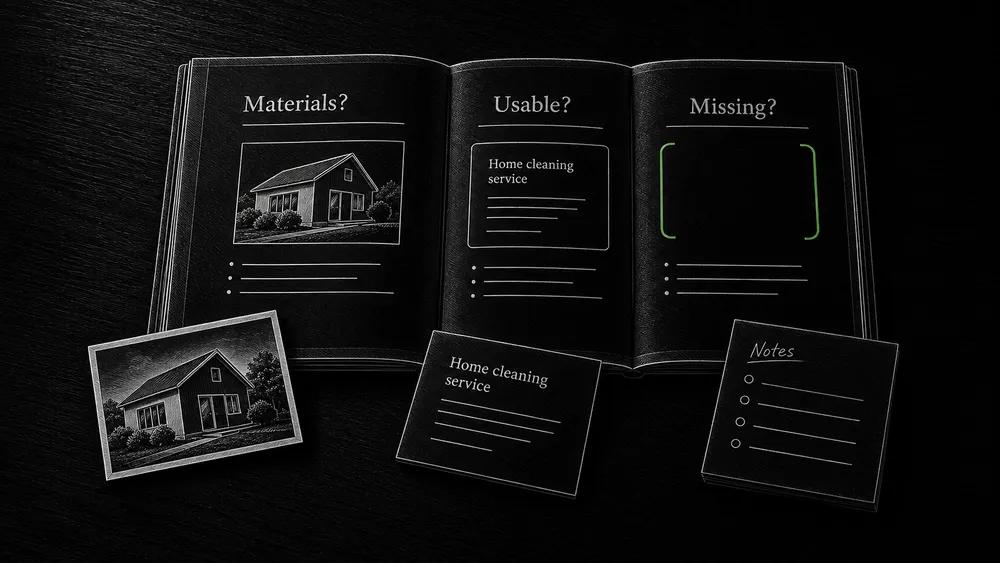
Interpret search metrics as observations, not diagnoses
Compare search patterns in the right context
Search Console can help identify which pages and queries have changed. Compare appropriate periods and separate relevant countries, devices, and search contexts where the data supports it.
Google’s traffic-drop guidance recommends investigating patterns and considering seasonality, changing interests, technical problems, and other causes. A decline does not automatically mean the article needs more words.
| Observation | Investigation to consider | What it does not establish alone |
|---|---|---|
| Impressions rise while clicks stay flat | Query mix, result presentation, and the searches where visibility changed | That the entire page is low quality |
| Clicks decline across many sections | Sitewide events, demand, search changes, or technical conditions | That every affected article needs rewriting |
| One page attracts unsuitable queries | Scope, terminology, and the answer actually provided | That every unexpected query requires another page |
| Several pages appear for related searches | Whether their tasks are distinct and their roles clear | Proven harmful cannibalization |
| A page has little search activity | Indexing, relevance, competition, age, and supporting purpose | That deletion will improve the website |
Account for data gaps and different measurement methods
Keep the limitations of the data visible. Search Console reports omit some queries, and page data is generally assigned to canonical URLs. Its data-grouping documentation explains those constraints.
Do not directly equate a Search Console click with an analytics session or a completed inquiry. They measure different events under different conditions. Use each source to answer the question it can support.
Include the quality of actual inquiries
Use recurring inquiry questions to identify content gaps
Review recurring questions from people who contact the business. Are they asking for work outside scope? Do they misunderstand what is included? Do they arrive better prepared after reading a particular guide?
Record the pattern without publishing private customer information. A repeated misunderstanding can identify an important content gap even when a page receives modest traffic.
Check the form and the page’s intended role
Also inspect the inquiry path itself. If the form fails or asks for information an ordinary owner cannot provide, a low submission count may not be a writing problem. Verify implementation before rewriting the explanation to compensate for a broken route.
For a guide intended to support independent action, immediate inquiries are only one possible outcome. Assess whether it teaches the task and creates a relevant path to further help. Avoid imposing a direct-sale expectation on every supporting page.
Choose the smallest editorial action that resolves the issue
| Action | Appropriate when | What to preserve |
|---|---|---|
| Keep | The page remains accurate, useful, and distinct | Its URL, effective explanation, and relevant links |
| Improve | The task is valid but the answer has specific gaps | Useful material and the page’s primary purpose |
| Merge | Several pages provide substantially the same answer | Unique information, relevant entry points, and evidence |
| Split | One page contains separate substantial tasks that impede use | A clear parent explanation and links between the new parts |
| Retire | The subject no longer has a useful role or available offer | Any information worth relocating and a deliberate URL outcome |
The decision should name the actual reason. “Improve: clarify what the client needs to supply and how missing materials affect the process” is more useful than “refresh for SEO.”
Prioritize by the consequence of the gap, the importance of the page to the business, and confidence in the diagnosis. Include factual dependencies and implementation effort. A shared incorrect service claim may deserve attention before an optional expansion of an already useful article.
Investigate overlap before merging pages
Distinguish shared context from duplicated answers
Compare the intended task, actual outline, unique information, and conclusion of each page. Similar wording or shared entities does not prove that they should be one URL.
If the pages serve different stages, clarify their boundaries and links. A planning guide and a production brief guide can discuss the same project while helping different decisions. The intent guide provides a method for that comparison.
Preserve useful material when consolidating pages
If the answer is substantially duplicated, identify the best maintained destination and the material that must survive consolidation. Record existing internal references and any important old entry points before changing the URLs.
Use the redirect guide for the technical treatment of retired addresses. A canonical tag does not replace the decision to merge editorial content, and a redirect should not send readers to a page that lacks the information they requested.
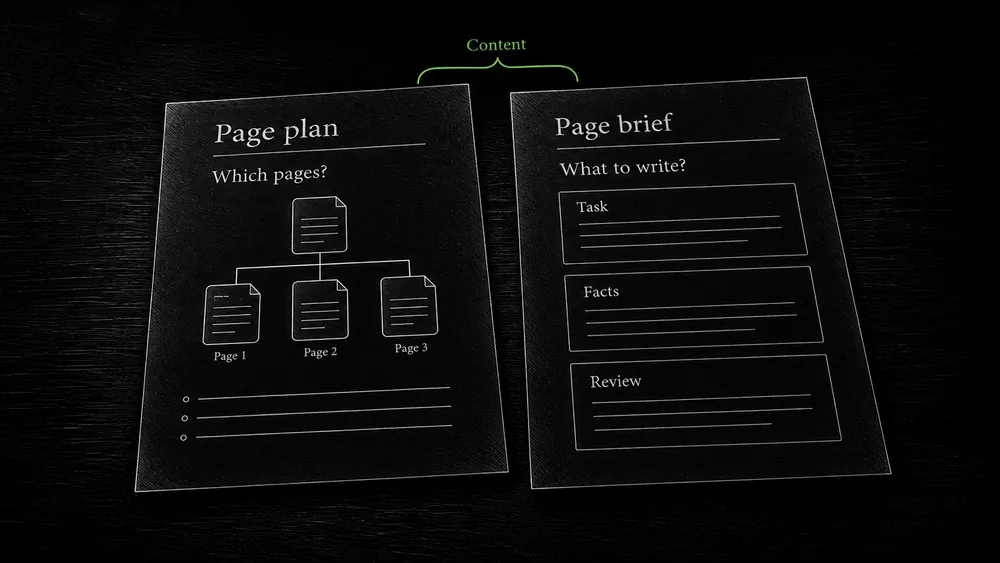
Write a revision brief instead of requesting “better content”
A revision brief should say what is wrong, what evidence supports that view, and what the revised page must help the reader do.
An illustrative change record could be:
Finding: The preparation guide lists materials but does not explain
what to do when the owner has none.
Evidence: The section ends at the checklist; the workflow is missing.
Change: Explain how a discussion can establish service facts,
which materials can be developed, and what cannot be claimed without proof.
Preserve: Existing preparation checklist and relevant links.
Review: Owner confirms scope; editor tests whether the fallback is usable.
This is an example of an editorial task, not a claimed result from a client audit. It makes the required improvement assessable without dictating every sentence.
Use the briefing workflow to track confirmation and the copywriting guide for the actual rewrite. AI can assist with the revision, but it should receive the findings and verified facts rather than a vague instruction to make the page longer.
Update facts and dates honestly
Prioritize facts that are likely to change
Review information according to how quickly it can change. The principle behind a method may remain stable while a tool interface, policy, price, or product capability needs current verification.
Keep the durable explanation separate from the changing implementation detail where that helps maintenance. A guide can teach how to evaluate a choice and link to current documentation for the exact limits or interface.
Record meaningful updates and dependent pages
Use publication and update dates that reflect the page’s actual history. Google’s byline-date guidance addresses visible dates and significant updates. Do not make an old article appear newly researched merely by changing its date.
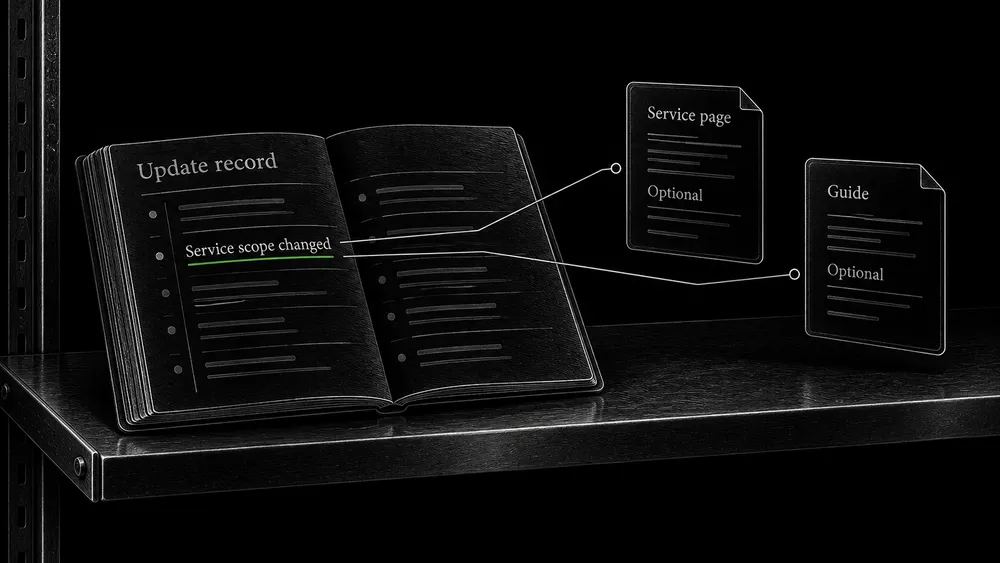
Record what changed and which dependent pages need review. If a capability becomes available or is withdrawn, the main hub, relevant spoke, and inquiry brief may all need adjustment.
Verify the revised page and its connections
Verify the revised answer and internal links
Compare the public version with the revision brief. Confirm that the missing answer is now present, retained material has not disappeared, sources support the current statements, and the page’s scope remains clear.
Check links into and out of the revised page. A merge may leave anchors promising an old narrow topic; a split may require a new parent explanation. Use the internal linking workflow to maintain those routes.
Test the next step and observe later evidence
Test the relevant form or next step after implementation. Keep the revision date and the successful public checks in the record. If a technical problem affects discovery, follow up through crawling and indexing diagnostics.
Observe later search and inquiry evidence over an appropriate period. Account for other releases and external changes. An improvement can be editorially sound before its search effect is measurable, and a favorable traffic change alone does not prove which edit caused it.
Make review part of ongoing development
Choose review triggers from the business: changes to services, repeated customer confusion, major platform changes, new evidence, and substantial changes in search performance. Add periodic checks for important pages whose facts can drift silently.
The process should be manageable. A small website may need focused reviews of a few important pages; a growing cluster needs a maintained inventory and clear ownership. The aim is to keep the resource dependable, not to rewrite every page on an arbitrary schedule.
For continued work after launch, content review can form part of website support and growth. The scope should distinguish routine factual maintenance from new sections, research, and substantial expansion.
Frequently asked questions
Should I delete pages with no traffic?
First establish their purpose, technical state, and usefulness. Some support customer decisions outside the first search visit. Others may need improvement or retirement, but traffic alone does not provide the decision.
Does every update need a new URL?
No. A useful page can usually be improved at its existing address when its task remains the same. If the subject changes substantially, assess structure and URL treatment deliberately rather than changing addresses as a routine refresh tactic.
How can I tell whether two pages should merge?
Compare the answer they deliver and the unique information each contributes. If they serve distinct decisions, clarify those roles. If one stronger explanation can replace both without losing a useful task, consolidation may be appropriate.
Is changing the year in a title an update?
Only if the content and its claims have actually been reviewed and made appropriate to that year. A date change by itself does not improve accuracy or usefulness. Record the substantive work behind the update.
Can AI audit all my pages automatically?
It can help identify repetition, gaps, and potential inconsistencies. Someone still needs to verify claims, interpret performance evidence, and decide which changes fit the business. Treat automated findings as review candidates.
How soon should I expect results after a rewrite?
There is no fixed outcome or deadline. Verify the improved answer and public implementation first, then observe relevant evidence over time. Search processing, demand, competition, and other changes affect what you can measure.
Decide what your website should improve next
Share the section you want reviewed and what prompted the concern. I can assess the content, identify the decisions that need work, and help implement a focused improvement plan within ongoing website development.