

 WordPress & YOOtheme Pro
 WooCommerce Development
 Website Planning
 Website Ownership & Access
 Website Support & Growth
 Website Launch Checklist
Backlink Monitoring & Reporting: Know What Changed and What to Do
A backlink report should help you make a decision. Is an agreed placement still present? Does it point to the correct page? Has the surrounding article changed? Are relevant visitors arriving, and is continuing this work justified?
A growing link count cannot answer all of those questions. Nor does a “lost link” notification automatically mean a publisher removed your placement.
Start with a reliable record of what was arranged. Use direct checks to investigate changes, and keep delivery evidence separate from audience response and search performance. That makes a report useful to the owner of the business, not just the person maintaining the spreadsheet.
Monitor the placements you know about
Distinguish arranged placements from discovered backlinks
There are two different sets of data: links you deliberately arranged and links a tool discovers across the web. They overlap, but they should not be treated as identical.
For arranged placements, you should know the publication, agreement, expected destination, and contact. You can compare the live result with that record. Discovered backlinks may include independent references, scraped copies, old pages, or links you had no role in creating.
Separate discovery dates from publication dates
Keep these categories distinguishable. A newly discovered URL is not necessarily newly published, and it is not evidence that your provider created it. Recording discovery date separately from publication date avoids a misleading growth report.
This guide covers the checking stage of Link Building & Content Placement. The purpose is to maintain evidence and make follow-up decisions, not to turn every discovered domain into a task.
Create the baseline at publication
Capture a baseline for each published placement
Record the actual live page rather than the publisher’s homepage. Save enough information to recognize a meaningful change later.
| Field | Why it matters |
|---|---|
| Source URL and publication | Identifies the page to check |
| Placement type and relationship | Distinguishes article, profile, independent reference, and paid arrangement |
| Publication date and first checked date | Separates timing of delivery from your observation |
| Destination URL and final landing page | Exposes wrong targets and later redirects |
| Link text and observed attributes | Records what was actually published |
| Relevant surrounding content | Helps identify edits that change the meaning |
| Visible disclosure, where applicable | Records the presentation of a paid article |
| Agreed conditions, cost, and contact | Provides context for a correction request |
| Check status and next action | Makes the record operational |
Preserve visible content and technical link details
Save an appropriate copy or screenshot of the relevant published content for your records. Visible evidence alone does not preserve all technical details; record the link destination and attributes separately.
For a directory, also keep account and factual-information status. A link can remain live while the phone number or business category becomes wrong. The business listings guide covers those additional responsibilities.
Check the source page and your destination
Inspect the publisher page and the final landing page
A complete link check has two ends. The publisher’s article may be intact while your destination has moved, broken, or become irrelevant.
On the source page, confirm that the expected content is available and the link still exists in the intended context. Inspect the actual destination rather than relying on the visible text. If a redirect or tracking URL is used, follow the path and record the final page.
On your site, confirm that the destination loads, answers the original promise, and offers a working next step. A redesign can accidentally break valuable referral routes even if the publisher changes nothing.
Investigate moves and automated alerts before confirming a loss
When a destination moves, choose a relevant replacement and handle the change deliberately. A redirect to an unrelated homepage may technically resolve but leave the visitor without the promised answer. See redirects and broken links for the technical work.
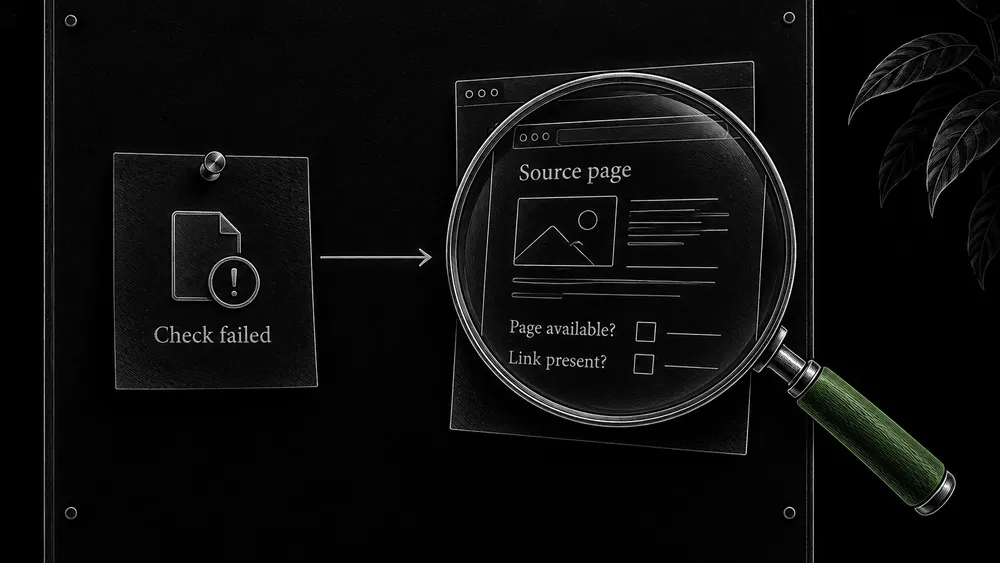
An automated check can identify a suspected change. Follow up with a direct inspection before reporting a confirmed removal. Temporary availability problems, access challenges, or differences in how a tool reads a page can affect the result.

Turn alerts into specific actions
Use statuses that distinguish observation from interpretation. “Check failed” is not the same as “article deleted.” “Link changed” does not say whether the change is wrong.
| Signal | What to verify | Possible action |
|---|---|---|
| Source page cannot be fetched | Direct visit, response, temporary challenge, and whether the URL moved | Retry appropriately or contact the publisher after confirmation |
| Link appears missing | Current article content and any revised placement | Request correction using the recorded agreement |
| Destination changed | Actual link target, redirect path, and relevance | Correct your redirect or ask for a publisher update |
| Link attributes changed | Current HTML, relationship, and agreed terms | Resolve a mismatch; do not remove appropriate paid-link qualification |
| Article text changed | Whether the business claims or context were altered | Request a factual correction if necessary |
| Tool reports a newly found link | First observed date versus actual publication history | Classify it accurately before counting it as new work |
| Visits decline | Comparable reporting period, distribution, measurement, and page condition | Investigate before attributing the decline to one cause |
Prioritize changes that affect visitors, factual accuracy, or an agreed deliverable. A failed inquiry form on a destination receiving referrals may deserve attention before a minor variation in anchor wording.
Keep the response proportionate. One temporary fetch failure does not justify repeated messages to a publisher. A confirmed wrong destination or removed paid article warrants a concrete request with evidence.
Understand what Search Console can show
Treat backlink reports as samples rather than a complete inventory
Search Console’s Links report provides a sample, not a complete inventory of every backlink. Google also groups and deduplicates parts of the data. A missing row therefore does not prove that a link was removed or ignored. See Google’s Links report documentation.
Use it to understand broad patterns and investigate references alongside your own placement register. It is not a substitute for opening a known article and checking its current state.
Record the source and limits of external-page evidence
Your own site’s Search Console access also does not give you the publisher’s URL Inspection data. If the publisher supplies evidence about its page, record the source and date. Do not label an external page’s indexing status as independently verified through an account you do not control.
Similarly, a third-party backlink database reflects what that provider has found and processed. Differences between tools do not automatically identify an error. Preserve the data source and observation date so future comparisons are meaningful.
Measure referrals without pretending to see every journey
Verify inquiry tracking and agreed campaign tags
Before evaluating an article’s response, confirm that your site’s analytics and inquiry tracking work. A report showing no inquiries is ambiguous if form submissions were never measured correctly.
For an agreed paid campaign, consistent UTM parameters can identify source, medium, and campaign in Analytics. Google documents how manual campaign tagging populates traffic-source dimensions. Agree on the URL with the publisher and verify that it reaches the correct page.
Keep attribution scopes and measurement limits visible
Use the same reporting definitions when comparing periods. First-user acquisition, session acquisition, and event attribution answer different questions; Google explains these traffic-source scopes. Do not present numbers from different scopes as interchangeable counts of placement-generated customers.
Even a functioning setup has limits. A reader may return later through another route, contact you outside the website, or decline analytics collection. Publisher clicks and recorded website sessions may not match. Describe what was measured rather than claiming complete visibility.
When an inquiry arrives, its quality matters. A relevant project request and an unrelated sales message should not have the same business interpretation. A simple owner-maintained note about qualified inquiries can add useful context to automated event counts.
Keep search observations separate from causal claims
Record search changes alongside other relevant events
A placement may be followed by higher search impressions or a ranking change. The sequence alone does not establish that the placement caused the change.
Record other relevant events: content updates, new pages, technical fixes, seasonal demand, and other promotion. Compare appropriate periods and relevant page groups rather than choosing the most flattering date range.
Separate observations, measurements, and hypotheses
Useful reporting language distinguishes the levels of certainty:
- Observed: the article is live and points to the approved guide.
- Measured: the analytics setup recorded visits associated with this source during the stated period.
- Uncertain: some later inquiries may have followed earlier exposure that is not identifiable in the available data.
- Hypothesis: the topic or destination may need revision before arranging a similar placement.
Do not turn “hypothesis” into a confident result by adding a percentage. Domain metrics and link counts are context, not revenue or proof of customer demand.

Make the report short enough to use
Summarize delivery, response, and decisions
The owner should be able to see what was delivered, what needs attention, what was learned, and what is proposed next. Detailed exports can sit behind that explanation.
A useful reporting outline is:
Reporting period and scope:

Delivery
- Published and checked:
- Awaiting publication or correction:
- Material changes since the previous check:

Audience response
- Data sources and measurement limitations:
- Relevant visits and inquiries observed:
- What remains unknown:

Decisions
- Continue:
- Investigate or change:
- Pause or stop:
- Responsible person and next review point:
Report uncertainty without delaying supported corrections
This is a working template, not a sample campaign result. Populate it only with actual observations and agreed work. If there is not enough data to judge effectiveness, say that clearly and explain what decision can still be made.
For example, you may be unable to attribute a business outcome while still confirming that a publisher failed to deliver the approved destination. One uncertainty does not prevent action on another, well-supported issue.
Use tools within a defined monitoring scope
Choose tools for the agreed monitoring workload
A small register can be maintained manually. Tools become useful when the number of pages, frequency of changes, or wider website responsibilities make repeated checks difficult.
SeoDrift, developed by Theo, includes backlink checks alongside website crawling, availability monitoring, and change history. Its broader purpose is described on the SeoDrift page.
Confirm check coverage and responsibility for findings
Before including any tool in a service, confirm the specific checks, schedule, supported notifications, and responsibility for responding to findings. Backlink checking does not automatically mean every link on the web has been discovered, every Google indexing decision is known, or a publisher’s page can be repaired automatically.
The procedure on this page is a recommended checking workflow. It should not be read as a claim that every field in the example register is automatically collected by SeoDrift. Manual review remains useful for context, factual changes, and commercial conditions.
Agree on what happens after handover
Monitoring is ongoing work only when it is included in the agreement. Define what will be checked, how often, what gets reported, and who contacts publishers or fixes your own pages.
If collaboration ends, hand over the placement register, relevant agreements, unresolved issues, and business-owned accounts through an appropriate process. Continuing access or checks should not be assumed after the client changes account permissions.
A future provider should be able to understand what exists and why it was arranged. That continuity is more useful than a final spreadsheet with unexplained domain scores.
Frequently asked questions
How often should backlinks be checked?
Check an arranged placement when it goes live. Set later reviews according to its importance, terms, and the monitoring scope. There is no universal frequency that suits every profile and article; specify it instead of implying constant oversight.
Does a missing backlink in Search Console mean the link is gone?
No. The report is a sample. Inspect the actual source page and your baseline record before reporting a removal. Keep tool-report changes separate from confirmed changes to a live placement.
Should every suspicious backlink be disavowed?
No. Google says most sites do not need the disavow tool and warns that incorrect use can harm performance. A third-party risk label alone is not a sufficient diagnosis. Review the official disavow guidance before considering that action.
Can a placement be delivered correctly but generate no recorded leads?
Yes. Delivery, audience exposure, and customer response are separate questions. Review the audience, distribution, destination, buying cycle, and measurement limitations before deciding whether to repeat the purchase.
Is a changed link attribute always a problem?
No. It may accurately reflect the relationship or a publisher policy change. Compare the current state with the arrangement and applicable guidance. Correct qualification of a paid link should not be treated as damage that must be reversed.
Can SeoDrift replace all manual checks?
Use the product for its confirmed capabilities and agreed setup. Contextual judgment, publisher terms, and interpretation of business outcomes still require review. Confirm coverage before relying on a tool to collect a particular field or send a specific alert.
Will monitoring continue if I take over the website myself?
Only if you keep a separate agreement for that work and the required access remains authorized. Otherwise, the records and outstanding actions should be handed over so you or another provider can continue.
Get clarity on your existing placements
Share the list of articles or profiles you want checked and the questions your current report leaves unanswered. A useful review begins with known URLs, agreed conditions where available, and a clear distinction between delivery and performance.