

 WordPress & YOOtheme Pro
 WooCommerce Development
 Website Planning
 Website Ownership & Access
 Website Support & Growth
 Website Launch Checklist
AI Search Optimization: Make Your Website a Useful, Accessible Source
AI search optimization means preparing your website so search-enabled AI services can discover its information and readers can trust the answers it provides. The practical work involves accessible pages, clear explanations, accurate business facts, supporting evidence, and a way to observe what happens after publication.
For a business owner, the objective is not to make every paragraph sound like an answer from a chatbot. It is to explain your subject well enough that a person can make a decision, while removing avoidable barriers between that explanation and the systems that might reference it.
This guide covers public website visibility in search-based AI answers. It does not promise control over a model’s training, a guaranteed recommendation, or a place in every answer about your industry. You can implement the method yourself or use it to define work on your website.
Understand what an AI answer may be using
Distinguish learned information, retrieved sources, and supplied documents
A conversational interface does not tell you where an answer came from. A response may use previously learned information, retrieve current web sources, or work with documents supplied in the conversation. Those situations should not be treated as a single distribution channel.
For website promotion, the most actionable situation is a service finding public sources while answering a question. You can publish information, allow appropriate access, and inspect available evidence of discovery and citation. Asking an assistant to summarize a URL you supplied tests something different from seeing whether it finds that page independently.
Evaluate search-based discovery separately for each service
Google’s AI search features may expand a question into related searches across subtopics. This helps explain why a useful supporting page can matter alongside a broad hub. Google says established SEO practices remain applicable; there is no separate mandatory AI markup. Google’s AI search guidance.
ChatGPT Search also retrieves current information and selects relevant sources. Its published guidance describes relevance and reliability as considerations and does not guarantee placement. A high Google position is not stated as a universal prerequisite. OpenAI’s search guidance.
The practical implication is to work on the information and its availability, then measure each service separately. There is no single “AI index position” that summarizes every system.
Separate three questions before changing the website
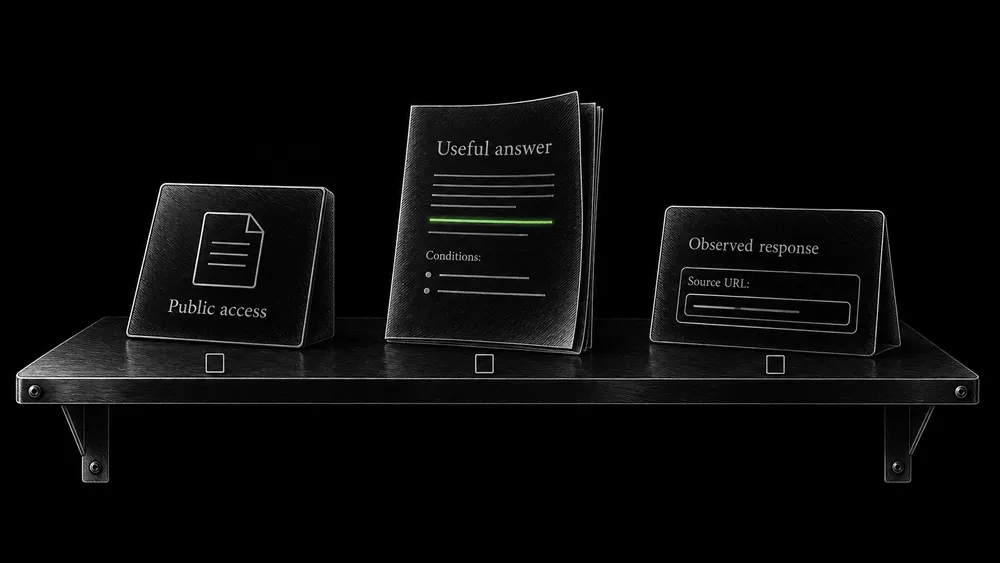
A page can be well written but unavailable to a crawler. It can be accessible but vague. It can be accessible and useful without being selected for a particular answer.
| Question | Evidence you can gather | What it does not establish |
|---|---|---|
| Can the relevant system access the intended page? | Responses, directives, rendered content, crawler records, and platform inspection where available | That it will select the page |
| Does the page answer the intended question accurately? | Editorial review, business facts, sources, examples, and completeness checks | That every AI system will interpret it correctly |
| Has the page appeared or attracted useful visits? | Observed citations, supported platform reports, referral data, and inquiries | That an individual change caused the outcome |
This distinction prevents two expensive mistakes: rewriting sound content to solve a blocking rule, and installing technical extras to compensate for an answer that says very little.
A website does not need to pass every third-party audit with a perfect score before it can be considered useful. Identify a real barrier and its effect. “Poorly optimized” is too broad to tell an owner what to fix.
Begin with a buyer’s question and a page that owns the answer
Define the buyer’s decision and the conditions that change it
Write down what the person is trying to decide, not just the keyword you hope to appear for. Include the situation that changes the answer: the business model, project stage, available resources, or technical constraints.
For example, “Will I control my website if I change developers?” is more precise than “website ownership.” A useful answer must distinguish access to WordPress from control of the domain, hosting, email, recovery, and software dependencies. A page that says only “you own everything” leaves important questions unresolved.
Assign a primary answer page and distinct supporting tasks
Our website ownership guide develops those distinctions and provides an inventory. It illustrates the content method used on this site; it is not presented as evidence of an AI citation or ranking result.
Choose one primary page for the main answer. Use a section for a short related explanation and a separate spoke when the reader needs a substantial additional task. Avoid publishing several near-identical pages for every possible conversational wording. The intent guide explains that decision in depth.
Make the answer clear without stripping out its conditions
Keep the conclusion and essential qualifications together
Give the reader an understandable conclusion early, then explain why it applies and when it changes. Keep essential qualifications beside the claim they limit.
For website ownership, the statement “the client controls project accounts” needs the explanation that third-party software remains subject to its license. Moving that qualification to an unrelated footer makes the main claim easier to misunderstand.
Use headings and formats to develop a complete answer
A useful section normally establishes the subject, answers the question, and supplies the reasoning or action needed to use the answer. It does not need a prescribed word count. Long pages can work when each section performs a distinct job; short answers can work when the question genuinely needs little explanation.
Use headings that identify decisions. Use tables for comparisons on common criteria and lists for real steps or checks. A table filled with generic advantages does not improve the underlying information.
The dedicated content preparation guide shows how to review a passage, retain its context, and connect it to deeper explanations without rewriting everything into isolated FAQ fragments.
Supply evidence that matches the claim
Match business, technical, and performance claims to evidence
Different statements need different support. A service scope comes from the business. A technical requirement should point to the relevant documentation. A performance claim needs actual measurements and their conditions. A recommendation should explain the reasoning and tradeoffs behind it.
If you have no measured result, do not invent a case study to look authoritative. You can still explain a process, provide a checklist, or identify what evidence someone should collect. Those are useful contributions when their status is clear.
Keep current capabilities and business identities consistent
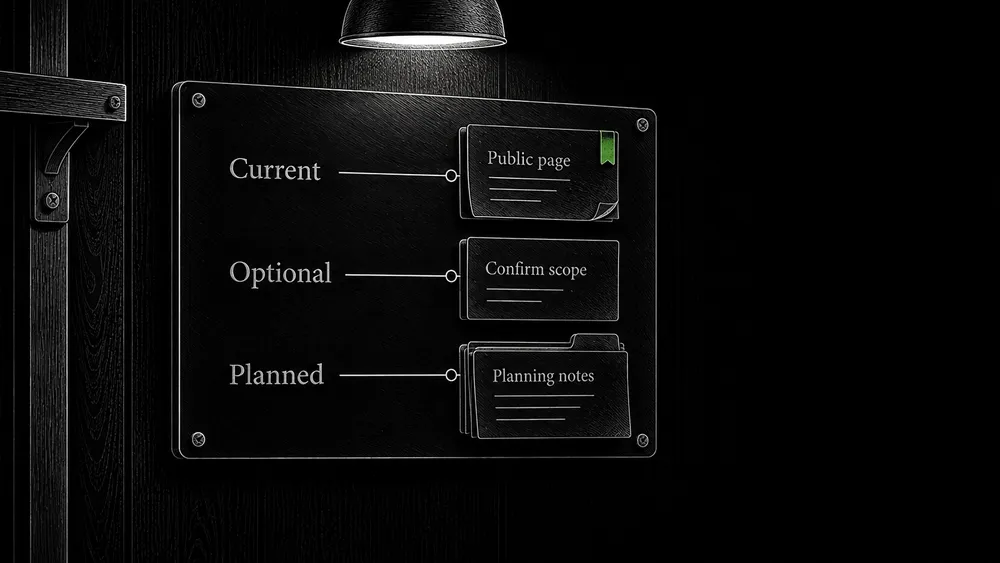
Maintain a factual distinction between current capability, optional work, and a future idea. That matters particularly for product pages: a feature planned for later should not appear elsewhere as an existing capability.
Consistent names also help readers understand relationships. A person’s name, business brand, and separately named product should not be used interchangeably. Explain who created or provides what using real facts, then reflect those facts in appropriate metadata.
Connect the hub and spokes around the actual service
A strong hub gives a complete overview of a decision. Spokes extend the parts that require independent explanation. The relationship should help someone navigate, not force them to open six pages to obtain a basic answer.
On this site, the development hub describes a complete website project. The ownership guide expands control and handover; the launch checklist expands release checks. These are different tasks within the same service boundary.
This structure gives both readers and source-finding systems meaningful pages to encounter. It is a sensible information architecture, not a demonstrated formula for causing an AI to cite the whole cluster.
If a new question falls outside what the business actually does, do not create a service promise merely to capture it. Broader topical coverage should remain honest about your role and capabilities. Use the content blueprint to maintain that boundary.
Check access on the finished website
Inspect the content delivered by the public website
Prepared text is not the same as a verified production page. Once content is placed in WordPress, inspect the actual output: important text, links, canonical destination, page directives, and any access challenges introduced by infrastructure.
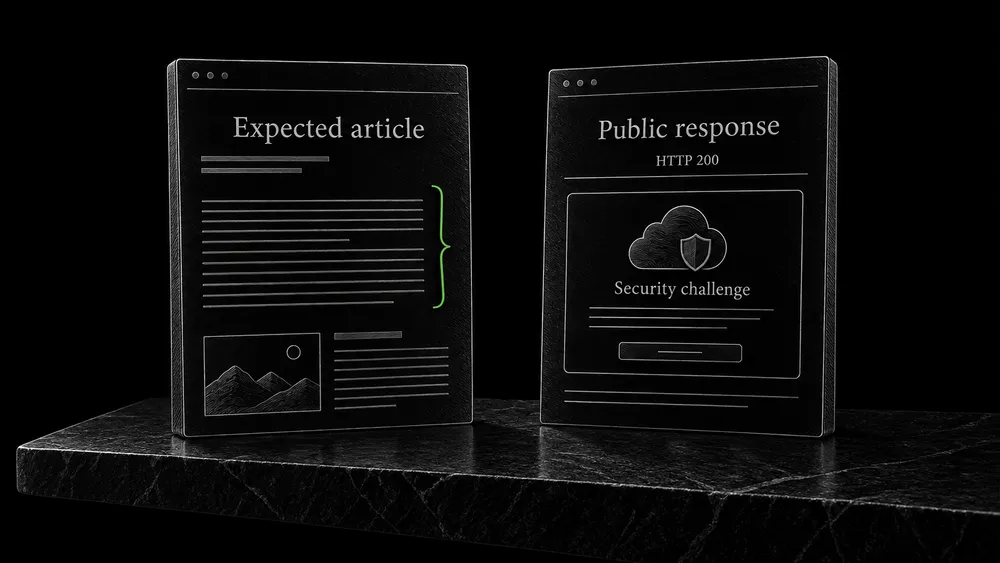
Look at the page without a logged-in editor session. A page builder preview may display information that an ordinary request does not receive. A successful response can still contain a challenge rather than the intended article.
Separate search access from other uses and private content
Search crawling and model training also require separate decisions. Allowing search discovery should not be treated as an instruction to open every private page or permit every use of the content.
The AI crawler access guide explains the distinctions and a WordPress/Cloudflare checking workflow. It connects to the existing technical SEO hub rather than replacing the underlying crawl and indexing work.
For Google-specific eligibility and troubleshooting, use AI Overviews and AI Mode. A rule for one service should not be assumed to control every other service.
Keep structured data faithful to the page
Structured data describes information in a machine-readable form. It should clarify the actual author, organization, page, or product where the relevant type fits. It should not introduce credentials, reviews, features, or locations missing from the real business.
Check what WordPress already generates before adding another plugin or custom block. Conflicting descriptions from several generators can create a different problem from having a modest, accurate implementation.
Our structured data guide explains how to choose and validate a representation. It also separates valid markup from a promise that a particular AI service will use it.
Publish with a baseline and an observation plan
Establish publication and verification records
Record what was released and what has actually been checked. Separate an editorial review from a live access test. Record the publication date honestly, and preserve notes about later substantive revisions.
After launch, collect the evidence each platform makes available. A citation, a brand mention, a visit, and an inquiry are different events. Someone can use an answer without visiting your site; a visit can arrive without turning into a relevant project request.
Observe buyer questions without selecting only favorable results
Choose a small, stable set of buyer questions for manual observation. Record the service, date, wording, region where known, and whether search was used. Do not repeatedly rephrase a question until the site appears and then report that result as typical visibility.
The AI visibility measurement guide explains how to combine observations and analytics without claiming access to a universal citation database.
Decide what to implement first
Start with problems that prevent the intended answer from being available or understood. Do not let a long list of optional refinements obscure a missing business explanation or a blocked public page.
| Situation | Useful first action |
|---|---|
| A new site has sound drafts but is not published | Build the pages and verify release conditions before evaluating visibility |
| A live page is blocked or replaced by a challenge | Identify the controlling layer and fix the unintended restriction |
| A page is accessible but mostly promotional | Add the concrete answer, conditions, evidence, and next steps |
| Several pages disagree about the same service | Establish the correct facts and update the conflicting versions |
| Content is useful but observation is inconsistent | Create a baseline and repeatable measurement method |
| Someone proposes a special AI package | Ask which observable issue each task addresses and how completion is verified |
You can use this process on an existing site or include it in the creation of a new one. Theo’s main development work brings content planning, WordPress implementation, infrastructure, and launch together. The benefit is that these responsibilities can be addressed as connected parts of the project.
Frequently asked questions
Can a website appear in AI search without paying for SEO?
Paying for a service is not an eligibility condition. A business can prepare useful pages and configure them appropriately itself. The relevant question is whether the work has been done, not whether it came with a particular agency label.
Are GEO and AEO completely separate from SEO?
The terms are used for work around generative answers and answer visibility, but much of the practical foundation overlaps with search optimization and good publishing. Ask for the actual tasks and platform requirements rather than assuming a new acronym means a separate technical system.
Do our existing pages need to be rewritten for AI?
Not automatically. Keep clear, accurate, well-structured explanations. Improve specific gaps and verify the published implementation. Reformatting a sound guide without a reason can consume time without improving its usefulness.
Does a detailed FAQ guarantee inclusion?
No. Use FAQ for genuine remaining questions. If a topic is central to the page’s purpose, develop it in the main explanation rather than hiding the essential answer among disconnected short responses.
Can I make an AI recommend my business?
You can publish accurate information, useful explanations, and supporting evidence. You cannot control which businesses a system recommends in a particular response. A statement on your own site claiming you should always be recommended is not independent evidence of suitability.
Is a citation the same as a customer lead?
No. A citation records a source relationship in an observed answer. A lead requires someone to take a relevant contact action. Measure both where possible and keep their meaning separate.
Can I use this website as an example of the method?
Yes. Its guides demonstrate decisions such as separating project ownership from software licensing and connecting a launch overview to a detailed checklist. Those are inspectable content examples. They should not be confused with a claim about measured AI-search performance.
Put the method into your website
Describe your business, your current website or planned project, and the questions customers need answered. We can discuss content and implementation work against specific needs rather than promise an unspecified AI score.