

 WordPress & YOOtheme Pro
 WooCommerce Development
 Website Planning
 Website Ownership & Access
 Website Support & Growth
 Website Launch Checklist
Search Intent for SEO: Work Out What the Reader Needs to Achieve
A search phrase is a clue, not a complete brief. The person using it may want to understand a problem, compare approaches, carry out a task, or choose someone to help. Those needs require different answers even when the wording overlaps.
Search intent is the task behind the search. Understanding it helps you decide what a page should explain, which details deserve attention, and what the reader can reasonably do next.
This guide focuses on those decisions. The broader process is covered in SEO content and copywriting; the resulting page map belongs in the content blueprint.
Start with the reader’s situation
Identify the uncertainty behind the search
Instead of assigning a label immediately, describe the situation that could produce the search. What does the person already know? What uncertainty prevents them from progressing? What would make the result useful?
A person searching for website ownership information may be preparing a contract, reviewing an existing arrangement, or planning to change developers. A useful page needs to establish the shared ownership principles and account for the conditions that change the next action.
Keep alternative interpretations visible
Do not invent a highly specific customer story from a few words. Keep alternative interpretations visible until evidence supports a narrower reading. The purpose is to improve the answer, not to pretend that a keyword reveals a person’s entire motivation.
Google describes meaning, relevance, location, and settings among the factors used to interpret and answer searches in How Search works. Your editorial task is to examine the likely need and provide an appropriate response.
Use intent labels as a starting point
Common classifications such as informational, commercial, transactional, and navigational can organize research. They are usually too broad to determine the outline alone.
“Informational” might mean learning a definition, diagnosing a problem, or completing a complicated procedure. “Commercial” might mean comparing providers or understanding the scope of a purchase. Write the actual task underneath the label.
| Reader task | What the page needs to provide | A suitable next step |
|---|---|---|
| Understand a concept | A clear explanation, boundaries, and relevant examples | Explore an implication or related decision |
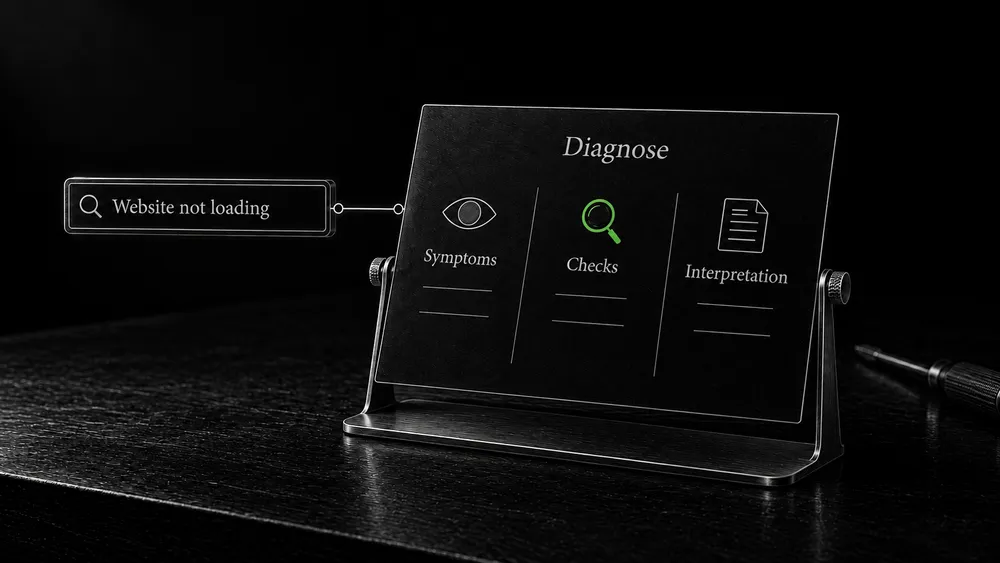
| Diagnose a problem | Observable symptoms, tests, and interpretation | Apply a correction or request a focused review |
| Choose an approach | Criteria, tradeoffs, constraints, and suitable conditions | Select a method or discuss the project |
| Prepare for work | Required information, responsibilities, and alternatives | Complete preparation or submit a brief |
| Implement a method | Prerequisites, steps, exceptions, and verification | Check the result and handle the next dependency |
| Find a named service | Accurate identity, function, fit, and access route | Visit the service or ask about implementation |
These are editorial distinctions. They help you avoid delivering a sales introduction to someone who needs a procedure, or a long definition to someone who already understands the subject and needs a decision.
Inspect search results as evidence of possible expectations
Record search context and inspect the actual answers
Review a group of related searches rather than one phrase once. For a US audience, record the language, geographic context, device, and date of observation. Search results are a snapshot, not a permanent specification.
Look beyond titles. Open relevant pages and examine the answer they actually provide. Record the dominant formats, the stage of understanding assumed, the questions answered early, and the information required to reach a conclusion.
Separate observed results from your interpretation
A useful research note separates observation from interpretation:
Search or related question:
Date and market context:
Observed page types and sources:
What those pages help the reader do:
Questions still unresolved after reading:
Our interpretation of the main task:
Other plausible interpretations:
Proposed page role and boundary:
This is a worksheet for future research, not a report that these searches have already been analyzed. In a real project, attach the observed URLs and notes so another person can review the interpretation.
Do not copy the ranking pages’ headings into your own outline by default. A repeated section may be useful, irrelevant to your offer, or repeated because the competitors copied one another. Test it against the reader’s task.
Find the missing decision behind a familiar topic
Find the decision that a generic answer leaves unresolved
A page can discuss the right subject while failing to resolve the actual uncertainty. This often happens when the draft explains benefits without showing how to choose, prepare, or verify.
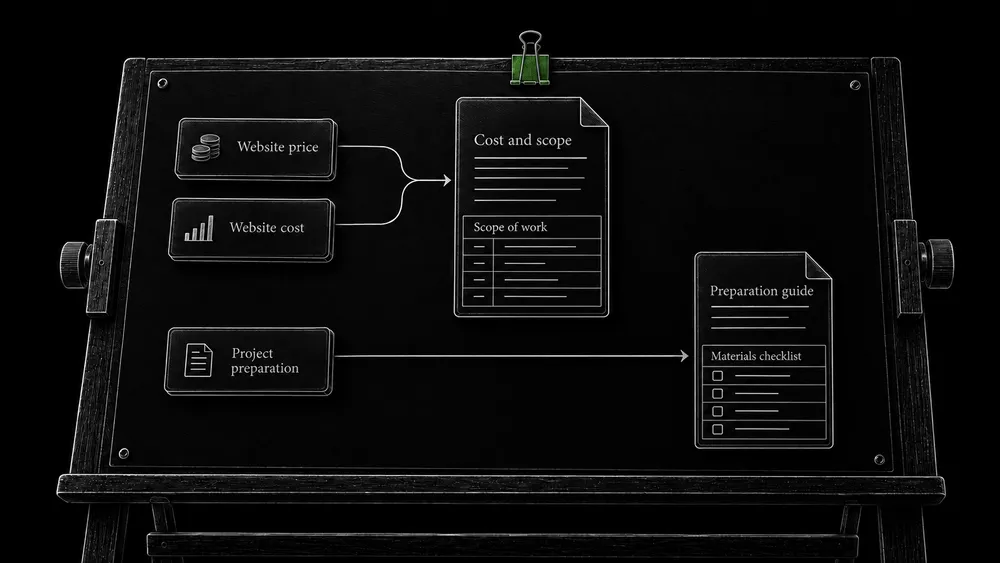
Consider an illustrative question about website content cost. A generic answer that “prices depend on complexity” names a variable without helping the reader. A useful answer would explain what complexity means: research depth, existing materials, required page roles, specialist review, and the difference between a complete first release and ongoing expansion.
Explain scope without inventing unsupported figures
The price itself must come from a real offer or a clearly supported comparison. If it is not available, the page can still explain the scope decisions and what information is needed for a quote. Inventing a market average would not improve the answer.
Look for phrases that appear to answer but stop short: “optimize,” “make it high quality,” “ensure consistency,” or “choose the best option.” Ask what the reader would inspect or decide after reading that instruction. If no action follows, the explanation needs another level of detail.
Handle mixed intent without making the page incoherent
Keep the primary task clear when intent is mixed
Some searches support more than one closely related need. A person can want to understand a process and evaluate whether to hire someone for it. You can serve both when the structure preserves the primary task.
Lead with the useful answer. Explain the method and its conditions. Then describe the implementation help available and what the inquiry needs to contain. This makes the service relevant to the content rather than replacing it.
Separate secondary needs that require their own answer
If the secondary need would require a substantially different answer, give it a dedicated page. A guide explaining the principle of account ownership can link to a handover procedure instead of becoming a complete migration manual.
Avoid forcing unrelated readers through the same introduction. Someone diagnosing a failed page needs a quick route to the diagnostic sequence. Someone considering a new site needs the overall method and scope. Those tasks can connect within a cluster without being compressed into one indistinct article.
Group searches by the answer they need
Test whether related searches need the same explanation
Compare the expected answers, not just shared words. Several phrases may lead to the same practical explanation, while similar phrases may concern different tasks.
Use three tests before grouping:
- Would the reader need the same essential information?
- Would the explanation lead through substantially the same decisions?
- Would the same conclusion or next step satisfy the need?
If all three align, one strong page may serve the group. If the decisions differ, a separate page may be justified even when the vocabulary overlaps.
Document distinct roles for neighboring pages
Keep an overlap note for neighboring pages. For example, both content planning and content briefs involve structure. Planning decides which pages should exist; a brief gives a specific page enough direction to be written and reviewed. The shared term does not make the tasks interchangeable.
Google’s spam policies describe doorway abuse, including substantially similar pages created to funnel visitors elsewhere. A browseable structure with independent answers is a better editorial objective than multiplying slight query or location variations.
Match depth to the consequences of the decision
Choose the depth required to complete the task
A definition can be short when it resolves a simple question. A procedure needs enough detail for the reader to apply it correctly. A comparison needs the criteria that would change the recommendation.
List the important failure conditions. What could someone misunderstand? What prerequisite is easy to miss? What result would indicate the approach is unsuitable? Answer those questions in proportion to their relevance.
Develop difficult decisions without expanding the scope
Depth can come from explaining one difficult decision carefully. It does not require adding every adjacent subject. Link to a supporting guide when a separate task needs its own procedure; keep the current page focused on its outcome.
The SEO copywriting guide explains how to turn this reasoning into direct answers, actionable instructions, and useful supporting material.
Choose a call to action that fits readiness
A reader learning a concept may not be ready to commission a complete project. Offer a relevant deeper guide or a way to ask about their situation. Someone comparing delivery scope may be ready for a project brief.
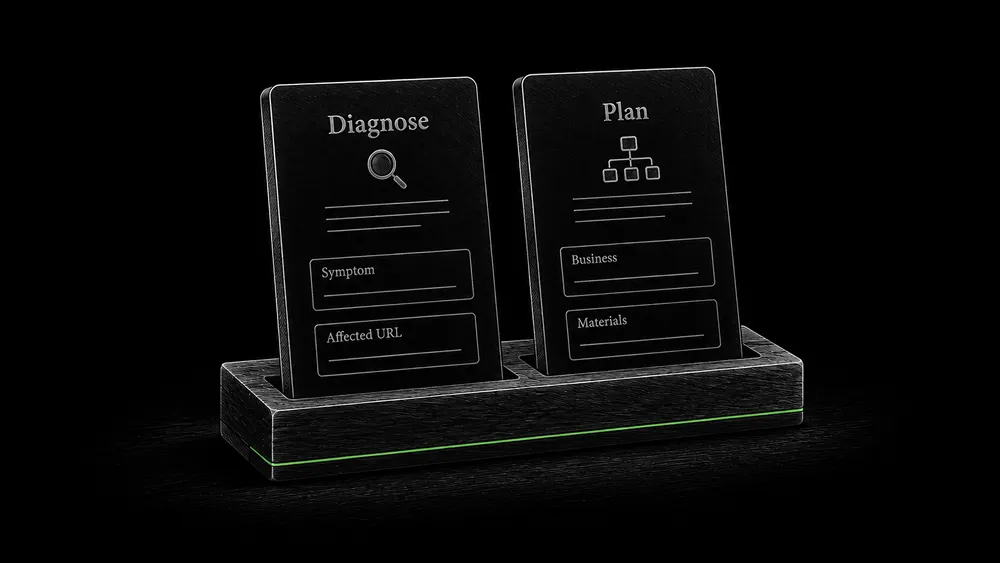
A diagnostic page can ask for the symptom, affected URL, and recent changes. A planning page can ask about the business, audience, and current materials. Those forms recognize different needs without requiring the reader to understand your internal workflow.
Do not interpret every visit without an inquiry as failure. Some pages are designed to help preparation or independent work. Assess whether the page performs its assigned role before imposing the same conversion expectation on the entire cluster.
Revisit the interpretation after publication
Review intent using queries and customer questions
Search data and real conversations can show that the initial interpretation was incomplete. Review which queries lead to the page, what visitors ask afterward, and whether inquiries match the work offered.
The Search Console Performance report contains useful evidence, but its query list is incomplete because some queries are omitted for privacy. Most page performance is assigned to canonical URLs. Google documents these data groupings. Use the report as evidence with limits rather than a complete transcript of customer intent.
Investigate unexpected audiences before rewriting
If a page attracts an unexpected audience, inspect the content before changing the title. Perhaps the explanation drifts into a different topic, or a section deserves clearer boundaries. A small set of unusual queries may also be insufficient evidence for a rewrite.
Use the content audit guide to compare observations over time and decide whether to clarify, expand, split, or preserve the page.
Frequently asked questions
Does every page need one keyword?
It needs a coherent task and subject. Several related expressions can lead to the same answer. Assigning one phrase to a page can be a convenient planning label, but it should not prevent natural coverage of the reader’s actual questions.
Can an informational guide generate inquiries?
Yes, when it demonstrates a useful approach and makes implementation help relevant and easy to understand. The answer should remain available to readers who choose to act independently.
Should I copy the format that appears most often in search?
Treat it as evidence about expectations, then assess the actual task. A comparison table may be necessary; a repeated generic introduction may not be. Preserve what helps the reader and add the substance your business can support.
What if a query could mean several things?
Record the alternatives, examine related searches and result pages, and choose an explicit scope. If the meanings are substantially different, do not combine them only because they share words. Make the page’s intended answer clear early.
Is cannibalization simply two pages mentioning the same topic?
No. Related pages naturally share concepts. Investigate whether they offer substantially the same answer and compete for the same role. Distinct tasks can coexist when their boundaries and connections are clear.
Can we analyze intent without a paid tool?
You can learn from search results, public documentation, customer questions, and your own site’s data. Record what the evidence supports. Paid research can add useful information, but it does not replace the interpretation needed to design a page.
Clarify what your pages should answer
If your content overlaps, attracts unsuitable inquiries, or feels unfocused, share the pages and the work your business wants to receive. I can help interpret the tasks and translate them into a clearer content structure.