

 WordPress & YOOtheme Pro
 WooCommerce Development
 Website Planning
 Website Ownership & Access
 Website Support & Growth
 Website Launch Checklist
SEO Content and Copywriting: Build a Website That Helps People Decide
A potential customer rarely begins with a complete understanding of your work. They may recognize a problem without knowing what caused it, compare approaches without understanding their limitations, or ask about price before knowing what the project includes.
Your website can help them work through those decisions. Useful content explains the problem, shows a practical approach, identifies the choices that matter, and makes clear where your business can help. Search brings people into those explanations at different stages, so the pages need to make sense individually and work together.
That is the purpose of SEO content and copywriting in my website projects: building a connected body of useful information around what the business actually does. The result should help someone take the next step even if they decide to do the work themselves.
Begin with the business you can actually deliver
Define services, customers, and delivery limits
The boundaries of the business define the boundaries of the content system. A company does not need to publish about every subject adjacent to its industry. It needs to explain the problems it can address, the decisions involved, and the conditions under which its approach makes sense.
Write down the services or products you offer, the customers you can serve, and the work you do not undertake. Include practical constraints: required materials, geographic limits, technical dependencies, and tasks handled by partners. These details help prevent a content plan from attracting inquiries for work the company cannot deliver.
Connect content topics to customer decisions
Then examine the questions surrounding the offer. What does someone need to understand before deciding whether it is suitable? What can they assess themselves? What information changes the recommendation? What must be prepared before the work starts?
A topic belongs in the plan when you can explain both its usefulness to the reader and its relationship to the business. That relationship can be indirect. A preparation guide may attract fewer immediate inquiries than a main service explanation while making future projects easier to scope.
Research how customers describe their needs
Research the language customers use
Owners know their services, but they do not always use the same language as customers. Search research helps uncover the terms, questions, comparisons, and concerns people use when looking for an answer.
In client projects, I begin with a conversation about the business, then use Ahrefs to research and export relevant search information. I use that evidence to design the proposed website structure. You do not need your own subscription or the ability to interpret an export; the decisions derived from the research are part of the work.
Filter search demand through business relevance
Research still requires judgment. A popular query may concern an audience the business cannot help. A small but specific question may reveal a serious purchase obstacle. A phrase can have more than one meaning. Neither a number nor a keyword list determines the page automatically.
Keep three things separate: what people appear to be asking, what your company can truthfully answer, and what evidence is available to support that answer. Where they overlap, you have a useful foundation for a page.
The search intent guide explains how to translate those observations into a clear reader task. Research describes demand; the content plan decides how the website will respond.
Give each page a job within the larger explanation
Assign a distinct role to each page
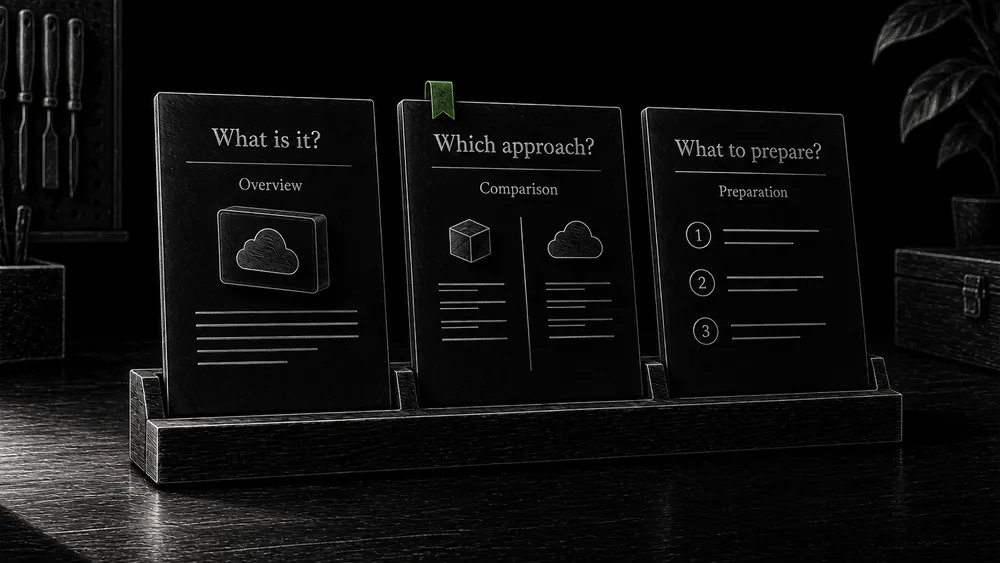
A strong content system has a hierarchy, but hierarchy alone is not enough. Each page needs a distinct purpose, and the links between pages need to reflect a useful progression.
| Page role | What the reader should receive | What belongs in deeper content |
|---|---|---|
| Main topic hub | A complete explanation of the topic’s central decisions and overall approach | Detailed procedures and narrower situations |
| Practical guide | A method the reader can follow, including prerequisites and verification | Separate tasks with their own substantial answer |
| Comparison or decision page | Criteria for choosing between suitable approaches | Full implementation instructions for each option |
| Preparation page | What to gather, decide, or clarify before work begins | The complete delivery process |
| Product or service-specific page | Accurate scope, suitability, limitations, and next steps | Related specialist guidance |
Build a hub that answers the central questions
These roles are planning tools, not a requirement to produce every format for every topic. A small service may need one substantial page and a few genuinely useful guides. A complex offer may support a much larger cluster.
The hub should remain useful without requiring the visitor to open every spoke. Explain the main decisions on the hub, then link to a spoke when someone needs a fuller procedure, a detailed comparison, or help with a specific condition.
Use the content blueprint guide to build this map, assign page boundaries, and decide which pages belong in the initial release.
Cover the decision, not every possible keyword variation
Group query variations that need the same answer
A page can address several closely related search expressions when they describe the same task. Splitting every wording variation into another URL often leaves you with several pages competing to deliver essentially the same answer.
Google’s language systems can relate pages to queries without an exact phrase match for every variation. Its SEO Starter Guide encourages anticipating readers’ terms without trying to include every possible formulation.
Separate pages when the reader’s task changes
A useful editorial test is whether the proposed new page changes the answer. Does it introduce a different decision, procedure, audience requirement, or substantial set of constraints? If the only difference is the phrase in the heading, improve the existing page instead.
Completeness is also a matter of boundaries. A guide can fully address its defined task without becoming an encyclopedia of the entire industry. State what it covers, explain the necessary dependencies, and direct readers to the next task when appropriate.
Collect facts before turning ideas into claims
Gather the raw material for accurate website copy
The business owner does not need to arrive with polished copy. A conversation, notes, documentation, screenshots, photographs, videos, and examples of deliverables can provide the raw material.
I ask clients to describe their services and capabilities and share the materials they have. The first task is to understand what is true: how the work happens, what varies, what customers need to provide, and what is actually included. The writing can then turn that information into a clear explanation.
Distinguish illustrations from evidence of completed work
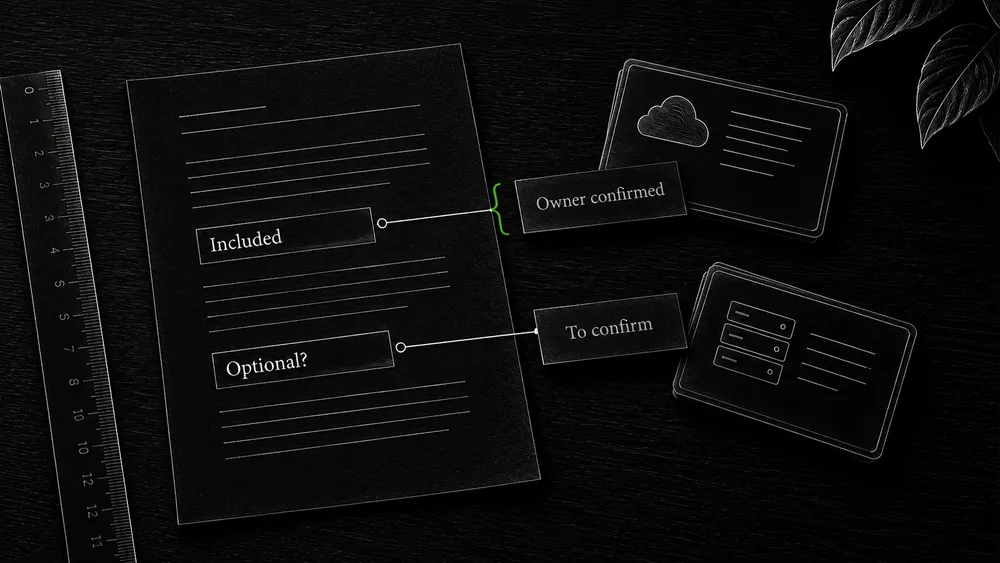
A company with little documentation can still begin. We can identify the process through discussion, research established principles, and use diagrams or clearly labeled illustrations where they help. Missing evidence does change what the page can claim. An illustration cannot prove a completed project, and a suggested benefit is not a measured client result.
Track claims and their responsible sources
Maintain a short record of claims and their sources. Operational claims belong with the owner or responsible specialist. Product specifications belong with current documentation. A case-study outcome requires the underlying project evidence. Unknown information should become a question or a narrower statement, not a convincing invention.
The briefs and editorial workflow guide explains how to keep this fact gathering manageable and how to review material without making the client rewrite the website.
Write an explanation that lets the reader act
Explain actions, conditions, and verification
A useful page does more than name best practices. It explains how to apply them and how to recognize whether they worked.
If you advise someone to prepare materials, say which materials, what makes them usable, and what to do if they are missing. If you recommend a check, explain what to inspect and what different observations mean. If the right choice depends on circumstances, identify those circumstances.
Demonstrate expertise through practical decisions
This depth shows expertise through decisions rather than adjectives. “We take an individual approach” provides little evidence. Explaining which project conditions change the recommendation gives the reader something they can evaluate.
Keep the language accessible at the point where someone needs it. Define unfamiliar terms before relying on them. Use the customer’s problem to introduce the technical detail, then connect that detail to a practical consequence.
The SEO copywriting guide develops this into a page-writing method: direct answers, evidence, examples, objections, useful formatting, and a relevant invitation to get help.
Use AI to develop the work without inventing the business
Use AI to develop and review the draft
AI can help organize research, explore unanswered questions, propose a structure, and improve a draft. It can also produce plausible details that nobody has verified. The workflow needs to distinguish a writing suggestion from a fact about the company.
My work uses AI as part of planning and production. The public page still needs a human decision about its purpose, the accuracy of its statements, and whether the explanation is useful. A draft is material to assess, not evidence that the task is finished.
Review value and keep proposed capabilities separate
Google’s guidance on generative AI content emphasizes accuracy, quality, and relevance; producing many pages without added value can violate its scaled-content policies. The practical response is to evaluate each page’s contribution before publishing it.
For example, AI may suggest a capability the business could develop. That can be useful in a planning conversation. Until the owner confirms that capability is available, it does not belong in the website as a current service.
Make the depth readable
Organize depth around the reader’s questions
Long content needs organization that reflects the reader’s questions. Begin with the answer and why the page matters. Use descriptive headings for decisions and tasks. Place supporting detail close to the statement it explains.
Use a table when the reader needs to compare the same criteria across alternatives. Use a list for steps, required materials, or parallel conditions. Keep reasoning and explanation in paragraphs. Reformatting every sentence into a bullet does not make the subject clearer.
Adapt FAQs and page layouts to the task
FAQ should address genuine follow-up questions, awkward conditions, and concerns not already answered adequately in the main flow. It should not become a second copy of the article with question marks added.
In WordPress and YOOtheme Pro, the design can provide a stable reading layout while the contents vary by page. Reusable layout does not require identical introductions, section order, table counts, or calls to action. The editorial structure should follow the task.
Link pages where the next question naturally arises
Internal links make the cluster navigable. They should help the visitor continue with a related decision or a more detailed explanation.
A hub can introduce the whole method and point to specialist guides. A specialist guide can provide the context needed from its hub and link sideways when another task becomes relevant. The destination should deliver what the surrounding sentence promises.
Plan these relationships during drafting, then verify them in the actual published content. A page can appear in a sitemap while being difficult to reach from the website. A generic “related articles” block may not solve that problem if its choices are unrelated to the reader’s task.
The internal linking guide explains how to choose destinations, write anchors, and check the structure as new pages are added.
Connect useful information to an appropriate inquiry
Readers should not have to guess whether you can implement the approach described. Explain the scope of available help, what information is needed to start, and what happens after an inquiry.
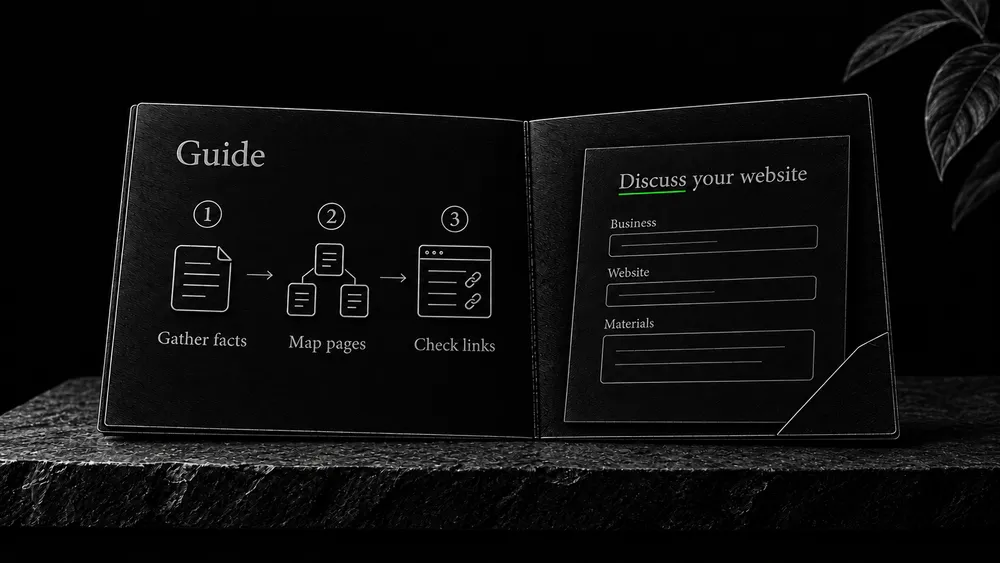
Place the invitation where it makes sense. A preparation guide may lead to a project brief. A diagnostic guide may ask for the symptom and affected pages. A full topic hub may offer a discussion of the complete project or a specific part of it.
The content should remain useful before the form. Do not withhold the central answer merely to collect a lead. People who implement the advice themselves may still learn what your standards mean and understand when a future task warrants professional help.
For my work, content planning and writing can form part of a complete WordPress website project. Continued expansion after launch is a separate support and growth arrangement. The brief should distinguish those needs.
Review performance in the context of the page’s job
Check discovery conditions before judging performance
A new page needs to be published correctly and eligible for discovery before its search performance can be assessed. Use the technical SEO guide for access, indexing, and delivery checks. A writing change cannot correct every technical obstacle.
Assess search relevance and inquiry quality together
Once evidence is available, ask whether the page attracts the intended audience, answers their questions, and supports the next step. Use search data, relevant website events, and the quality of real inquiries together. A raw visit count does not describe business suitability.
| Observation | Question to investigate |
|---|---|
| Visits arrive from unrelated searches | Is the page’s scope attracting a different task or audience? |
| Visitors ask questions the page should answer | Is the answer absent, unclear, or difficult to find? |
| Several pages repeat the same explanation | Should their roles be differentiated or the content consolidated? |
| A guide is accurate but hard to use | Would a better sequence, example, or comparison improve it? |
| A previously useful section becomes outdated | Which facts, steps, and dependent pages need updating? |
Treat these as investigation prompts. A single metric rarely explains why someone did or did not become a customer. The content audit and updates guide provides a method for making evidence-based revisions.
Build an initial release that can grow coherently
Define a complete first release
The initial website should cover the essential questions needed to understand the offer and make a decision. It does not need every future topic before launch.
Define a first release with complete priority pages, meaningful connections, and a functioning inquiry path. Keep a separate backlog for deeper questions, new evidence, useful tools, and future services. That backlog should record why each addition belongs rather than serve as an endless list of keywords to publish.
Expand the content system when a useful gap appears
Growth can come from improving existing explanations as well as adding URLs. A clear comparison may resolve a gap inside a guide. A substantial new procedure may deserve a spoke. A change in the business may require a new cluster, but it should be supported by actual delivery capability.
The durable part of the system is this discipline: each page has a reason to exist, claims have support, and readers can move from understanding to action. Individual tools and interface instructions will need maintenance; the whole structure should not need reinvention whenever a tool changes.
Frequently asked questions
Is SEO content mainly blog writing?
No. Useful search content can include the main service explanations, topic hubs, practical guides, product categories, and preparation pages. Choose the page type from the customer’s task rather than place every subject in a chronological blog.
Do I need to understand keyword research before working with you?
No. Describe your business, its capabilities, and the customers you want to help. I handle the research and explain the proposed structure and content plan for your review.
Can we start if I have no written materials?
Yes. We can begin with a discussion of the service and develop the facts from there. Existing photos, videos, and documents help, but their absence does not require abandoning the project. We will distinguish explanations and illustrations from evidence of completed work.
How long should each page be?
Long enough to resolve its defined task with the necessary detail. Google does not prescribe a preferred word count in its helpful-content guidance. The useful test is whether the reader can understand the decision or carry out the procedure, without repetitive padding.
Can useful content attract traffic without buying links?
Buying links is not a prerequisite for a page to be discovered or perform in search. However, content quality alone does not establish a traffic forecast. Demand, competition, technical accessibility, and the website’s wider signals affect outcomes. Build the useful foundation and measure what happens rather than promise orders on a deadline.
Will I see the structure before the pages are written?
Yes. I share the proposed structure and content plan. This is the point to confirm business boundaries, priorities, factual gaps, and whether the planned pages represent the work you want to receive.
Do you continue adding content after launch?
That can be arranged separately. The first project delivers the agreed initial website; ongoing development can expand its content, improve existing pages, and introduce other useful features within the business’s scope.
Plan content around the work you want your website to support
Tell me what your business does, who it helps, and whether you need a new website or development of an existing one. You do not need a keyword list or a finished brief. We can begin with the business and identify the content decisions from there.