

 WordPress & YOOtheme Pro
 WooCommerce Development
 Website Planning
 Website Ownership & Access
 Website Support & Growth
 Website Launch Checklist
SEO Copywriting: Write a Page That Answers the Question and Earns the Next Step
Good website copy helps someone understand a subject and make a decision. It explains the facts that matter, deals with uncertainty, and makes the available help clear. SEO gives that explanation a discoverable structure; it does not require turning every paragraph into a repetition of the target phrase.
For a business website, the challenge is to combine depth with direction. A reader should be able to learn something useful without ordering, while someone who needs implementation should understand what they can ask you to do.
This guide concentrates on writing one substantial page. Use the content blueprint to decide which pages belong on the site and the search intent guide to define the task. The broader system is explained in SEO content and copywriting.
Give the draft a clear finish line
Define what the reader should be able to do
Before writing the introduction, complete this sentence: “After reading, this person should be able to…”
Choose an observable result: compare approaches using defined criteria, prepare the information needed for a project, or carry out a check and interpret what they find. “Know more about the topic” is too vague to guide a substantial draft.
Match the explanation to prior knowledge and scope
Then identify what the person already understands and what needs explanation. A business owner may understand that they need inquiries but have no reason to know the tools used for keyword research. Explain the outcome and necessary decisions before discussing the production tools.
Keep the page’s boundary nearby. If a section begins to answer a different substantial question, decide whether it belongs in a linked guide. A page can be complete for its task without teaching the entire profession.
Open with the answer the reader came for
Introduce the problem, approach, and useful outcome
Use the first paragraphs to establish the issue, the approach, and the benefit of reading. Avoid beginning with a broad history of the industry or claims that every business needs to “stand out in today’s digital world.”
For a practical guide, state what the method helps the reader do and any essential condition. For a comparison, identify the decision and what makes the answer vary. For a main topic page, explain the overall approach and who it fits.
Test whether the opening contains a clear answer
The introduction should be understandable without your brand name. This is a useful editing test: if removing the brand leaves only vague praise, the opening needs a clearer subject and result.
Do not delay the central answer until the final section to manufacture engagement. Give the reader orientation, then earn their attention through detail.
Turn best-practice labels into usable explanations
Replace vague advice with observable actions
A best practice needs enough context to be applied. Name the action, explain why it matters, show what to inspect or prepare, and describe how the result changes the next decision.
Here is an illustrative writing revision, not a report of a client project:
Weak: Make sure you own your website and receive a complete handover.
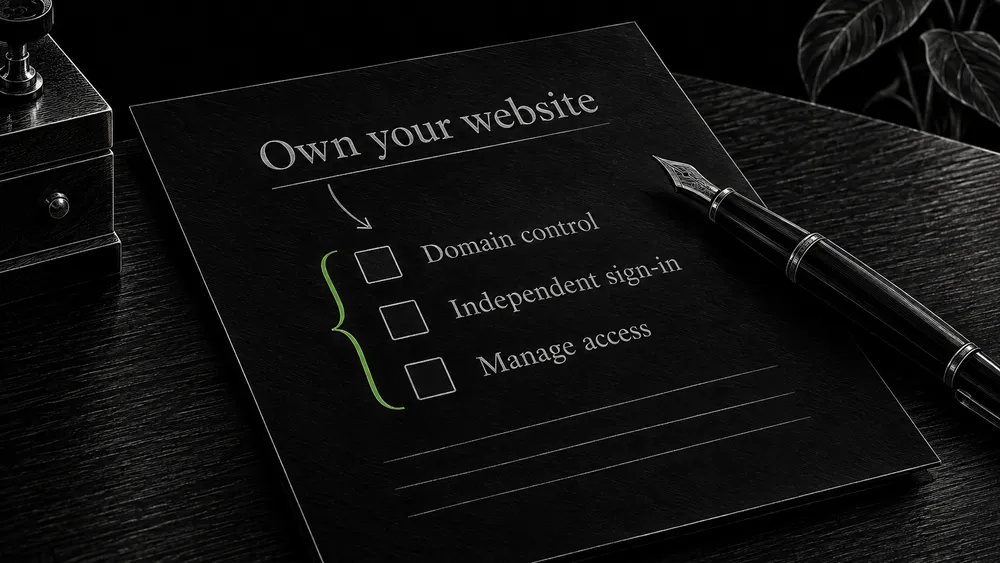
More useful: Check which account controls the domain renewal and whether you can access it independently. Record the hosting, email, and website administration accounts, along with who can change their permissions. Before the project closes, verify that another developer could receive the necessary access without relying on the original provider’s personal account.
Check whether the instruction is usable
The second version makes the principle testable. It does not need an inflated claim about “unmatched transparency.” It shows what control means.
Apply the same revision to phrases such as “high-quality content,” “optimized structure,” and “individual approach.” Ask what the reader can actually observe and what conditions change the recommendation. Keep adding detail until the instruction becomes useful; stop before it turns into an unrelated procedure.
Build depth from decisions and exceptions
Explain prerequisites, choices, and signs of success
A long page becomes substantial when it explains the difficult parts of the task. Identify where a reader could choose incorrectly or become stuck.
For a procedure, include prerequisites, the order of operations, signs of success, and what to do when the expected result does not appear. For a comparison, explain the criteria that favor each option. For a preparation page, say what counts as usable material and what can happen if it is unavailable.
Show which conditions change the recommendation
Exceptions should change the advice. A sentence saying “every business is different” does little by itself. Explain which difference matters and how it affects scope, sequence, or suitability.
If a full answer requires another expertise area, link to the relevant guide and explain why it is needed. Do not bury the reader in a partial server manual inside a content-writing page.
Support claims with the right kind of evidence
Match each claim to the evidence it needs
Different claims require different support. Treat this as an editorial check before the copy becomes public.
| Claim type | Suitable support | What to avoid |
|---|---|---|
| What the business includes | Confirmation from the person responsible for delivery | AI-generated scope presented as an agreed offer |
| A technical behavior | Current primary documentation or a reproducible test | An unsupported assertion copied from a competitor |
| A project outcome | Actual records, context, and permission to publish | Invented percentages or a generic screenshot labeled as a result |
| A recommendation | Clear criteria and the circumstances where it applies | “Best” without explaining suitability |
| An author’s experience | Accurate biography and demonstrable work | Manufactured credentials or testimonials |
Place sources near claims and label illustrations honestly
Where a source supports a specific statement, link near that statement. Distinguish your own recommendation from the documented behavior of a tool or search engine.
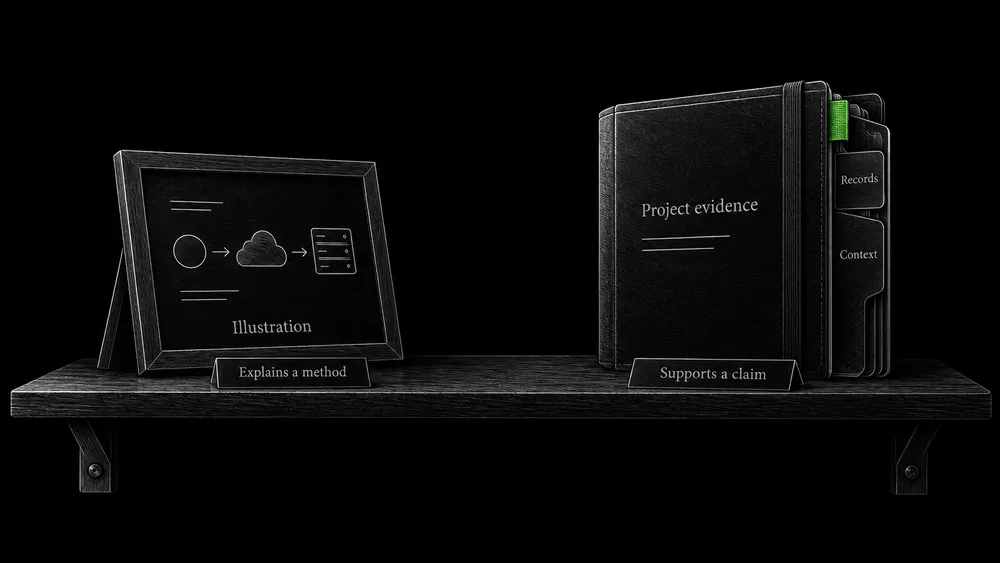
A website without case studies can still demonstrate expertise through precise explanations, original diagrams, and transparent methods. It should not imply that those materials prove results from completed client work.
Authorship should also be accurate. Google’s helpful-content guidance encourages clear information about who created content and relevant background. A byline becomes useful when the biography genuinely helps the reader assess the source.
Use AI as an editorial assistant with a fact boundary
Provide the facts, task, and scope for AI assistance
Give AI the confirmed facts, the page’s task, the intended audience, and the topics that belong elsewhere. Ask it to identify unanswered questions and unclear reasoning as well as propose wording.
Require unsupported details to remain visible as questions during drafting. A confident invented service, price, integration, or case result is more costly than an incomplete sentence in a working document.
Check for invented promises across copy and metadata
Review the output against the source material. Check whether a possibility became a promise, an example became a claimed project, or a future capability became available now. Also check whether several pages acquired the same introduction and conclusion despite having different jobs.
Google’s AI-content guidance applies quality expectations to automatically generated content and metadata too. The fact boundary should therefore cover titles, descriptions, image text, and structured data as well as the article body.
Choose formatting that helps the specific task
Choose paragraphs, lists, and tables by purpose
Use paragraphs to explain cause, consequence, and judgment. Use a list when the reader needs to follow steps or collect parallel items. Use a table when the same criteria need comparison across alternatives.
A table is unhelpful when every cell contains a different topic or a long mini-article. A numbered list is misleading when the items are not sequential. Formatting should express the relationship between the information.
Make headings and mobile layouts support reading
Headings should reveal what the section answers. “How to verify account control” is more informative than “Our excellence.” Avoid giving every section a question heading if a direct task label is clearer.
In a WordPress layout, test the reading experience on mobile. A comparison that is clear on a desktop can become unreadable when column headings disappear. Keep the essential explanation available as text and use visual elements to support it.
Write metadata after the page’s promise is clear
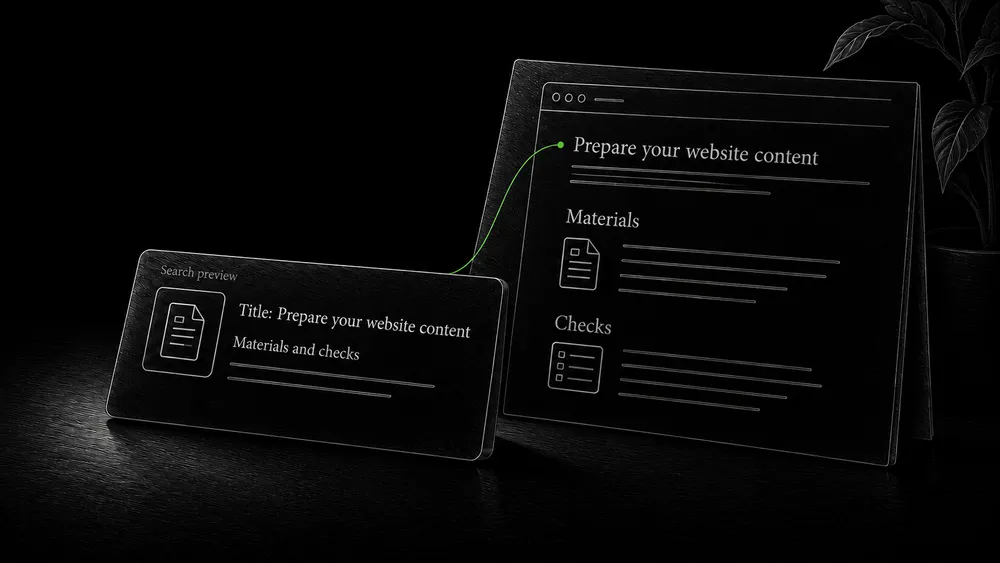
Write a title and description that reflect the page
The SEO title should accurately identify the page’s main subject and useful distinction. Avoid forcing every related phrase into it. Google’s title-link guidance recommends descriptive, concise titles and explains that the displayed search title can come from several page signals.
The meta description should summarize the value of this particular page. It should not promise a checklist, calculator, or comparison that the page does not contain. Google may use it or generate a query-dependent snippet from the content, as described in its snippet guidance.
Check consistency between metadata and the actual answer
Read the title, description, H1, and introduction together. They should make a consistent promise. If the title attracts a different task from the one the article completes, rewriting the metadata alone may not solve the underlying mismatch.
Use character previews as practical editing aids, not fixed laws that justify removing an essential distinction or padding an already clear description.
Handle images as information or illustration
Choose visuals that explain the task
Use photographs, screenshots, diagrams, and video when they explain something the text cannot show as efficiently. A process diagram can clarify responsibility; a real screenshot can help someone locate a relevant setting.
Label illustrative material honestly. AI-generated visuals can help explain a concept, but they should not be presented as photographs of the business’s completed work or as evidence of an actual product state.
Write contextual alt text and retain essential instructions
Describe meaningful images in their context. Google’s image guidance explains the role of surrounding content and descriptive alternative text. Avoid turning alt text into a list of search phrases.
If an image is necessary to understand a procedure, ensure the text also explains the action and interpretation. The reader should not have to guess from an unlabeled screenshot.
Make the invitation to get help specific
After giving the useful explanation, describe what implementation help is available. State the relevant scope and what information is enough to begin a conversation.
Match the form to the task. A content rewrite may need the current URL and the problem the owner sees. A new website needs a description of the business and available materials. Do not ask for an advanced SEO report before letting an ordinary owner inquire.
You can include an early, unobtrusive route to the form for readers already ready to act. The main reading flow should remain intact for someone still learning.
Avoid invented urgency, guaranteed traffic, and unsupported delivery promises. The reason to choose the service should be the clarity of the method and its fit with the reader’s situation.
Review for usefulness before polishing sentences
Review the page as both reader and business owner
Read the draft once as the intended reader. Can you locate the main answer? Are the important decisions explained? Could you carry out the proposed check? Is anything necessary withheld until an inquiry?
Then read it as the business owner. Are the services, responsibilities, constraints, and capabilities accurate? Is any promise stronger than the actual offer?
Check neighboring pages before proofreading
Finally, compare it with neighboring pages. Remove repeated sections that add no new value, preserve the context needed for independent reading, and add links where another guide genuinely helps. Use the briefing workflow to record unresolved facts and approvals.
Proofreading comes after those decisions. A fluent page with an unclear task remains an unclear page.
Frequently asked questions
Can a useful guide also sell a service?
Yes. Explain the method fully, then show what you can implement and how to discuss the reader’s situation. The service invitation should follow naturally from the task rather than replace the answer.
Should every page use the same layout?
A consistent visual system is useful. The editorial structure should vary with the task: a diagnostic guide, comparison, and planning page do not need identical sections. Reusable design and distinctive content can coexist.
What if I have no testimonials or case studies?
Use accurate explanations and evidence you do have. Show decisions, methods, and real materials where available. Do not manufacture proof or turn an illustrative example into a claimed client result.
Should FAQ repeat the main article in shorter form?
Use it for follow-up concerns, exceptions, and clarifications that remain after the main explanation. If an answer is central to the page’s task, it usually belongs in the main content rather than only in FAQ.
How many times should a keyword appear?
Use the terminology needed to explain the subject clearly. A numerical repetition target can produce awkward copy and does not establish relevance. Review whether the page answers the task and distinguishes its concepts naturally.
Can you work from an existing weak draft?
Yes. I can assess what is usable, identify factual gaps, and rebuild the explanation around the page’s intended task. The work may involve restructuring and research rather than simply making the sentences sound smoother.
Develop a page with something useful to say
Send the subject or existing URL, describe your offer, and share any materials you have. I can develop the content within a new WordPress project or an agreed program of website improvement.