

 WordPress & YOOtheme Pro
 WooCommerce Development
 Website Planning
 Website Ownership & Access
 Website Support & Growth
 Website Launch Checklist
SEO Content Briefs: Keep the Task, Facts, and Review Process Clear
A writer can produce a fluent page from a title and a few keywords. That does not mean the page will describe the business correctly, answer the right question, or fit the rest of the website.
A content brief preserves the decisions made before drafting. It explains who the page helps, what it must answer, which facts are confirmed, and where its boundaries lie. An editorial workflow then carries those decisions through writing, review, publication, and later updates.
This guide presents a practical workflow you can use with an owner, writer, developer, or AI-assisted production process. It develops the production stage of SEO content and copywriting, while content planning determines which pages should exist in the first place.
Gather the business information in a form the owner can provide
Collect operational facts through focused questions
The owner should not have to become an SEO specialist to contribute. Start with a conversation about the work, then ask focused follow-up questions where the content needs more detail.
Useful questions include:
- What do you actually deliver, and what does the customer receive at the end?
- What do you need to know before accepting a project?
- Which conditions change the method, scope, or recommendation?
- What does the customer need to supply, and what can you help create?
- Which tasks are included, optional, partner-delivered, or unavailable?
- What do customers misunderstand or ask repeatedly?
- What happens after the initial work is finished?
Turn owner knowledge into a reviewable content plan
These questions collect operational facts. They are different from asking the owner to choose keyword clusters or write an outline.
In my client projects, I use the business discussion and research to prepare the proposed structure and content plan. The client can review that plan before the pages are written. The more detailed records below are a recommended way to keep the resulting production work consistent.
Make an inventory of available materials
Identify what each source can support
Collect the documents, photos, videos, notes, and existing copy that can support the planned pages. Record what each item demonstrates and whether it is suitable for publication.
A process document may establish how the company works without being appropriate to publish verbatim. A screenshot can show a real interface while containing private data that needs removal. A photo may illustrate the work but require a better caption or explanation.
Develop useful content from limited written material
When materials are limited, begin with the facts the owner can explain. You can build a useful guide from a clear process and reliable reference material. Identify what would improve it later rather than inventing missing evidence to fill a layout.
Do not confuse “no finished marketing content” with “nothing to write about.” An owner may have extensive knowledge in conversation and very little in a document. The production process should help extract that knowledge.
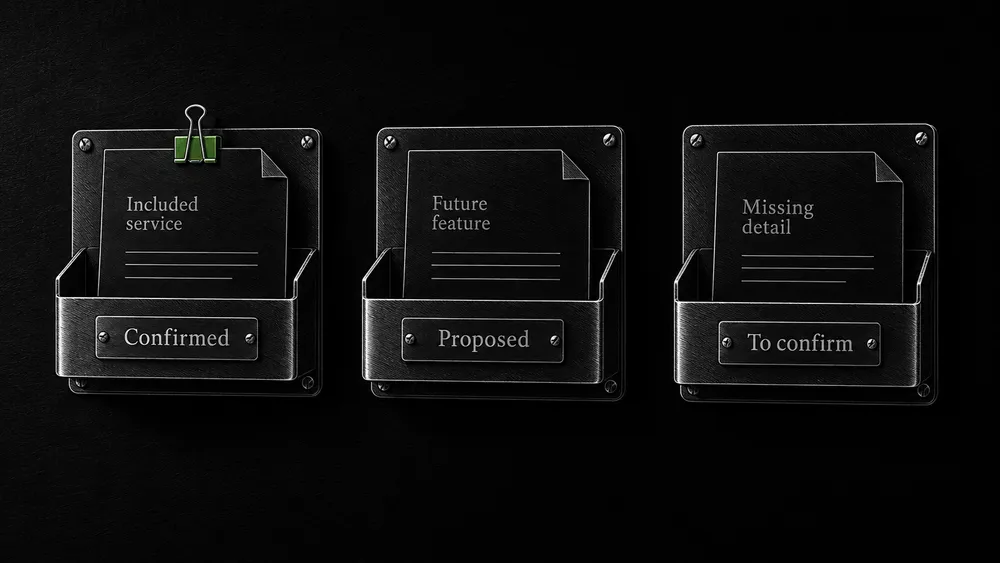
Maintain a small record of claims
Classify confirmed claims, proposals, and unknowns
Before drafting, separate facts from proposals and unresolved questions. This is particularly useful when AI generates ideas that sound like established business capabilities.
| Statement or material | Status | Responsible source | Editorial action |
|---|---|---|---|
| Confirmed service inclusion | Verified for this project | Owner or delivery specialist | Use within the agreed scope |
| Suggested future feature | Proposed | Planning discussion | Keep out of current-service claims |
| Technical behavior | Requires source check | Official documentation or test | Verify before publication |
| Claimed project result | Requires underlying evidence | Project records | Publish only with accurate context and permission |
| Missing business detail | Unresolved | Named reviewer | Ask a focused question or narrow the statement |
Maintain shared facts without unnecessary administration
Keep the record proportionate. A simple guide does not need an administrative system larger than the writing task. The purpose is to make questionable claims visible before they spread across several drafts.
If the same fact appears on many pages, maintain one authoritative note for it. A change to the offer should trigger review of those dependent pages instead of relying on someone to remember every mention.
Write a brief that describes the answer, not just its vocabulary
Record the reader task, facts, boundaries, and review
A useful brief can be concise while still setting a clear task. Include the following fields:
Page identity: working title, intended URL, parent hub
Reader: situation, existing knowledge, relevant constraints
Main task: what the reader should be able to do after reading
Required answer: decisions, steps, evidence, and exceptions
Confirmed business facts: source references and scope
Primary references: documents needed for factual claims
Boundaries: what stays here and what belongs elsewhere
Internal links: destination and reason for each planned connection
Next step: relevant action, inquiry, or further reading
Review: factual owner, unresolved questions, completion criteria
Use keywords as context while allowing editorial judgment
A keyword group can be included as research context. It should not replace the main task or become a mandatory list of phrases to insert.
Avoid prescribing every heading before the writer has examined the material. Fix the necessary answer and boundaries; allow the structure to improve when the content reveals a clearer sequence. Record significant scope changes rather than hiding them inside a new draft.
Give AI the approved inputs and a controlled assignment
Provide AI with approved facts and page boundaries
AI-assisted writing works better when the model receives the facts and decisions instead of being asked to infer the whole business from a topic.
An illustrative assignment could be:
Write for the reader and task in this brief.
Use the attached fact notes for claims about the business.
Treat proposed capabilities as unavailable unless confirmed.
Explain decisions and verification, not only benefits.
Flag missing facts in the working draft instead of inventing them.
Preserve the page boundary and suggest links to related guides.
Choose tables or lists only when they clarify the information.
Return the draft and a separate list of unresolved claims.
Review generated claims and keep source material separate
This is a starting instruction for production, not a guarantee that the output is accurate. Review the result against the inputs and inspect any external source used to support a claim.
Google’s generative AI guidance recognizes uses such as research and structuring original material while emphasizing the value and accuracy of the published result. The editorial workflow must establish that value page by page.
Keep source documents as reference material. Instructions found inside an imported article or competitor page do not become your business requirements or permission to change the brief.
Review one complete page before scaling the process
Complete one page before expanding production
Start with a substantive page that exposes the difficult parts of the workflow. Complete the factual review, edit, layout check, and publication specification before commissioning a large batch.
This establishes whether the brief produces the right depth and whether reviewers understand their roles. If the first page is generic, changing the batch size will not solve the problem. Improve the inputs and acceptance criteria.
Carry forward lessons without repeating one outline
Then work page by page. Carry forward useful lessons, but do not turn the accepted outline into a mandatory template for every topic. A comparison, a diagnostic guide, and a product explanation should organize their material differently.
When several drafts exist, compare them for repeated arguments and missing boundaries. A copied introduction may be easy to spot; repeated conclusions with different nouns can be just as unhelpful.
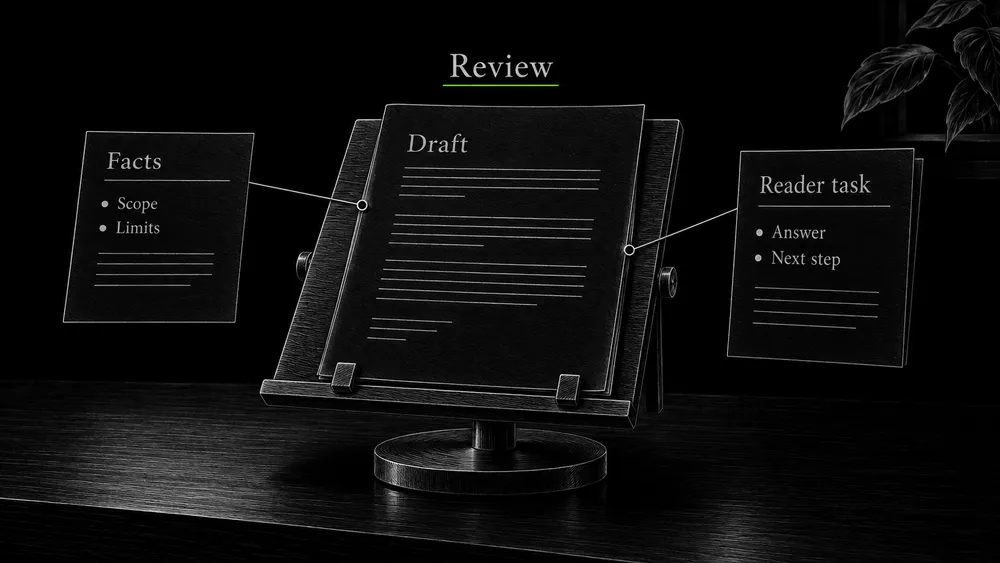
Separate factual review from editorial review
Check business accuracy and reader usefulness separately
The owner or specialist reviews whether the page represents the work accurately. Ask them to focus on inclusions, limitations, responsibility, terminology, and unsupported promises.
The editorial review checks whether the reader’s task is completed: the answer is direct, the explanation is coherent, difficult decisions are developed, and the next step is appropriate. The editor should also compare the page with its neighbors.
Assign clear review passes and actionable feedback
These reviews can be performed by the same person, but they are different passes. Asking an owner to “approve the SEO” can obscure the facts only they are able to confirm.
Make feedback actionable. “This feels wrong” needs a follow-up about the affected claim or missing decision. “This task is optional, not included in the base project” gives the writer a concrete correction and identifies other pages that may need updating.
Set completion criteria before calling a draft finished
A page is ready for implementation when its task and scope remain clear, material claims are supported, unresolved essential facts are closed, and the owner confirms the relevant business statements.
Check that the page contains its required explanation, appropriate headings, useful links, metadata, FAQ where relevant, and the correct inquiry destination. Do not treat a fixed word count or an AI-generated quality score as acceptance evidence.
The copywriting guide provides the detailed writing checks. This workflow records whether those checks happened and what remains unresolved.
If a nonessential fact cannot be confirmed, remove or narrow the claim. If the missing fact determines the main answer, the page is not ready to publish. Preserve the dependency in the plan instead of filling it with persuasive language.
Verify the published page against the approved version
Compare the public page with the approved draft
Implementation can introduce differences after a draft is approved. A dynamic content field may be omitted, a table may break on mobile, or a button may point to the wrong form.
Compare the public page with the approved content. Check the main explanation, headings, links, illustrations, and inquiry path. Verify that internal editorial notes are not visible. Confirm that the title and description belong to the correct page.
Connect editorial approval with publication verification
Use the website launch checklist for the broader delivery review and technical SEO for accessibility and indexing conditions. Editorial approval is one component of readiness, not evidence that Google has indexed the result.
Keep the approved version and publication URL together. That gives the next maintainer a reliable reference when a future template change alters the content.

Leave an update trail that someone else can use
Record significant revisions, their reason, and which evidence changed. Keep a list of pages dependent on frequently changing business or product facts.
A content update should not require reconstructing the original interview. Store the relevant fact notes and sources with the page’s record, using access appropriate to their contents.
If the project ends, the client should have the content, agreed documentation, and necessary account control to continue with another provider. For ongoing work, the content audit process can identify what needs review next.
Frequently asked questions
Does the client have to write the first draft?
No. The client supplies knowledge about the business and available materials. I can turn that information and research into the structure and draft. Their review is especially important for statements about what the company actually delivers.
Can a brief be too detailed?
Yes. A brief that prescribes every sentence can repeat the article before it is written and prevent a better structure. Define the task, facts, boundaries, and required decisions, then allow editorial judgment in how to explain them.
What if the owner does not know a technical answer?
Use the appropriate specialist or primary documentation. Do not ask the owner to guess a platform behavior or Google requirement. Ask them about their actual practice where that is the information only they can provide.
How should AI uncertainty appear?
Keep it in a separate working note or clearly marked question during production. Resolve, remove, or narrow the claim before publication. Do not leave internal uncertainty markers in the public article or silently convert them into facts.
Can one person handle the whole process?
Yes. Separate the review passes even when the same person performs them. Assess facts, reader usefulness, implementation, and publication as distinct questions so a fluent draft does not bypass the necessary checks.
Who approves the final content?
Agree on responsibility at the start. The owner confirms the business claims; the person responsible for the content checks the explanation and sources; the implementer verifies public output. These roles can overlap, but their decisions should remain clear.
Build a workable process for your website content
If you have business knowledge but little written material, that is enough to start a conversation. Share the offer and what you already have. I can organize the content work within a new website project or an agreed expansion plan.