

 WordPress & YOOtheme Pro
 WooCommerce Development
 Website Planning
 Website Ownership & Access
 Website Support & Growth
 Website Launch Checklist
Link Building & Content Placement: Make Every Placement Worth Considering
A link is useful when it gives someone a reason to visit your website and takes them to a page that delivers on that reason. Before choosing a publisher or buying an article placement, establish who you want to reach, what they need, and why your website belongs in that conversation.
Link building involves encouraging other websites to reference yours. Content placement is more specific: arranging for an article, resource mention, or business profile to appear on another website. The two overlap, but a paid article, an independently selected reference, and a directory profile are different relationships. They should have different expectations and be evaluated accordingly.
For a business owner, the practical questions are straightforward: Is the website ready? Which opportunities deserve attention? What exactly does the publisher provide? How will you know the placement is still working? This guide answers those questions before you commit to a campaign.
What links can contribute to a business
Evaluate the audience value of a reference
A relevant reference can introduce your business to people who would otherwise never encounter it. A useful article can help a reader understand a problem before they visit your service page. A complete business listing can help someone confirm what you do and find the correct contact details.
Search visibility is another reason businesses consider links. However, buying a placement is not the same as buying a ranking improvement. Google identifies links created primarily to manipulate rankings as link spam, including paid links that pass ranking credit and low-quality directory links. See Google’s spam policies.
That distinction changes the buying decision. If a publisher’s only selling point is that a payment will increase your authority score or move a keyword, there is little concrete business value to evaluate. If it serves a relevant audience, offers a useful editorial environment, and explains what you receive, you can assess the opportunity on observable terms.
Separate delivery, audience response, and search performance
A good plan therefore separates three outcomes:
- Delivery: the approved article or profile exists, contains accurate information, and links to the agreed destination.
- Audience response: people encounter the placement, visit, read, inquire, or return later.
- Search performance: relevant pages gain or lose visibility over time, alongside other changes to the website and its market.
Delivery can be checked directly. Audience response is only partly observable. Search performance requires context and cannot usually be attributed to one placement with confidence.
Decide whether the website is ready first
Check whether the destination fulfills the reader’s need
You do not need a huge website before considering external promotion. You do need a credible destination for the particular visitor you hope to attract.
Open the proposed destination as if you had never heard of the company. Can you understand the service, determine whether it fits your situation, and find a sensible next step? Does the page explain important limitations and answer the questions that could stop someone from contacting you? Is there enough information about the business to make an inquiry feel reasonable?
Test the inquiry route before external promotion
Then test the practical path. Follow the link on a phone, use the form, and confirm that the message actually arrives. A published article cannot compensate for an unavailable page, a broken inquiry form, or an offer that visitors cannot understand.
A simple readiness check is enough to expose many problems:
| Question | If the answer is no |
|---|---|
| Does the destination match the article’s promise? | Choose a more appropriate page or improve the existing one. |
| Can the reader evaluate the service without contacting you for basic facts? | Add the missing explanation before paying for attention. |
| Is the content accurate and supported by real business capabilities? | Confirm claims with the owner and remove unsupported ones. |
| Does the inquiry route work? | Test delivery and fix the failure before promotion. |
| Can you distinguish at least some visits and inquiries by source? | Set up a realistic measurement baseline. |
| Will somebody maintain the destination and placement records? | Assign ownership so problems have a route to resolution. |
For a website that still needs this foundation, start with website development. For an existing page that explains too little, use the SEO content and copywriting guide. External placement should have something worth introducing.
Choose the format by the reader’s situation
Different placements solve different problems. A reader comparing suppliers has a different need from someone learning how to approach a project.
| Format | Useful when | What to verify |
|---|---|---|
| Independently chosen editorial reference | Your page supplies information an author genuinely needs | The context, destination, and editorial relationship |
| Contributed article | You can explain a topic that fits the publication | Submission rules, editorial control, compensation, and attribution |
| Sponsored article | There is a plausible audience worth paying to reach | Audience evidence, disclosure, link treatment, distribution, and duration |
| Industry or business directory profile | Buyers use the directory to discover or verify businesses like yours | Eligibility, category, profile accuracy, ownership, and fees |
| Addition to an existing resource | Your page fills a real gap in that resource | Why the addition improves the page and whether placement is paid |
A contributed article is not automatically independent coverage. Find out whether the publication selects it on editorial merit or guarantees publication in exchange for compensation. For paid placements, Google prefers rel="sponsored"; nofollow is also acceptable. These attributes describe the relationship to search systems. Google explains the link attributes here.
The detailed workflow for contributed and paid articles belongs in Guest Posts & Sponsored Articles. For profiles rather than articles, use Business Listings & Directories.
Pick a destination that continues the conversation
Choose the destination promised by the surrounding content
Sending every link to the homepage makes reporting simple but often makes the visitor work harder. The destination should answer the question created by the surrounding content.
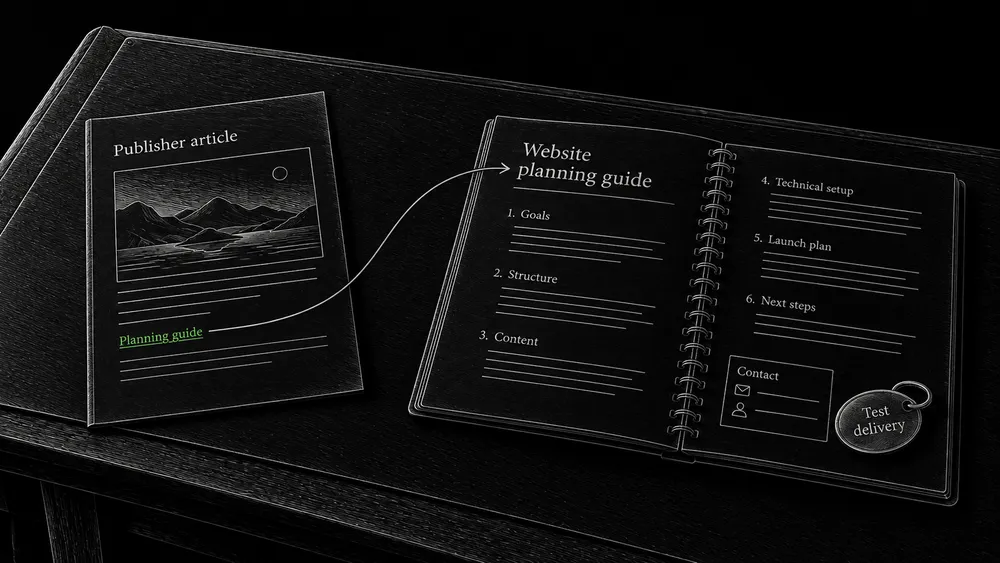
An article about preparing a website project could reference a detailed planning guide. A profile describing the business as a whole may reasonably link to the homepage. An article discussing an implementation decision might lead to a focused explanation with an optional route to request help.
Improve the existing answer and connect it to the website
Do not create a separate thin page solely to receive a link. If the answer already exists, use that page. If the answer is incomplete, improve it. If it deserves its own treatment within the business’s scope, add it to the content blueprint.
The linked page should also connect naturally to the rest of your website. A helpful guide can explain a decision in full and link to the broader service when implementation becomes relevant. This is how external attention can enter a useful content system instead of reaching a dead end. See internal linking for building that path.
Evaluate the publication before discussing volume
Inspect the actual publication and relevant section
A marketplace can help you find candidates and compare stated terms. Its filters cannot make the final decision for you. A domain score, estimated traffic number, or placement price does not explain whether the proposed article will reach appropriate readers.
Start with the actual publication. Read its relevant section and several recent articles. Look for a coherent subject, intelligible authorship, useful explanations, and an audience that has a reason to care about your topic. Then inspect where contributed or sponsored content appears. A strong homepage does not establish the quality of every section.
Confirm market fit and the route to readers
For a US audience, look for readership and subject matter that fit the market you serve. A US domain extension or a server in the United States is not a substitute for that fit. A specialist international publication may be more relevant than a general US site with no connection to the buyer’s problem.
Ask how readers will discover the placement. Will it appear in a relevant category? Is any newsletter or social distribution included? Is that distribution documented or merely implied? A live URL and an audience introduction are separate deliverables.
The full website quality assessment provides a practical inspection method, evidence worksheet, and reasons to accept, investigate, or reject a candidate.

Agree on the purchase in plain language
Record the placement scope and responsible parties
Before payment, make the proposal specific enough that another person could verify delivery. Record the publisher, proposed topic, destination page, article preparation responsibilities, editorial review, fees, link treatment, disclosure, and publication conditions.
If an intermediary handles the placement, clarify who approves changes and who resolves a problem after publication. A promise from a marketplace representative is only useful if you understand what their terms actually cover.
Clarify duration, remedies, and the full cost
Pay particular attention to language such as “permanent,” “guaranteed,” and “premium.” What happens if the article is removed? Is there a stated coverage period? Does a replacement require approval, or can the provider substitute another website? Are future edits included? Is a refund possible, and under which conditions? Do not assume these answers from a sales label.
Separate the costs of research, writing, editing, publication, and ongoing checking. This makes it possible to reduce scope without quietly reducing quality. If the budget is limited, prioritize fewer well-understood opportunities and preserve enough time to check what you bought.
The strategy guide shows how to turn these decisions into a manageable initial scope.
Make the article useful without the link
Give the article a useful purpose beyond promotion
A strong placement has a reason to exist for the publisher’s readers. The article should help them understand a decision, avoid an error, compare options, or complete a task. Your link should extend that usefulness.
If removing the company name and link leaves nothing but broad claims, the contribution is probably too promotional. Replace generalities with a clear problem, a method, important exceptions, and facts you can support. Use the company’s real experience where it is available; do not invent projects, testimonials, or results to make an article look authoritative.
Match the subject and editing to supported business expertise
This does not require giving away something unrelated to your work. The most useful subject often sits close to the service: what to prepare, what to check, what makes one approach appropriate, or how to recognize that implementation has gone wrong.
The publisher may have different formatting and tone requirements from your website. Respect those requirements while preserving factual accuracy. Approve substantive changes, particularly anything that alters the description of your service or implies a guarantee.
Check the live placement and keep a record
Verify the live article, destination, and commercial treatment
Publication is a checkpoint. Open the actual URL, read the article, follow the link, and compare the result with the agreed scope. Check the visible disclosure for a paid article and inspect link attributes rather than relying on how the text looks.
Keep the live URL, date, destination, cost, agreed conditions, contact, and a record of the published version. That gives you a baseline if the article changes later. A screenshot is useful for visible content; it does not by itself prove the link’s underlying attributes.
Review delivery and effectiveness as separate questions
A later review should answer two questions: Is the placement still as agreed, and is continuing this type of work justified? Those questions need different evidence. Missing content is a delivery issue. A lack of recorded inquiries may require reviewing audience fit, distribution, the destination, or measurement before drawing a conclusion.
Use Backlink Monitoring & Reporting to organize those checks and interpret the results without treating every change in a third-party report as a lost link.

How implementation can fit into a wider website project
Theo’s work in this area includes selecting placement websites, preparing or coordinating articles and links, and working with suitable business directories. The scope should follow your business, existing content, and available budget.
You can request help with a specific shortlist, an article placement, or a defined initial set of opportunities. The useful starting information is your website, what you sell, whom you want to reach, and what has already been arranged. You do not need to purchase an SEO tool or arrive with a list of technical metrics.
Placement work can also become one part of ongoing website support and growth. Content development, technical maintenance, and external promotion should remain visible as separate responsibilities so you understand what is being done and why.
Frequently asked questions
Does a new website need backlinks before it can get search traffic?
There is no universal requirement to buy placements before publishing a useful website. Begin with clear, accessible pages that address relevant customer needs. External promotion may help people discover the business, but it should be considered alongside the website’s current condition and the actual opportunities available.
Is a paid article the same as an earned backlink?
No. Payment for publication creates a commercial placement. An earned reference involves a publisher independently deciding that your resource belongs in its content. Describe the relationship accurately and agree on appropriate treatment before publication; calling a purchased article “editorial” does not change the arrangement.
How many links should a small business arrange each month?
Start with the work you can justify and check. A monthly number is an operational scope, not a universal SEO requirement. It should follow the supply of suitable publications, the content you can contribute, your budget, and what you learn from completed work.
Can I choose websites through a placement marketplace myself?
Yes. Treat listings as a discovery tool. Inspect the actual publication, confirm the current offer and terms, and keep your own records. A marketplace badge or score should not replace reading the site and understanding the placement you are purchasing.
Should every link use the keyword I want to rank for?
Choose wording that describes the destination naturally in its sentence. A company name, resource title, or concise description may be appropriate. Forcing the same commercial phrase into unrelated articles makes the content less credible and gives the reader less useful context.
How quickly will a placement generate leads?
There is no reliable general deadline. Distribution, audience fit, the reader’s buying cycle, and your destination all matter. Agree on what will be delivered and observed; do not turn a publication date into a promised date for inquiries or ranking changes.
Can I keep the work if we stop collaborating?
Keep the placement register, article files available for handover, publisher terms, and accounts registered for your business. Publisher-hosted content remains subject to its publication agreement. Continuing checks and publisher communication should be agreed separately rather than assumed after the work ends.
Discuss the right placement work for your website
Tell me what your business offers, who you want to reach, and whether you already have a website or publisher shortlist. We can use that context to define suitable work and the information needed before spending on placements.