

 WordPress & YOOtheme Pro
 WooCommerce Development
 Website Planning
 Website Ownership & Access
 Website Support & Growth
 Website Launch Checklist
How to Evaluate a Website Before Placing an Article or Link
The website in a placement offer is not necessarily the environment your article will receive. A publisher may have a strong main publication and a neglected contributor section. An impressive traffic estimate may come from topics unrelated to your buyers. A clear price may leave the actual publication conditions unresolved.
Evaluate three things separately: the publication, the proposed location within it, and the arrangement being sold. A positive impression at one level cannot answer all the questions at the others.
You can do much of this work by reading public pages and asking precise questions. SEO tools can add context, but you do not need a subscription to recognize an irrelevant audience, weak articles, or unclear terms.
This assessment is the selection stage of Link Building & Content Placement. If you have not yet chosen the business objective or destination page, establish those before comparing publishers.
Start with the exact offer
Identify the publication, section, and placement format
Ask for the domain, the likely section, the format, and examples of comparable recent placements. Clarify whether the offer covers a new article, an addition to an existing article, a business profile, or another format.
If the provider will not reveal the website until after payment, you cannot complete a site-specific assessment beforehand. Treat that lack of visibility as part of the decision, rather than assuming the provider’s quality label answers your questions.
Inspect the exact page or comparable placements and identify the seller
For an existing article, request the exact URL and the proposed location of the addition. For a new article, inspect the section and comparable pages because your final URL does not exist yet. Make the remaining uncertainty explicit.
Also establish who you are dealing with. Is it the publisher, an agency, a marketplace, or a reseller? Who can approve the article, confirm conditions, and correct a problem? An intermediary can be useful, but its role should be clear.
Read the publication as a potential customer
Read the publication and section as the intended customer
Open the homepage, the relevant category, the About page, and a selection of recent articles. Include both ordinary editorial content and examples resembling the proposed placement. Do not rely only on the provider’s best sample.
Try to describe the publication in one sentence: it helps this group of people understand these subjects. If that is difficult, examine whether it is a broad publication with clear sections or a collection of unrelated articles with no apparent audience.
Broad coverage alone is not a reason to reject a site. The question is whether your proposed section has a coherent purpose. A general publication can have a useful business section. Conversely, a narrowly named domain can contain thin, unrelated promotional posts.
Assess audience geography from relevant content and evidence
For US-facing work, examine whether the content addresses circumstances your customers recognize: terminology, availability of services, examples, and geographic context where relevant. Ask for audience geography when it affects the buying decision. Hosting location and domain extension do not establish readership.
Finish this first pass with a plain-language conclusion: “There is a plausible reason our intended reader would use this section,” or “The connection is too weak to justify further work.”

Look for evidence of editorial judgment
Check useful answers, references, and editorial responsibility
Read whole articles. Check whether they answer their headlines, develop a useful explanation, and support factual claims. Notice whether outbound links help the reader or interrupt the article with unrelated commercial phrases.
Look at how contributions are handled. Are authors identified appropriately? Do bios make plausible claims? Are company relationships understandable? Is there a way to contact the publication about an error? A site does not need a large newsroom, but someone should appear responsible for what it publishes.
Useful questions include:
- Does the article explain something beyond the obvious introduction?
- Are examples relevant and clearly distinguished from real reported results?
- Do dates, cited facts, and product references make sense together?
- Does the publisher correct or update information that affects the answer?
- Are article titles and subjects consistent with the section’s purpose?
- Do commercial links lead to resources the surrounding sentence genuinely describes?
Describe content problems without inventing penalty diagnoses
Weak writing is not proof of a search penalty. It is still relevant to whether you want the business represented there. You are making a placement decision, not diagnosing Google’s private assessment of the domain.
Do not use an AI detector as the deciding test. Inspect the output itself: usefulness, factual reliability, editorial accountability, and the relationship between the article and its links. Those observations are more actionable than an unsupported claim about how the text was produced.
Use metrics to investigate, not to approve automatically
Understand what domain scores and traffic estimates measure
Domain Rating can be a useful comparative signal about a backlink profile. It is not a Google quality certificate or a forecast of what your placement will achieve. Ahrefs explains that there is no evidence search engines use its DR score as a ranking factor.
If someone quotes a traffic figure, ask which tool, which period, and which part of the website it describes. Ahrefs’ organic traffic figure is an estimate of search clicks, not the publisher’s actual analytics or total audience. Ahrefs explains its estimation method.
Inspect where the relevant audience evidence comes from
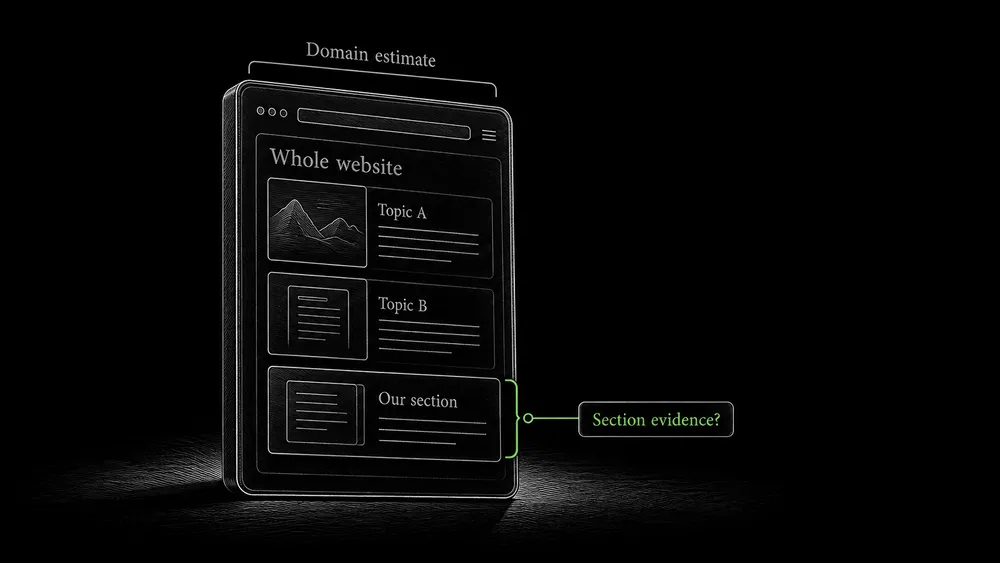
The next question is where that estimated traffic comes from. A domain total may say little about the section where your article will appear. Look at relevant pages, query themes, countries where data is available, and changes over time. A small specialist audience can be valuable; a large unrelated audience may have little practical relevance.
| Observation | Reasonable next question | Conclusion to avoid |
|---|---|---|
| High DR, weak relevant section | What supports this score, and what would readers see near our article? | Every page on the domain is a strong opportunity. |
| Large estimated search traffic | Which topics and pages account for it? | Our article will receive a similar audience. |
| Sharp traffic decline | What changed, and is the relevant section affected? | Google definitely penalized the site. |
| Little estimated search traffic | Does the publication have another credible audience source? | Nobody reads the publication. |
| Publisher supplies analytics | What property, period, geography, and section are shown? | A screenshot proves future article performance. |
| Strong competitor presence | What are those placements, and are they current? | We need to buy the same thing. |
Label supplied data and avoid universal score cutoffs
Publisher-provided evidence can help, especially when the offer is sold on readership. Ask for an appropriately scoped summary rather than access to private accounts. Mark it as publisher-supplied; it is not independently verified merely because it appears in a presentation.
There is no defensible universal DR or traffic cutoff for every niche and objective. Use requirements tied to your intended audience and the price of the actual offer.
Check history when the current picture raises questions
Use site history to investigate a present-day mismatch
A sudden change in subject, an inconsistent brand history, or articles unrelated to the domain name can justify examining older versions of the site. Public web archives may help you understand what the domain used to publish.
A gap in an archive is not proof that the website was offline. A change of ownership or subject is not automatically misconduct. The useful question is whether the present publication has a credible purpose and whether the seller is relying on a historical reputation that no longer describes it.
Record unexplained discrepancies and shared audience patterns
If metrics look strong but the current content does not, investigate the mismatch before paying. Ask the provider to explain it and compare that explanation with what you can observe. Record an unresolved discrepancy instead of converting suspicion into a statement of fact.
Where several candidate sites look strikingly similar, compare their public contact details, editorial patterns, and placement conditions. Shared ownership alone does not make them unsuitable. It may, however, mean that buying across all of them creates less audience diversity than the domain count suggests.
Inspect the neighborhood your article will enter
Inspect the route into the section and neighboring articles
Find out how a reader reaches comparable placements from the publication. Can you navigate to them through the relevant category or other meaningful pages? Are they mixed with useful material, or isolated in an archive that the rest of the site barely acknowledges?
Inspect several neighboring posts. An attractive main website does not compensate for a section full of unrelated paid articles. Judge the context that will actually surround your business.
Check link context and separately agreed distribution
For an insertion into an existing article, read the paragraphs before and after the proposed link. The addition should improve the explanation. An article’s age or estimated traffic does not justify dropping in a sentence that makes no sense.
Check the destination of other links too. If the text routinely misdescribes where links lead, that is a reason to question editorial care. Avoid unsupported labels such as “toxic site”; describe the concrete issue you observed.
For a paid audience placement, ask about distribution explicitly. Publication in an archive, homepage exposure, newsletter inclusion, and social promotion are separate things. If a distribution item is part of the price, record its scope and what evidence of delivery will be available.
Review the page’s practical accessibility
Test readability and the current page’s usable link path
Open comparable pages on a phone and a desktop if possible. Confirm that the article is readable, navigation works, and intrusive elements do not make the content difficult to use.
For an existing proposed page, inspect whether it loads normally and whether the link would be a real, usable link to your intended destination. Technical review can also check redirect behavior and visible indexing directives. These are checks of the page’s current state, not proof of how a search engine will treat it in the future.
Separate pre-publication conditions from live-page verification
For a new page, those checks remain publication acceptance tasks. You cannot verify the final HTML, response, or placement position before the page exists. Separate pre-publication conditions from post-publication evidence.
If search discovery is part of the rationale, ask about any intentional restrictions, canonical settings, or publishing practices that affect the article. Do not accept “we guarantee Google indexing” as a substitute for a clear explanation. A publisher can control aspects of publication; it cannot control Google’s final decision.
Detailed troubleshooting belongs in crawling and indexing. This assessment only needs enough technical depth to identify a material mismatch with the offer.
Ask the questions that prevent expensive misunderstandings
Before approval, send the provider a concise request covering the unresolved facts:
Please confirm:
- The publication and section where the article will appear.
- The proposed topic and destination URL.
- Who writes, edits, and approves the final text.
- Whether compensation is involved and how that relationship is handled.
- The link attributes and visible disclosure for a paid placement.
- Any included distribution beyond publication of the page.
- Total fees, publication conditions, and cancellation terms.
- How corrections, removal, and replacements are handled.
- Which conditions apply after the initial publication check.
You are asking for a reviewable offer, not demanding every possible guarantee. Some publishers will have standard terms and limited flexibility. Decide whether those terms fit the project.
If the seller offers a substitute site, assess it separately. “Same DR” does not mean the same audience, editorial environment, or value. The original approval should not silently transfer to an unknown replacement.

Make the decision with evidence and open questions
Record audience fit, inspected evidence, and commercial conditions
Use a short assessment record:
| Field | What to write |
|---|---|
| Candidate and proposed section | Exact domain and relevant URLs |
| Audience fit | Who would care and why |
| Evidence inspected | Articles, data source, dates, and publisher responses |
| Article concept and destination | How the reader’s journey connects |
| Commercial conditions | Fees, attributes, disclosure, duration, and responsibilities |
| Material concerns | Specific observed problems or missing facts |
| Decision | Approve, request information, or reject |
| Reason and next action | A sentence someone else can understand |
Choose approval, further investigation, or rejection with a clear reason
Do not let a total score override a fundamental issue. A publisher outside the audience, an offer with an undisclosed destination, or an article that would misrepresent the business may be unsuitable even if several superficial indicators look positive.
“Request information” is a useful outcome. It prevents uncertainty from being treated as either approval or condemnation. If essential answers never arrive, you can decline without pretending you proved the site was fraudulent.
Keep approved assessments with your placement monitoring records. This makes it possible to compare the delivered page with the reasoning behind the original decision.
Frequently asked questions
What is the most important quality signal?
There is no single metric that settles the question. Begin with audience and subject fit, then inspect actual content and the proposed placement conditions. A fundamental mismatch at that level is more useful to your decision than an attractive domain-level number.
Should I reject every website that accepts sponsored articles?
No. Sponsorship is a publication model, not a complete quality assessment. Evaluate how the publication serves readers, labels commercial content, handles links, and delivers the specific offer. The arrangement should be transparent and appropriate for your objective.
Is a low-traffic specialist site ever worth considering?
Potentially. Its audience may be small but relevant, or its readership may come through channels not represented by a search traffic estimate. Ask for evidence that matches the claim being sold, and price the uncertainty into your decision rather than inventing a readership figure.
Can a US campaign use an international publication?
Yes, if the publication reaches relevant people in the intended market. Inspect the subject matter and available audience evidence. A country label alone is not enough to establish either suitability or unsuitability.
Does a traffic drop prove that a publisher has been penalized?
No. It is a reason to investigate, particularly if the placement depends on search readership. Changes in demand, rankings, content, measurement, or tool estimates can produce different patterns. Describe the observation without asserting a cause you cannot verify.
Can I assess a publisher without Ahrefs?
Yes. Read the site, inspect comparable placements, verify the offer, and ask for relevant evidence. Tools add context and make some investigations faster. They do not replace the editorial and commercial judgment needed to decide whether the opportunity makes sense.
What if the publisher changes the conditions after I approve?
Compare the change with your recorded scope and pause any dependent commitment where possible. A new section, destination, fee, or replacement site may require a fresh decision. Keeping the original agreement makes that conversation concrete.
Have a publisher shortlist you want checked?
Send the candidate URLs and the offers you received. Include what you want to promote and any budget already proposed. The review can focus on the actual decision you face rather than a generic domain score.