

 WordPress & YOOtheme Pro
 WooCommerce Development
 Website Planning
 Website Ownership & Access
 Website Support & Growth
 Website Launch Checklist
Preparing Content for AI Search: Make the Answer Useful on Its Own
A useful source does more than mention a subject. It answers a question, explains the conditions that matter, and gives the reader enough support to use the answer correctly.
Preparing content for AI search is therefore partly an editorial task. Review what a passage actually says, how easily its meaning survives outside the surrounding page, and whether its claims can be checked. Preserve strong material instead of rewriting it merely to adopt an “AI-friendly” style.
The method below is a practical editing workflow. It is not a published list of hidden ranking factors. Microsoft recommends clear structure, supporting evidence, and accurate, consistent information for AI-search content; those recommendations do not make a particular layout a citation guarantee. Microsoft’s content guidance.
The AI Search Optimization hub explains how this content work connects with technical availability and measurement.
Give the page a defined job
Define the reader’s task and the page’s scope
Before editing sentences, state the reader’s task. Include enough context to distinguish it from related tasks.
For the ownership guide on this site, the task is to understand and retain control of a website project, including accounts and dependencies. That is different from learning how to build the website or how to maintain it every month.
Record the required outcome, facts, and business boundaries
Write a brief note:
Reader's situation:
Question this page must answer:
Decision or action the reader should be able to complete:
Facts needed to support the answer:
Conditions that change the recommendation:
Related tasks handled elsewhere:
If you cannot name the result the reader should obtain, adding more text will not resolve the page’s direction. Use the intent guide to settle the purpose first.
Keep the business boundary visible. A page about a service you provide can explain neighboring issues without pretending you deliver every adjacent service. This is especially important when AI-assisted research suggests attractive topics beyond the company’s real capabilities.
Check whether each important heading receives an answer
Check the promise of each heading against its opening answer
Read the headings without the body text. They should describe the decisions or subjects the page actually covers. Then read the first paragraph beneath each heading. Does it start answering the question, or repeat a broad introduction?
A heading such as “Website Ownership” leaves more interpretation than “Separate account control, editing access, and usage rights.” The latter tells the reader which distinction the section develops.
Develop conditional answers without imposing one template
A direct answer does not mean an oversimplified answer. Sometimes the correct opening is conditional: client-controlled hosting can provide a route to server administration, while a managed service may expose a different level of control. The following text must explain how to check which situation applies.
Avoid answering every heading with the same pattern of three benefits and a sales invitation. The structure should follow the information: a distinction, a sequence, an exception, a comparison, or a test.
Keep the subject and conditions inside the passage
Name the subject clearly within the passage
Imagine a reader arriving directly at a subsection or seeing a short excerpt. Can they tell what the recommendation concerns and where its limits are?
Vague references such as “this,” “it,” and “the system” are not always wrong, but they can make a passage ambiguous when the subject is distant. Name the relevant object when it prevents confusion: the domain account, the WordPress administrator role, the publisher’s article, or the production server.
Keep limitations close to the claims they qualify
Put a necessary condition close to the claim. If a sentence says a client receives control, explain which control. If a guide says a backup succeeded, distinguish file creation from a tested restoration. Do not place the exception three sections away and expect every reader to connect it.
This is an accuracy test rather than an instruction to repeat the company name in every paragraph. Write naturally and supply context where it changes the meaning.

Example: ownership explained through distinct responsibilities
The website ownership guide already separates three concepts:
| Concept | What the explanation establishes | Why the distinction is useful |
|---|---|---|
| Account control | Who can manage access, recovery, billing, and authorization | Editing a page does not establish control of the domain or hosting |
| Editing access | Who can change website content or settings | A role inside WordPress has a defined operational scope |
| Usage rights | Which materials are delivered and which licenses apply | Third-party software is not made exclusive property by inclusion in a project |
The page then turns these concepts into an inventory of actual assets. The reader can examine the registrar, DNS, hosting, email, analytics, and software arrangements rather than rely on a vague ownership promise.
This is an example of existing content doing its job. It is not a manufactured “before and after,” and it is not evidence that an AI system has cited it.
Apply the same method to your own subject: identify terms that customers may combine incorrectly, explain the distinction, and provide a way to check their actual situation.
Example: a launch checklist with an acceptance condition
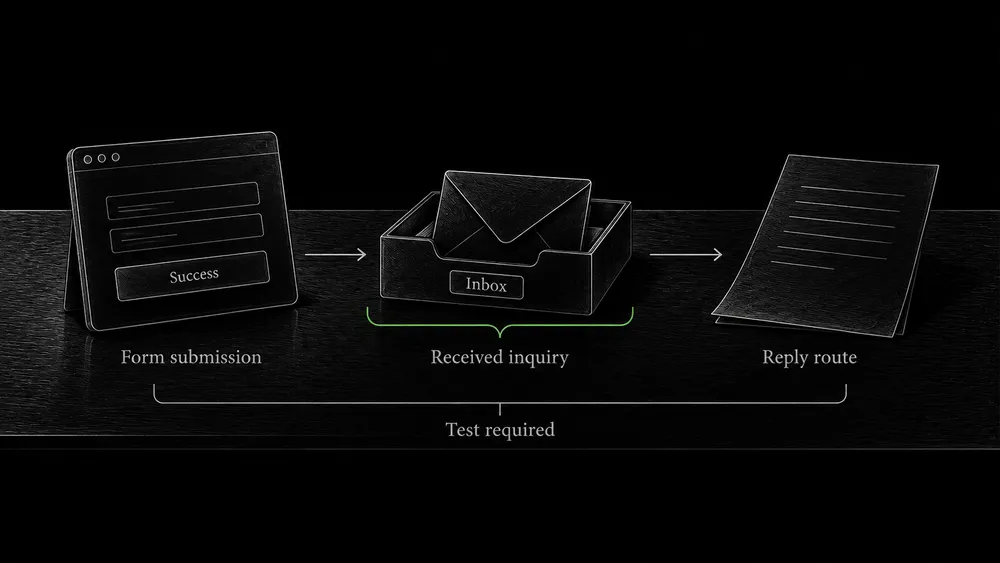
A checklist item that says “test the form” leaves the definition of success unresolved. Our launch guide follows the inquiry through validation, submission, recipient delivery, and the reply route.
The useful part is the acceptance condition: the business receives an actionable inquiry and the visitor gets an accurate result. A success message alone does not complete the test.
This pattern can strengthen many procedural pages:
- Name the action.
- Explain what to inspect.
- State the expected result.
- Explain what a failure means and where to investigate.
Do not apply the pattern mechanically to opinion pieces or simple definitions. Use it where the reader needs to complete and verify a task.
Match evidence to the kind of statement
Match the support to the type of statement
Not every sentence needs an external citation. It does need an honest basis.
| Statement type | Appropriate support | Common mistake |
|---|---|---|
| What your service includes | Confirmed scope from the business | AI invents an attractive capability |
| A platform requirement | Current official documentation | An old article becomes a timeless rule |
| A measured improvement | Real data, conditions, and comparison | A hypothetical number is presented as a result |
| A recommended process | Reasoning, tradeoffs, and limitations | A personal method is attributed to Google |
| A product feature | Confirmed current product behavior | A roadmap item becomes an available feature |
| An example | Clear illustrative status | A fictional scenario resembles a client case |
Distinguish explanatory expertise from measured results
A business can demonstrate expertise through careful explanation even without a public performance case study. What it cannot honestly do is convert an illustrative process into a claimed result.
When using AI to draft, keep confirmed facts and open questions separate. Ask it to organize the explanation, but require unsupported claims to be identified rather than filled with plausible inventions. The editorial brief guide provides a wider production workflow.
Choose a format because it helps the answer
Choose tables, steps, and diagrams for their actual purpose
A comparison table works when options share criteria. A numbered list works when order matters. A checklist works when the reader needs to verify completion. A diagram works when relationships are hard to explain in a sentence.
Keep explanatory prose around these elements. The table should not carry a conclusion that depends on an unstated assumption. The checklist should not remove the reasoning someone needs when their situation differs.
Use overviews and FAQs without hiding the central answer
For a long guide, an overview can help readers locate the right section. It should summarize the page faithfully rather than introduce a stronger promise than the body supports.
Use FAQ for remaining questions and objections. If most of the useful content exists only in the FAQ, reconsider the main page structure. The central answer deserves a coherent explanation.
There is no required ratio of prose, lists, and tables. A page can be well prepared without containing all of them.
Decide when depth belongs in a spoke
A hub should resolve the broad decision while offering a route to deeper work. It should not become a directory of links with a few generic sentences between them.
Keep a detail in the hub when the reader needs it to understand the overall answer and it can be explained without a separate workflow. Create a spoke when the topic has its own substantial task, conditions, and verification.
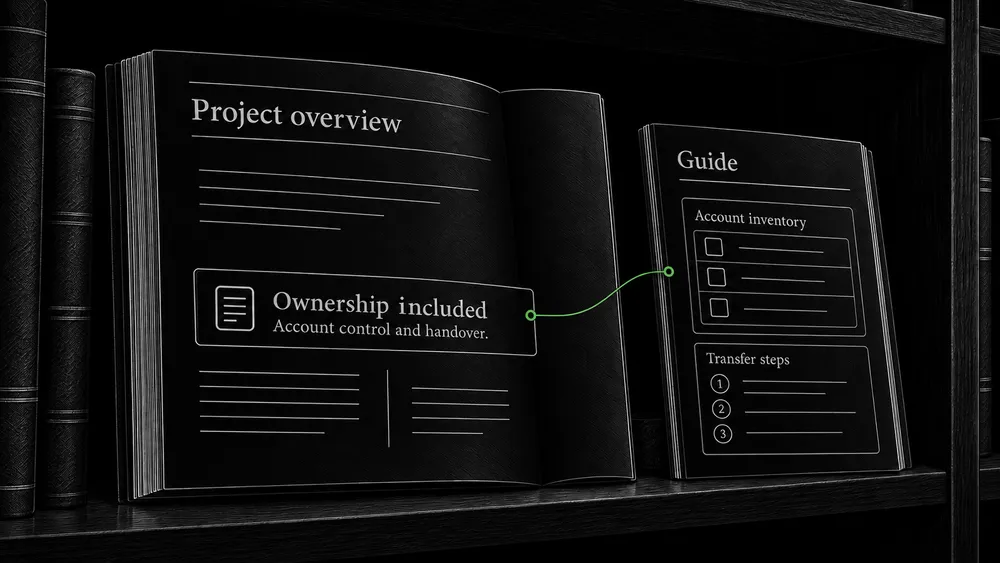
For example, the development overview needs to explain that ownership and handover are part of the project. The detailed account inventory and transfer sequence belong in the ownership spoke. The hub remains useful on its own, and the spoke has a reason to exist independently.
Link at the point where deeper information becomes useful. Avoid forcing the reader through an unrelated “resources” block to find the next step. Use the internal linking guide for implementation detail.
Do not create five spokes that answer the same question with slightly different wording. Depth comes from distinct useful work, not the number of URLs.
Keep business facts consistent across the site
Identify conflicting facts across related pages
Review names, scope, geography, availability, and responsibilities across related pages. A precise product page cannot fully resolve a contradictory statement elsewhere on the website.
Maintain an approved factual reference for information that appears repeatedly. When a service changes, identify the pages that depend on it. Update the visible copy before or together with its structured representation.
Preserve service boundaries without repeating identical copy
For this project, the distinction between building a new website and providing ongoing management matters. A page should not imply that monitoring continues automatically after handover if the client has not retained that service.
Consistency does not mean repeating identical sales paragraphs on every page. State the relevant fact in the context of the task being explained.
Review the published reading experience
Review the published layout and interactive content
Check the finished WordPress page, not only the manuscript. Read headings in order, inspect tables on a phone, follow the links, and confirm that important explanations are present outside an editor preview.
If an accordion contains FAQ, verify that its content is available and the interaction works. If an image contains essential information, provide an appropriate textual explanation. Do not make the only practical answer depend on an unlabeled screenshot or a video someone cannot interpret without context.
Keep practical answers available and distinguish editorial from access checks
Keep useful content accessible before the inquiry form. The reader should be able to apply the method without submitting their email to unlock the missing steps.
The crawler access guide covers technical delivery. An editorial review alone cannot prove what a bot receives.
Use a final passage review instead of an AI score
For each important section, ask:
- Is its subject clear?
- Does it answer the intended question?
- Are necessary conditions nearby?
- Can important claims be supported?
- Does it give a usable decision, action, or explanation?
- Is deeper work linked where needed?
- Does it agree with the rest of the site?
Record the specific issue and revision. If a passage already passes this review, retain it. The goal is a stronger explanation, not an endless cycle of rewriting for a new label.
Frequently asked questions
Should every answer be very short so AI can quote it?
No. Supply the length needed for the answer and its conditions. You can make the conclusion easy to find without deleting the explanation that makes it accurate. There is no universal ideal answer length for every topic and service.
Does adding more entities improve the page automatically?
No. Include people, products, processes, and concepts because they help resolve the reader’s task. A list of loosely related terms can make an answer less clear. Define relationships rather than merely increasing vocabulary.
Can AI help write the content?
Yes, as part of a reviewed workflow. Supply real business facts, require uncertainty to remain visible, and verify important claims and sources. The publication remains your responsibility even when drafting is assisted.
Do I need original data on every page?
No. A useful procedural explanation or comparison may be supported by confirmed practice and authoritative documentation. Use original data when you have it and can explain its conditions. Never invent it to satisfy a perceived authority requirement.
Are tables and FAQ special AI ranking factors?
Treat them as information formats, not guaranteed ranking mechanisms. They can make appropriate material easier to understand. They do not compensate for inaccurate or irrelevant content.
How do I know whether the changes worked?
First verify the editorial improvement and published output. Then observe search and referral evidence separately. A clearer section is an inspectable improvement; a citation or lead is a later outcome requiring its own evidence.
Develop useful answers on your own website
Share the pages you want to improve and the questions customers still ask after reading them. That gives the content work a concrete purpose and helps preserve material that already explains the subject well.