

 WordPress & YOOtheme Pro
 WooCommerce Development
 Website Planning
 Website Ownership & Access
 Website Support & Growth
 Website Launch Checklist
Structured Data for AI Search: Describe What Your Page Actually Says
Structured data gives a machine-readable description of information on a page. It can identify an article and its author, describe an organization, or represent appropriate product information. The value begins with accurate facts and a suitable type.
It cannot turn an unsupported claim into evidence. It also cannot make a hidden, unavailable, or unhelpful page a reliable answer simply by adding more properties.
For Google AI search, there is no special required schema.org markup. Google confirms this in its AI guidance. Use structured data as part of a coherent website implementation, with expectations tied to documented behavior rather than a generic promise of AI visibility.
The AI Search Optimization hub explains where this work fits alongside content and crawler access.
Separate description, eligibility, and selection
Three different questions are often combined in a schema proposal:
- Does the markup accurately describe the page?
- Does it satisfy the requirements for a particular supported search feature?
- Will a system display that feature or cite the page?
Validation can help answer the first two. It does not guarantee the third. Google explicitly says that correct structured data does not guarantee a rich result. General structured data guidelines.
A report that says “valid” is therefore a technical result with a scope. It is not proof that the business became more authoritative or that an AI service now understands every relationship on the site.
Start with the facts visible to the reader
Identify the visible page purpose and responsible author
Before choosing a type, establish what the page actually represents. Who wrote it? Who provides the service? Is it a guide, an overview, a profile, or a product page? Which claims are visible and current?
Make those answers readable in the page itself. Google requires markup to represent visible content rather than information introduced only in structured data. Content requirements.
Distinguish people, organizations, brands, and products
For a small business, pay particular attention to the distinction between a person, a trading brand, and a legal organization. Use the representation that matches the real situation. Do not invent a corporate identity or US office because a template contains those fields.
Similarly, a product created by a person is not the same entity as its developer. Explain the relationship in ordinary content first. A structured relationship is easier to maintain when it reflects an already clear explanation.

Choose a type that fits the page’s main purpose
Match representation types to real page purposes
The following is a selection aid, not a requirement to place every type on every page.
| Page or information | Representation to investigate | Essential review |
|---|---|---|
| An authored editorial guide | Article-related markup where appropriate | Actual author, title, dates, and page purpose |
| Information about a real organization | Organization markup | Accurate name, URL, and applicable identifying details |
| A person’s profile | Person/profile representation appropriate to the page | Real identity and supported biographical facts |
| Navigation hierarchy | BreadcrumbList where appropriate | A meaningful route through the site |
| An individual store product | Applicable Product implementation | Current product facts and the requirements of the intended search feature |
Check type-specific requirements instead of relying on a generator
Google documents Article, Organization, breadcrumbs, and product implementations separately. Read the relevant requirements instead of treating a generic generator as the specification.
A hub is not automatically a news article because it contains a lot of text. A service overview is not automatically a product offer. Choose according to what the page really does and which representation you can support.
Map every important field to its source
Map structured fields to authoritative source values
A reliable implementation has an answer to “where does this value come from?” That matters when information changes.
| Field or fact | Source to establish | What to avoid |
|---|---|---|
| Page title | Approved page content or a deliberate mapped field | An unrelated template default |
| Author | The person responsible for the article | A generic administrator account presented as an expert |
| Publication date | Actual publication record | A date invented to make the page appear established |
| Modification date | A meaningful update record | Automatic freshness claims with no substantive change |
| Business name and URL | Approved identity information | Different identities emitted by different plugins |
| Product availability or terms | The relevant current product record | Manually duplicated values that become stale |
Document field ownership for future maintenance
This mapping is practical documentation, not additional public copy. A future maintainer should be able to update the source value and understand which pages it affects.
On this website, a guide’s explanation of author responsibility and service scope should remain aligned with the eventual author and business representation. That is a proposed implementation check; it is not a claim that the live site’s structured data has already been inspected.
Inspect WordPress output before adding another generator
Inventory existing markup and the components that generate it
WordPress sites can obtain structured data from plugins, a theme, commerce extensions, or custom code. First inspect representative live pages to see what already exists.
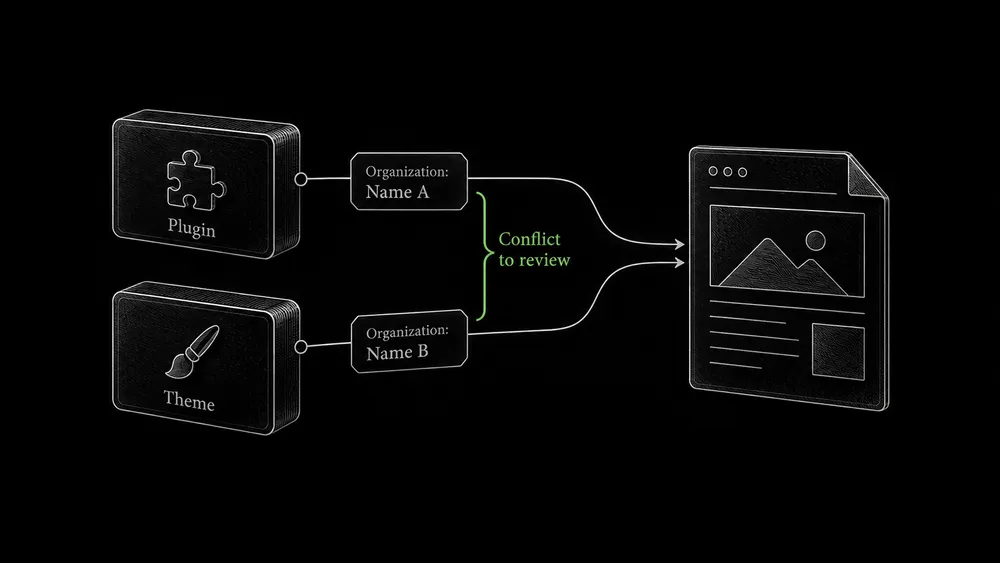
Identify the component responsible for each output. Multiple blocks are not automatically wrong: a page can legitimately describe several related things. The problem is conflicting or misleading information, such as incompatible organization names, wrong author identities, or outdated product details.
Resolve overlapping responsibilities without deleting valid relationships
Where practical, give each responsibility a clear owner. If one component generates the article representation, avoid a second independent generator repeating the same article with different fields. Resolve the configuration deliberately rather than deleting every extra block without understanding it.
For WordPress with YOOtheme Pro, verify the deployed output instead of assuming the visual builder controls all metadata. The WordPress implementation guide explains the wider relationship between content and templates.
Validate in three passes
Check schema syntax and the relevant Google feature separately
First, inspect syntax and vocabulary. Check that the data is parseable and that the types and properties are used appropriately. Schema Markup Validator is intended for general schema.org validation.
Second, test the relevant Google feature. Rich Results Test checks Google-supported rich-result implementations. A type not supported by that test is not automatically invalid schema. Google explains the difference between its testing tools.
Verify factual accuracy against visible content and business records
Third, compare with the page and business facts. No syntax validator can establish that a biography is true or a service is actually available. Read the visible page, compare its details with the emitted data, and confirm the facts with the responsible owner.
Save the test date, URL, result, and unresolved issues. A one-time successful test does not prove the markup remains correct after a template or plugin update.

Test page families and exceptions
Test representative page types and missing-field cases
Choose examples from the page types you actually publish: a hub, a guide, an author page, and a product page if the site has a store. Include cases with missing optional fields, several authors where genuinely applicable, or recently changed information.
A template may work for one well-populated page and generate misleading defaults elsewhere. Inspect the exceptions before applying the configuration broadly.
Verify live output after deployment and caching changes
Then test the public version after deployment. A preview, code snippet, and live rendered page can differ. Include caching and publication state in the investigation if the output does not match the configuration you changed.
The technical SEO audit can place these checks within a broader site review.
Avoid adding facts to satisfy a template
Do not fabricate ratings, reviews, credentials, office locations, prices, or product capabilities because a plugin offers a field. Leave an inapplicable field out or choose a more accurate representation.
Do not add invisible question-and-answer text solely for a markup block. If the answer benefits the reader, publish it as content first. Whether a particular search feature supports that markup is a separate decision.
Do not use identity links to imply relationships that do not exist. A reference source is not necessarily another profile of your organization. Keep citations, affiliation, authorship, and identity distinct.
These checks protect the accuracy of the website regardless of which search service later uses the information.
Frequently asked questions
Is there a universal schema that makes AI cite a website?
No such universal requirement is established by the guidance used here. Ask which type is being proposed, what information it describes, and which documented system behavior supports the claim. Valid representation is not a citation guarantee.
Should I add Article markup to every long page?
Choose the representation from the page’s purpose. Length alone does not make a service overview an editorial article. Check the intended feature’s documentation and what the page actually presents.
Do I need a dedicated schema plugin?
Not necessarily. Inspect the existing implementation first. The site may already have an appropriate generator. Add tooling only when it solves an identified gap and can be maintained without contradictory output.
What if a validation tool finds no supported rich result?
Check what that tool evaluates. Google feature validation and general schema validation have different scopes. Also inspect the actual markup and the page facts before drawing a conclusion.
Can schema replace an author biography or clear service description?
It should not be used to hide the only explanation of those facts. Publish accurate information for readers and keep the structured representation aligned with it. The two forms should describe the same reality.
When should I check the markup again?
After changes that affect its source fields or generator, including relevant template, plugin, product, identity, or content updates. Prioritize changes that could make the output inaccurate rather than rerunning checks without a reason.
Clarify your site’s structured information
Share the website and the types of pages it contains. The first step is to inspect existing output, identify factual or technical gaps, and define what should generate each representation.