

 WordPress & YOOtheme Pro
 WooCommerce Development
 Website Planning
 Website Ownership & Access
 Website Support & Growth
 Website Launch Checklist
Location & Service Area Pages: Create a Page When the Place Changes the Answer
A location page should help someone use a real business location or understand how service is delivered in an area. Its value comes from the information that changes with that place.
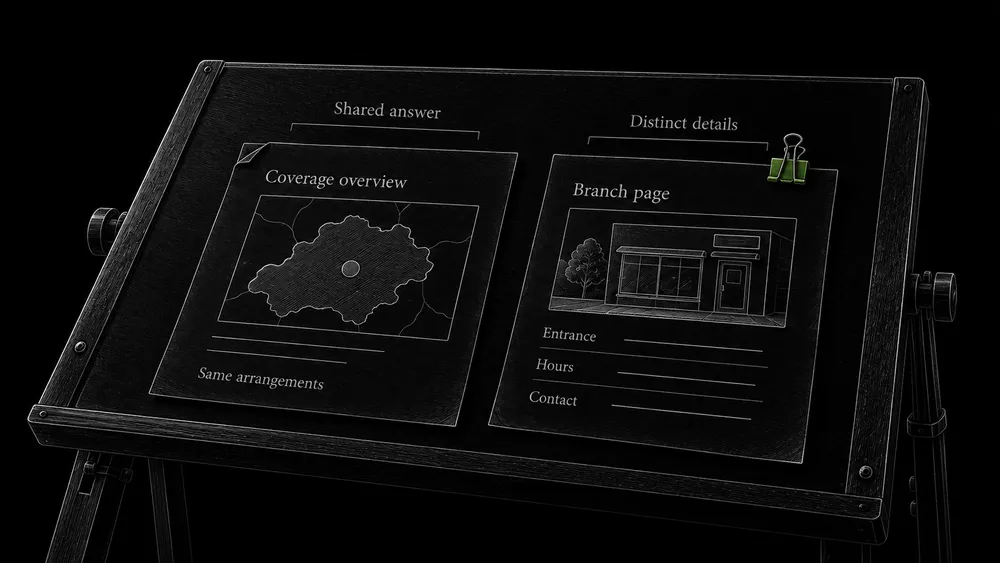
If the only difference between two pages is a city name, consider whether a clear coverage section would serve the reader better. If contact details, availability, arrival instructions, or delivery conditions genuinely differ, a separate page may have a useful independent role.
This guide helps you make that decision within Local SEO. It covers page planning, factual content, internal links, and what to do with an existing collection of thin city pages.
Distinguish a business location from an area served
Distinguish premises, service areas, and coverage overviews
A business location is a real operating place. A service area describes where the business works for customers. Serving a city does not establish an office there.
| Page type | Main question | Facts that may belong |
|---|---|---|
| Real location page | How do I use this particular location? | Actual address, contact, hours, services, arrival and appointment details |
| Service-area page | Can this business serve me here, and under what conditions? | Coverage, delivery arrangements, relevant limitations, and how to confirm suitability |
| Coverage overview | Where does the business generally operate? | Areas served, a clear boundary explanation, and the route for uncertain cases |
Describe the place without implying nonexistent premises
Use titles and introductions that reflect the distinction. Do not label a service-area page “our office” or add a map pin suggesting premises that do not exist.
Website architecture also does not grant eligibility for additional Google profiles. Assess profiles under the Google Business Profile guide, separately from the decision to publish a web page.
Decide whether the page has an independent job
Test real coverage, independent usefulness, and maintainable facts
Before creating a URL, answer three questions:
- Does the business genuinely serve this place or operate this location?
- Does a visitor need information specific enough to justify a separate page?
- Can that information be supported and maintained?
If the first answer is no, do not publish a service claim for that area. If the second answer is no, use a section or coverage overview. If the third answer is uncertain, collect facts before assigning a writer to invent the difference.
A separate page is not justified merely because a keyword tool can combine a service name with a city. Demand research can help identify questions, but the business must still have a truthful useful answer.
Choose a page structure that fits the actual operation
Use this practical decision table:
| Situation | Reasonable starting choice |
|---|---|
| One location with one local audience | A strong homepage and service pages, with clear location information |
| Several real locations with meaningful differences | A location overview linking to substantive individual pages |
| One service-area business with similar delivery throughout its coverage | A coverage explanation rather than automatic city pages |
| An area where genuine arrangements need a detailed explanation | A focused service-area page |
| A large list of speculative expansion markets | Keep internal planning separate from current public availability |
These are editorial decisions, not fixed rules about how many locations a website may contain.
Gather the details that justify a location page
Gather arrival, appointment, and location-specific details
For a real location, collect facts that help the customer arrive, contact the correct team, and understand what is available there.
An address alone may not be enough. Check whether an appointment is needed, which entrance is used, whether hours differ from another location, and what verified accessibility or arrival information matters. Include only facts the business can confirm.
Document delivery conditions and the facts that differ
For a service-area page, explain the actual delivery arrangement. Does the business routinely work there? How is availability confirmed? Are there meaningful limitations or preparation requirements? Do not invent a travel surcharge, response time, or local team to make the page look unique.
Keep a short page brief:
Page type: real location / service area
Place represented:
Business relationship to that place:
Customer question requiring this page:
Verified facts that differ from the overview:
Shared service explanation to link to:
Evidence available:
Contact route:
Owner responsible for updates:
If the “facts that differ” field is empty, reconsider the page rather than padding it with generic city information.
Write a complete local answer
Answer the customer’s practical local question
Open with the relationship between the business, service, and place. Then explain the practical information that makes the page necessary.
For a real location, a customer should be able to understand what can be done there and how to arrange it. For an area served, they should be able to determine whether their situation fits and what to provide if coverage needs confirmation.
Reuse shared service detail without creating conflicting versions
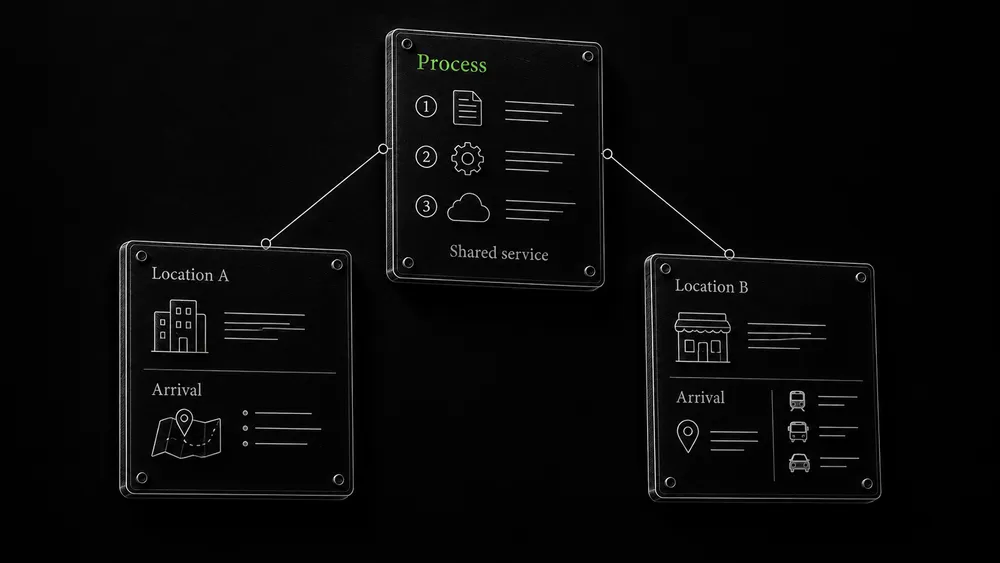
Link to a shared service page for the full technical or procedural explanation when it is the same across locations. Retain enough context that the local page remains useful independently.
Avoid changing factual descriptions merely to make paragraphs unique. If the process is identical, it is better to explain the genuine local difference and link to the main process than to create several subtly contradictory versions.
The local content guide covers service depth and owner fact collection.
Avoid doorway patterns and artificial scale
Assess whether each local page contributes a useful answer
Google describes doorway abuse as pages created for similar queries that lead people to less useful intermediate destinations. Its examples include substantially similar regional or city pages that funnel visitors elsewhere. Google’s doorway policy.
A shared contact form does not by itself settle whether a page is useful. Evaluate the page’s actual contribution. A legitimate location page can share a booking system while still providing essential information. A generic city page can be weak even if it has its own form.
Avoid expanding city pages beyond supported customer needs
Do not create a matrix of every service multiplied by every town without reviewing the individual need. The operational burden also grows: changes to scope, contact details, or availability must remain accurate across the resulting pages.
If a proposed page has no independent value, use the existing relevant page or a coverage section. That is an architectural decision, not a failure to create enough content.
Make the pages findable in a coherent hierarchy
Connect location pages through navigation and relevant services
A visitor should be able to reach location information through normal navigation or relevant contextual links. Avoid leaving pages accessible only through a sitemap or an unexplained URL list.
A location overview can help customers select the appropriate place. Service pages can link to meaningful coverage information where geography affects delivery. Individual location pages can link back to the relevant service explanation and overview.
Use clear anchors and appropriate profile destinations
Use link text that identifies the destination. Do not turn every paragraph into a list of city names. The internal linking guide explains how to connect pages around the next useful action.
Where a Google profile represents a real location, review whether its website destination should be that page. Keep the profile and page facts aligned without assuming every area page should have its own profile.
Review existing city pages before merging or removing them
Review each existing city page’s purpose and evidence
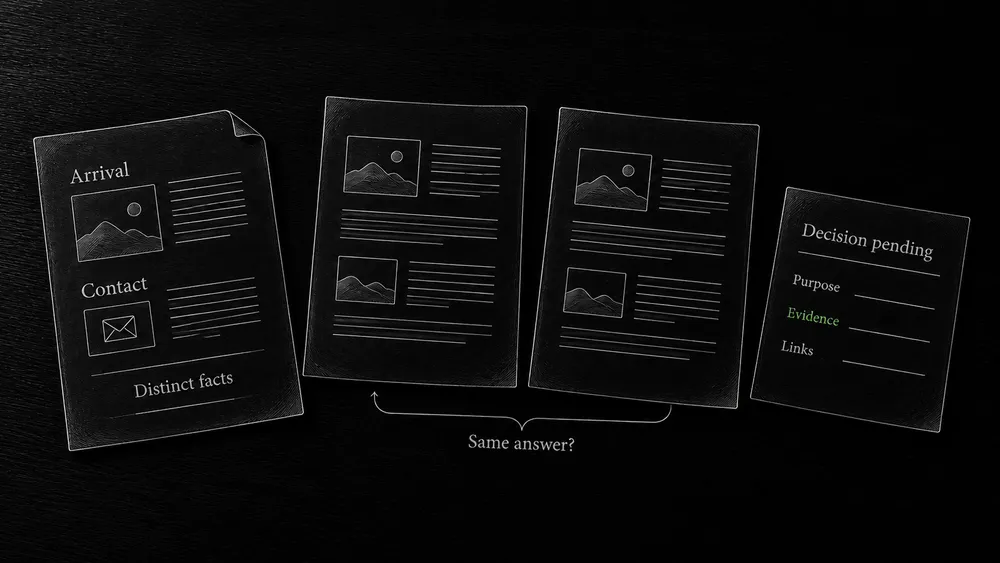
Create an inventory with URL, page purpose, actual business coverage, unique information, internal links, and available performance evidence. Identify which pages have a legitimate independent role.
A page with useful distinct facts may need improvement. Several pages answering the same question may be better combined. A page describing a service the business no longer provides may need retirement or a clear update.
Plan retention, consolidation, and URL changes deliberately
Do not delete pages solely because they have little traffic or because a template was used. Inspect the task and evidence. A template can organize useful distinct information; the issue is whether the content fulfills a real purpose.
If URLs change, plan relevant redirects and update internal links. Do not redirect every removed local page to an unrelated homepage by default. Use the redirect guide for implementation and the content audit guide for editorial decisions.
Keep location changes synchronized
A move, closure, new appointment arrangement, or coverage change can affect the page, profile, navigation, and external listings. Assign an owner to the change rather than editing only the most visible surface.
Distinguish temporary information from permanent scope. If an arrangement has an end date, record when it needs review. Do not leave a temporary announcement as the page’s enduring description.
The local citations guide provides a record-based approach to updating the wider presence.
Frequently asked questions
Can I have a page for a city where I have no office?
A truthful service-area page can explain work you actually provide there. It must not imply nonexistent premises. Decide whether there is enough useful area-specific information to justify a separate page.
Does each location page need a different service description?
Not if the service is genuinely the same. Explain the distinct location information and link to the main service detail where appropriate. Forced rewriting can introduce factual inconsistencies.
Are all city pages doorway pages?
No. Judge their purpose and usefulness. A real location or meaningful area-specific explanation can serve an independent customer need. A mass of near-identical intermediate pages raises a different concern.
Should I create every possible service-and-city combination?
No. Evaluate the task for each proposed page. A large combination list is not a substitute for useful information and can create a substantial maintenance burden.
Can several locations use the same inquiry form?
Yes, if the form routes the request correctly and the visitor understands what happens next. Shared conversion infrastructure does not remove the need for useful location-specific content.
Should I remove every page that receives no traffic?
No. Review its purpose, accuracy, distinct information, and available evidence. Low traffic alone does not establish that a page is unnecessary or that deletion is the right action.
Plan location pages around real information
Share the locations or areas you serve and any existing pages. We can discuss which need independent treatment, which belong together, and what factual material is missing.